The “likeness” of John C. Fulton, Co. H, 12th Pennsylvania Reserves
This letter was written by John Collins Fulton (1841-1882), the son of James Fulton (1810-1875) and Elizabeth McCune (1810-1876) of Conemaugh township, Cambria county, Pennsylvania. At the time of the 1860 US Census, John was still enumerated in his parents home in Yoder Township, Cambria county, Pennsylvania—both he and his father employed as farm hands—poor as dirt—no real estate, and only $125 worth of goods to the family name. When the war erupted the following year, patriotic duty may have only been eclipsed by a steady paycheck and a chance to see something of the world other than the mountains of western Pennsylvania. And so John enlisted with other young men, mostly from nearby Indiana county, in Co. H, 12th Pennsylvania Reserves (41st Pennsylvania Infantry) in August 1861. For three years he would march with his regiment to the Seven Days Battles, South Mountain, Antietam, Fredericksburg, Gettysburg, the Mine Run Campaign, and finally the Wilderness Campaign, mustering out just before the carnage of Cold Harbor. His 1863 and 1864 diaries are published at: The John Collins Fulton Diaries.
In this letter to his sister, John mentions his sister Rebecca and his two younger brothers, Willie and Henry. He also reveals that his father was none too happy about his enlistment.
[Note: the original letter from which this previous transcription was made has not yet been located but a photocopy of the song sheet entitled “Soldier’s Memento” is shown below courtesy of Bill Fulton, great-grandson of John C. Fulton.]
TRANSCRIPTION
[Camp Tennally, a few miles from Georgetown]
October 4th 1861
Dear Sister,
I received your letter on the 3rd of October with the most of pleasure and was very glad to hear that you was well. I am well at present and hope that these few lines will find you in the same state of health. I would have answered your letter last night but when I got your letter we was just putting on our knapsacks and getting ready to go out on picket guard. I read your letter in ranks.
We have to go about 3 miles. We have a very fine time on picket. I am on guard now and writing to you. I brought my portfolio along on purpose to write. You wanted to know if pap scolded. He asked me if I had got my spree out. He said I could get work there without going away was about all he said. He did not scold much about it.
We have very good water and plenty of soap but I gave my shirt to a darky to wash as it had never been ironed.
I got a letter from Rebecca yesterday. She said they was all well at present. Willie and Henry had the diphtheria but they are well again. I will get my likeness as soon as I get paid again. Let me know if you want paper and stamps and I will send them to you. Give my respects to all friendly enquirers.
This song [sheet] is what we want to fight for and I offer this lock of hair as the memento of the song. But I must close now but please write soon. If you leave there, give me the address. No more but I remain your dear brother, John C. Fulton
This letter was written by Pvt. William Crawford Foy (1833-1863) who served in Co. E, 11th Pennsylvania Reserves (40th Pennsylvania Infantry). William enlisted on 21 June 1861 and served with the regiment through the Peninsula Campaign and the Maryland Campaign before becoming a casualty at the Battle of Fredericksburg in December 1862. In that battle, the Pennsylvania Reserves were commanded by General Meade, attached to Reynolds Corps of Franklin’s Grand Division.
After the artillery duel on the 13th December, the 11th Pennsylvania Reserves were among the men ordered to assault the enemy’s works where William received a serious gunshot wound (“vulnus sclopet”). He died in a hospital in Alexandria, Virginia, on 3 January 1863. His captain, Daniel R. Coder, later wrote of the battle, “Never did I look back for support with more anxiety than on that fatal day; for on seeing but a single line advance I had anticipated the result. We lost color bearer after color bearer, I know not how many. I picked up the colors at three different times myself. The flag staff was shot off and the flag perforated in nineteen different places by rebel bullets. I took thirty-one men into the engagement, only one of whom came out safe. Four were killed, three mortally wounded, twenty-two wounded and one captured. Such was the fatality of company E. in the battle of Fredericksburg.”
George Clinton Foy (1835-1863), died at Libby Prison
William Foy and his brother, George Clinton Foy (1835-1863), both enlisted in the Federal service. George served as a private in Co. A, 78th Pennsylvania Infantry. His enlistment record indicates that he joined the regiment just three days prior to William’s letter. Unlike William, however, George was married before he entered the service. He was married in 1857 to Lavinia Rearick [Rarich] (1833-1904) and resided in Rural Village, Armstrong county, Pennsylvania. But like William, he did not return from the war. He was taken prisoner on 23 September 1863 and died at Libby Prison in Richmond on the 19th November 1863.
George’s pension file indicates that he had “contracted a sudden and severe sickness which disabled him from marching and consequently he was left with other sick at a house in [Lookout] Valley in care of Dr. Hosack until they could be sent to a hospital where they remained until after the Battle of Chickamauga, and after our army fell back to Chattanooga, they were taken prisoners by the enemy on the 23rd of September 1863.”
[Note: The location of the original letter is yet unknown but this photocopy of the letter was kindly provided by Bill Fulton.]
TRANSCRIPTION
Fairfax Co., Virginia
Camp Pierpont ¹
October 15, 1861
Dear Cousin,
I take the pleasure of penning a few lines to let you know I’m well and I hope you are enjoying the same blessing. John ² was over to see me yesterday. He was well. I did not know he was here till last week. I went over to see Robert C. Stunkard before I seen him. Robert C. Stunkard is now dead. He died of typhoid fever. I heard it since John was over.
We moved last week from camp Tennally to Camp Pierpont in Virginia—a distance of 9 or 10 miles. We are about 4 or 5 miles off the enemy but I think we will not have a fight here for I think they will retreat.
I want you to be ready to go along with me to my sister’s again [when] I go home—but says you, if you get home. But if I do get home, I want to go and see her the first place I go as she is fretting because I’m out here. Now mind, I want you to go along for sure. My brother George is in the army [too].
Mary Jane, I think if I had an old wife to cook for me and so on, I would have stayed with her. What do you think, Jane, as we are middling through now? And [I was] hoping to have the pleasure of talking with you again. You must excuse the shortness of this letter. Please give my best respects to Uncle and Aunt and the rest of my cousins. Tell Uncle & Aunt I think John will make a soldier and that he is hearty. And I want you to have two pretty girls picked out for us to squeeze the first night after we get home.
John thinks I am getting fat & I think so too. And if nothing goes wrong, I can wrestle you when I get home. Jane, I think I must close for this time. Nothing more at present but I remain your cousin and friend, — Wm. C. Foy
Address Wm. C. Foy, Co. E, 11th Regt P. R. C., Care of Col. Gallagher, Washington D. C.
¹ Camp Pierpont was located near Langley, Virginia.
Mattie (Howard) Enslow in later years — “We have a government that should be loved and cherished by every people and every nation.”
At a time when women rarely shared their political opinions, this incredible letter is a breath of fresh air. And what a perceptive comprehension of events for one who claimed to be “not too well posted in these things.” Though the author’s identity was known only as “Mattie,” I resolved to use the few scattered clues within the letter to determine her identity, believing such wisdom needed to be attributed to the woman who wrote it, if at all possible.
After a couple of hours I determined that the letter was written by 20 year-old Martha Ann (Howard) Enslow (1843-1938), the wife of Pvt. Charles Calvin Enslow (1836-1900) of Co. C, 77th Illinois Regiment. Martha, or “Mattie,” was the daughter of Tilton Howard (1814-1878) and Temperance Sweet (1815-1875) of Woodford county, Illinois. Her husband “Charlie” was the son of John Dobbs Enslow (1808-1872) and Sarah Louisa Enslow (1809-1895) of Lee county, Iowa.
In the letter, Martha mentions Charlie’s brother James “Harvey” Enslow (1838-1902) who served in Co. I, 47th Illinois Infantry. Another brother of Charlie’s is mentioned in the army whom I assume was either Daniel Young Enslow or William Henry Enslow, both of who served and gave their lives for their country.
The “Uncle Phil” mentioned in the letter may be Lt. Philip Jenkins who served with Charlie in Co. C, 77th Illinois Infantry. Jenkins was promoted on 17 March 1863 from 2nd to 1st Lieutenant and remained with the company until he resigned on 12 February 1864.
TRANSCRIPTION
[Illinois]
Tuesday, April 7th 1863
My Dear Husband,
I have just finished reading my letters over again that I got yesterday. One was written March 22 & 23rd, the other 26th & 27th. I don’t know why it is that I generally get two at once unless one lays in Metamora two or three days. I am very thankful to get them either way.
We are all well once more but Jessie and Grandmother. She came up Sunday and was very sick all day yesterday but today has seemed a great deal better. Jessie is well, she says—all but the place swollen on her neck. It hasn’t been lanced yet but will be this week. We think she suffers awfully with it but when it is opened, it will get well soon I think.
CDV of Mattie’s “Pa” — Tilton Howard
Pa has been to the election today. The first thing I asked him when he came in was if Jo had a fight with any of the men there. He didn’t; but everything went off peaceably. But after Jo voted he went down where the Stringtown boys go to vote. He heard Phil was going to take Mat along and likely they would have a fracas over him, but they didn’t I guess, or at least not that I have heard of. Pa will finish sowing his wheat tomorrow. He says the ground is in better order for grain this spring than it has been for years. He is putting in twenty-five bushels. Jimmie is quite a good boy. Helps Pa considerable.
You ask my opinion of this war. I hardly know what to say or where to commence. I feel what I could say would do but little good for you know as well as I that I’m not too well posted in these things as I should be and therefore can say but little—in fact, nothing that will cheer and and encourage a soldier. But this I well know—we have a government that should be loved and cherished by every people and every nation. But alas! we have men, thousands of them, that would rejoice if they could bring disgrace upon it—men who have been for years plotting and planning that they might succeed in getting an excuse that would justify them in withdrawing themselves from us which they had no right to do. And had they known in the beginning what they know now, they never would have commenced.
But God has permitted it [and] allowed them to commence in a cause that will ruin them. They as a people have gone on in their sinfulness even so far as to buy and sell their own flesh and blood. God can allow it no longer. He will bring all things right in His own good time. They will be made to yield—be compelled to come back—live under and sustain the government they are now trying to disgrace. Think for one moment how humble they will be. They will no longer have the power to steal, buy and sell, and enslave a nation that is a few shades darker than they. These things will soon be laid aside and the poor race that has long been made to bow under the lash will be made a free and happy people. I say God speed the day. I look on these things somewhat different than I used to. I think I see the overruling hand of God. He will guide and protect the right—although He may (but I hope not) let this struggle be continued for years. The right will come out victorious. I do hope the time is not far distant when blood will cease to flow and we may have a true and honorable peace—a peace that may last through all coming ages.
Now, Charlie, these are my thoughts that are written here. Now don’t make fun of me, will you, when you have finished reading it, for it’s the best I can do tonight. I am real glad that Uncle Phil will go back to Co. C when he leaves here for I could not bear the thought of him leaving the company, but I might have known that he did not leave with his own free good will.
I got the letter from [your brother] Harvey the other day. I hardly think you will get to see him soon for he said he couldn’t get a pass to go and see his brother. He was then about ten miles from him. Why, Charlie, when did your brother enlist? Didn’t your folks at Iowa know anything about it?
Yes, I think the Enslow family have turned out well. Each one is ready and willing to do their part.
While Tomas was up here, we went over to Zo’s one day. Charlie is growing like a weed. Louise is more than Lizzie ever was with Gib, and while I’m talking about Gib, the nigger almost scared him to death. He wouldn’t go to Phil’s at all but Mat went up there and Gib scared off in the bedroom and got in bed.
Well, Charlie, I just know you will feel like pulling my ears when you see this letter (if you can read it) for I’ve been so dreadful careless, but I just can’t help it for I’ve got the meanest pen in the world and if you scold, why I’ll jerk your ears good for you when you get home.
It is almost midnight and I shan’t write anymore tonight but will in the morning if I don’t get a chance to send it to Lacon.
— Mattie
Charlie, on reading this letter over this morning, I am ashamed of it and wouldn’t send it if I had time to write another this week but I’ll let it go and you may not call it a letter. Yes, I will commence the 10th and read every day if it is a possible thing.
This letter was written by James Nisbet LeConte (1834-1862), the son of William LeConte and Sarah Angelina Nisbet. James was born at Cedar Hill Plantation in Liberty County, Georgia. After his father died in 1841, he and his mother and siblings moved to Macon to be near their Uncle, Judge Eugenius Nisbet. He graduated from Franklin College (University of Georgia) in 1853 and then attended and graduated from The Jefferson Medical College of Philadelphia, PA. He was admitted membership to the First Presbyterian Church in Macon 10 June 1956. In 1858, He settled in Rome, GA to practice medicine. On April 22, 1858, he married Mary B. Gordon of Columbia, TN. He died of tuberculosis at the age of 28 years at his residence in Dade County, GA.
Since James’ father and step-father were both dead by the time of this letter, it must have been written to his father-in-law, George Washington Gordon (1801-1862) of Vicksburg, Mississippi.
Dr. James N. LeConte and his Father-in-law George W. Gordon
TRANSCRIPTION
Macon, [Georgia]
January 12, 1861
Dear Father,
I have neglected writing you much longer that I intended. In fact, I intended writing every night since your letter came. My neglect mat be the cause of your losing an opportunity to make a good purchase for us. For a month I have thought of nothing scarcity but the position of our country. The continual arrival of telegrams from Charleston and Savannah keep up a constant excitement. The military companies are equipping themselves expecting every day to be ordered to Savannah to prevent invasion or relieve the guard at Fort Pulaski.
The seceding party have 50 majority in the convention which decided Georgia’s position. The last day or two have brought the news that Mississippi, Florida, [and] Alabama, have adopted a secession ordinance—and Louisiana will soon do the same. All the forts on the coast of these states are in possession of these states, determined to hold them at all hazards.
Next week we expect to go to Liberty County to spend several weeks. We will not get home till April. By that time I hope to be well. Willie was here Christmas. We agreed to write you to buy a jack for us. We do need one very much.
Much love to all for us. Affectionately, — James LeConte
This moving sympathy letter was written by Francis (“Frank”) Alexander Sinclair (1834-1918), Captain of Co. L, 9th New York Heavy Artillery. Capt. Sinclair was from Mottville, Onondaga county, New York. Frank joined the regiment in September 1862 as a sergeant in Co. I and was commissioned the captain of Co. L when it formed in November 1863. In 1864, after Grant ordered the Heavy Artillery regiments into the field as infantrymen, Frank was wounded in action before Petersburg on 18 June and according to a grandson, the captain borrowed a horse and rode all the way home from Virginia to avoid hospitalization and a certain leg amputation. Military records indicate that he was discharged from the service in November 1864. After his recovery, he returned to the chair making business in Skaneateles, New York.
The letter was addressed to Margaret (Weeks) Sayles (1838-1912), the widow of John B. Sayles (1830-1864) and a brief member of Sinclair’s company before his death on 7 March 1864. Records indicated he died from pneumonia while recovering from a bout of the measles.
The second letter dated March 30th was penned by Capt. Sinclair in response to a request by Margaret Sayles asking for his support in obtaining the bounty that was due her deceased husband.
TRANSCRIPTION LETTER ONE
Fort Simmons
March 8th 1864
Mrs. John B. Sayles
Marcellus, New York
My dear Madam,
What can I say to you to lighten your affliction—I feel the hopelessness of my task. But I thought I must say a few words to assure you that others here mourned with you, and your little one, now fatherless.
Mr. Sayles was comparatively a stranger to the company, but it needed but a slight acquaintance with him to respect and love him. I had no man in the company that I should feel their loss so much as I do his, and I have many good men. All who came in contact with him were impressed with his goodness of heart, his high moral principle, and his bright, cheerful spirit, supporting him through all his severe trials here—brighter and more submissive to the last. I had never felt him dangerous or thought we must give him up until yesterday morning for he always met me with a smile and I did not realize his situation. By his death, we lose one of the best members of our company and the Government a true defender.
You have our fullest sympathy in your great affliction. And may the good God watch over you and your little one in his mercy, bring you to see that it was to serve an all wise purpose that He has taken your helpmate from you, is the prayer of yours truly, — Frank A. Sinclair, Capt., Co. L, 9th N. Y. [Heavy] Artillery
Page 1
Page 2
TRANSCRIPTION LETTER TWO
Fort Staunton, D. C.
March 30, 1864
Mrs. Margaret Sayles
Marchellus, New York
Dear Madam,
Yours came to hand yesterday. I would gladly aid you if I could in collecting John’s bounty but it should be done by a U. S. Agent. I would recommend you to Robert Trowbridge, Esq., Syracuse, N. Y. who is engaged in such matters altogether and is well informed how to proceed.
You need make no excuses about intruding on my kindness if we are strangers for as you say, it does not seem so to me. There was but little I could do for your husband, but I don’t know what I wouldn’t have done for him—he was so kind and good, so different from the other men. How I prayed that he might be saved for I would always have felt that I had one man who would have stood by me to the last. When I used to take him any little nicety I could get, he was so grateful the tears would start in spite of me & he wished that he might recover to show how he thanked me. You and your boy will miss him much for he must have been a kind husband and father.
I would have sent for you to come had I known how ill John was but he was so cheerful and so thoughtful of you that he did not wish you to take the journey alone. I know it would have been a great satisfaction to you to have seen him before he died for it’s a pleasant thought among the many sad ones (upon the death of our dear ones) that we were with them to the last—that their last look was at us & that we received their last farewell.
Our regiment is divided and I have not seen Mr. Smith lately. Will comply with your request as soon as I meet him. Should I be spared to visit New York State again, I will be pleased to accept your kind invitation and if I can be of any use to you, do not be afraid to ask any time. Hoping this will find you and your little one in health & prosperity, I remain yours respectfully, — Frank A. Sinclair
These letters are a poignant reminder of the nearness of death. The letters were written by John B. Sayles (1830-1864), a corporal in Co. H [later Co. L], 9th New York Heavy Artillery, to his wife on stationery engraved with the words to a song entitled, “Who Will Care for Mother Now?” He penned the letter on 7 February 1864 and one month later—to the very day—he died of pneumonia while recovering from the measles in a military hospital in Washington D. C.
John B. Sayles was the son of Charles and Mary Sayles of Cayuga county, New York. About 1859, he married Margaret Weeks (1838-1912) and the couple had a son named Herbert John Sayles (1862-1931) who was born prior to John’s enlistment at Skaneateles in December 1863 to serve three years in the 9th New York Artillery.
The first stanza of the song sheet reads:
Why am I so weak and weary? See how faint my heated breath; All around to me seems darkness; Tell me, comrades, is this death? Ah! how well I know your answer, To my fate I meekly bow, If you’ll only tell me truly Who will care for mother now.
Stationery of 7 February 1864 used by John B. Sayles with a CDV of unidentified member of the same battery, 9th New York Heavy Artillery
TRANSCRIPTION LETTER ONE
Camp near Fort Mansfield
February 7, 1864
Dear Wife,
I bought this little song and there being a place to write, I thought I’d fill it with something. I have not heard from you yet. You can little imagine how I would like to hear from you. We left Elmira about the time I should have had a letter. I left a directed envelope with a friend there to have it sent to me here but it has not arrived yet. Tell Henry I could not get an opportunity to express that money but shall do so as soon as I can from here. He can get it as I wrote to him from Elmira. Direct J. B. Sayles, 9th Artillery, Co. H, N. Y. V., Washington D. C.
This is the right directions. Ever yours, — J. B. Sayles
TRANSCRIPTION LETTER TWO
My dear, dear wife,
I am in the hospital but let me tell you before going farther that I have passed the crisis and I can see many favorable symptoms myself now. I must tell you my diseases. Measles first. Inflammation of the lungs came after. I was taken with the measles last Sunday at night. I sent for the doctor 2 or 3 different times but he would not come. I got up, rolled myself in my blanket, started for the old hospital. They had no measles on the men with the attendance of my bunk mate. He has stuck to me like a brother.
Oh my wife, how I felt when I got your letter—the first news of any I had had but long, very long did it take me to make it out, My eyes were so full of measles and tears together. I am so glad [my son] Burly and all of you are well. I received Emma’s letter—also Henry’s—but you must take off my hand some of the time. I wrote to Lib the same time I wrote to Emma. Some of you said Ike’s folks did not like it because I had not written to them but little. Can you tell you what John’s been through since he’s been in hospital?
The first measle hospital kept me from Sunday till Thursday. Our room got so cold that some of the boys actually froze their toes. I done everything I could to prevent taking cold. How could I help it. Just as I was getting along so finely with the measles and feeling so well satisfied to think I had had them, but alas, I was elected. I had been so extremely careful not to take cold on my own part but the men that built the shanty or the doctor that would put a patient into it what cared they. But I meant never to stay in that shanty again. I was deranged crazy and a mad man. I swore that I would pull down their old shanty. This has rested since yesterday. Now I am feeling a little better today. But too slow getting along.
There is one thing that surprises me. I have no sore throat or next to none. I had it once or twice in Elmira but tis clean and clear as need be. I have been bleeding from the left lung pretty thorough. Oh dear wife, you can pick this out, can’t you? Several of the boys offered to write to you but no sir, do you suppose I was going to let them when I could write.
I don’t suffer much pain. I can eat but very little. The tea and coffee they furnish here would make a lovely dose for some sheep stealing dog whom you wanted to make afraid. Now, my love, don’t worry anymore than you can help about me. They all think I am coming out all right. I find now and then a friend that I can trust. There has come in today 4 having the measles. I just got some sage and I am going to make some tea. I have been drinking a good deal of crust tea and it tasted first rate. Their tea and coffee I could not get down. We had far better tea in the regiment than was given any hospital.
I will tell you how I proved the deviltry. The first night I came in a slice venerable looking bread if age and care had ought to do with its appearance was placed before me coffee or tea. Tea said without giving me time to say what. I wanted on it came it was something with a great amount of the cheapest sugar mixed with it. That was a good deal better a times when the bread was fresh. I never saw nicer bread in my life. The tea was brought me I tasted. I saw their game, It was nothing more nor less than clover or other bitter herbs as long as they could sweeten it the sugar took away the taste. I sent for my next cup. It came and back it went and I have never tasted tea or coffee.
Tell Ike what or some of what I have written. I don’t see why Lib’s letter did not go through the same as Ema’s did. They were both mailed the same time. Lib’s had a fine little picture and a song suggestively of the whole thing. Ike has undoubtedly heard that Old Abes fancy horses comprising his carriage team a fancy team of some guest and a pair of ponies the man discharged not long since was arrested for the fire.
Now dear wife and little boy, God take you into his own good keeping and preserve your lives from all harm is the prayer of your father.
I am getting to use my hand better as you can see. With many a warm kiss already on those I love. I bid you goodnight. [—John Sayles]
This letter was written by David J. Oberholtzer [Overholtzer] (1842-1891), a musician and later nurse in the 2nd Pennsylvania Reserves (31st Pennsylvania Infantry). He enlisted early in the war and mustered out on 10 August 1862.
It was written just following the 5 August 1862 “battle” (a mere skirmish really) in Virginia opposite the Point of Rocks, Maryland—a few miles below Sandy Hook. Five rebels were killed and 15 captured along with twenty horses. [Source: A Politician Goes to War, The Civil War Letters of John White Geary, page 5]
Accompanying the letter is a most interesting envelope illustration depicting a retreating Gen. Beauregard who was the Confederate leader at 1st Bull Run. I believe that the envelope was designed and printed some time before that battle when Union sentiments expected a rapid defeat of the Confederacy. So much for expectations.
David was the oldest son of huckster Jacob and Sophia Oberholtzer. In 1860, David was enumerated as a 17 year-old shoemaker in his parents home in Montgomery county, Pennsylvania. He married Esther Spare after the war and resided in Philadelphia
David wrote the letter to his friend, Abraham Reinwald Springer (1829-1869), a “Conveyancer” in Kulpsville, Montgomery county, Pennsylvania. Abraham died tragically in a train accident in 1869 at the age of 40.
[Note: This letter is from the personal collection of Richard Weiner and is published here by express consent.]
TRANSCRIPTION
Addressed to A. R. Springer, Kulpsville P. O., Montgomery Co., Pa.
Sandy Hook
August 7, 1861
Mr. Springer,
I will write you a few lines about camp life. We are at Sandy Hook one mile below Harpers Ferry. I am well and I hope you are the same. It was a great time last Monday [Aug. 5] when they had that battle at Point of Rocks, in our camp. We were all ready to march but we did not go. They got the prisoners in our camp but we will have some hard time one of these days. We have a great many regiments where we are. We have infantry, cavalry, and flying artillery in our camp.
This is all at present. I hope that you will write to me. We do not know anything but what we see. We do not know what is going on. Do not forget to write.
Direct your letters to Knoxville Post Office in care of Col. [William B.] Mann.
This letter was written by Presbyterian minister Thomas Cole Smith (1823-1895) who filled the pulpit in Farmington, Missouri in the late 1850s and early 1860s. Thomas was the son of Robert A. Smith and Sally Watkins Spencer (1797-1875) of Prince Edward county, Virginia. In 1860 he was enumerated as a 34 year-old Virginian employed as an “O. S.” [Old School] Presbyterian Clergyman in Central township, St. Louis county, Missouri. He was married to Tennessee native Frances (“Fanny”) Josephine Dupuy (b. 1830). I believe Thomas was a minister in Somerville, Tennessee in 1855.
Thomas wrote the letter to his brother-in-law, Milton Pleasant Cayce (1804-1888) who married 1st Susan A. Ellis (in June 1830) and after death, Virginia C. Dupuy (in November 1850). Milton first came with his young bride to St. Louis in 1830, settling in St. Charles where he remained until 1832 before moving to Farmington in St. Francois county, some 70 miles south of St. Louis, where he made a living as a merchant, eventually bringing his sons Ellis and Nettleton in with him as M. P. Cayce & Sons.
The Dupuy sisters—wives of these correspondents—were two of at least eleven children born to James Henry Dupuy (1801-1855) and Elizabeth Guerrant (1804-1852). One son, Asa Purnell Dupuy (1834-1862) was mortally wounded in the Battle of Shiloh on 6 April 1862. Another son, William Hall Dupuy (1836-1864) of Co. A, Crawford’s Battalion, Arkansas Infantry, was killed at New Hope Church in Paulding, Georgia, on 29 May 1864. A third son, John (Jonny”) James Dupuy (1837-1898) served in the same Arkansas Battalion as his brother but survived the war and died in Memphis in 1898. It appears that the bearer of the news had mistaken which of the two brothers had died.
[Note: This letter is from the private collection of Richard Weiner and is published here by express consent.]
TRANSCRIPTION
Montauban, St. Louis, County, Missouri
June 21, 1864
M. P. Cayce, Esq.
My Dear Brother,
Much to my surprise yesterday evening, out on the plank road, I met with an old friend from Memphis—Mr. Plummer, who, together with Dr. Mansfield was banished from that city to this county about a year or more ago, and of whom you have heard me speak.
I learned from him that our friends in Memphis are well and are getting on as well as could be expected for these times. But he brought us sad intelligence—that our dear brother Jonnie was killed in the late battle with Sherman near Dalton (or Dallas), Georgia. This he learned from Dr. Williams. He could give us no particulars save that he was killed in the field, supposed to be instantly. Thus, two of our brothers, out of one family have been suddenly and violently torn from us under circumstances appalling and heart-rending! And when we come to call the roll of friends, relatives, and acquaintances, after the great struggle has ceased, how many, oh! how many will be found to have passed away under like circumstances! We have hope that Jonnie was prepared for the sudden change, and that now he is at rest—at rest far away from these dark and bloody scenes from this sin polluted world—at rest, the “rest which remains the people of God!” Hence, it is far better for himself, and ought to be a comfort to us. Though he was a promising young man and bid fair to have made himself of great usefulness to his fellow men, yet we ought not count so much upon this loss on account of his great, incalculable gain. For three years of terror past, we have missed him from our family circle, and just when he was becoming the better prepared for rendering that circle more bright and happy; but now, we shall miss him, save in memory, till we go down to the grave, and that glorious reunion takes places, which shall never be broken, in our heavenly home.
Therefore, dear brother, and ye stricken, heart-broken brothers and sisters, let us resign ourselves in humble submission to God’s will and his dealings with us in these events of his providence! Have the years past been enshrouded in much darkness? Yet there many pleasant memories—many green and refreshing spots upon which we delight to dwell. Is the future still dark & forbidding, and do we shrink back from entering upon the gloomy years to come? Oh! in the humble faith of our fathers, let us trust in the God of our fathers! We may not then fear to go forward.
This finds us in the enjoyment of good health. Our little boy with the long name has entirely recovered and is himself again. We are generally in need of rain—some of the crops are suffering—gardens dry—nothing new in the neighborhood. I had a pleasant visit in St. Charles, preached twice, and conducted the communion service for Bro. Farris. No special interest in the congregation. I would like to write to Mrs. Curtis but have so much hard work upon my hands that I do not see how I can at present. My kind regards to herm with assurances of sympathy, &c.
Love to the sisters. Kiss the little ones. As ever, yours truly, — Thomas C. Smith
These three letters were written by Newton Spaulding Manross (1825-1862), an 1850 graduate of Yale who afterwards studied chemistry in Göttingen and received his Doctorate degree from that university in 1852. He spent the next few years exploring mining regions of the globe and looking for investments. These letters were written while serving as a professor of Chemistry at Amherst College just prior to his raising a company of volunteers and entering the Civil War in its second year as the Captain of Co. K, 16th Connecticut Volunteers. He lost his life in the cornfield at Antietam on 17 September 1862.
Newton was the son of Elisha Manross (1792-1856) and Maria Cowles Norton (1799-1867). He was married in 1857 to Charlotte (“Lottie”) H. Royce (1836-1874) and had one child, Lottie (“Tot”) Marie Manross (1860-1936).
TRANSCRIPTION LETTER 1
Amherst [Massachusetts]
March 5th 1862
My dear Lottie,
I reached here Monday afternoon about five minutes before 4 o’clock, the time for my recitation, but found that the class was to recite in mathematics—the tutor in that branch having returned and being anxious to make up lost time. I shall begin my lectures on Friday and give them at the rate of 3 a week. This term ends three weeks from next Monday or Tuesday, Just think of that. I shall be back again with you before you know it and I want you to recruit up most enough to enjoy the spring vacation with me.
I found a letter here from Major Clark ¹ written a few days after the Battle of Roanoke Island and giving me some account of the share he had in the great fight. He says he was under fire about two hours where the bullets whistled pretty thick around him but he never got a scratch. He also sent me a shin plaster—a twenty-five cent North Carolina bill with the date of the battle written on it. I reckon it is worth its face [value] at least. He thinks that Burnside is going to give the rebels some hard knocks before he gets through with them.
I want to hear from Angeline and yet am almost afraid to. Is she gaining yet? A few days more will probably decide the question of life or death with her. Let me hear as often as you can how she is.
I hope this letter will find you up and dressed and enjoying yourself better than when I left. Tease little pet a bit for me.
Your loving, — Mont
¹ Possibly Major William S. Clark of the 21st Massachusetts Infantry. This regiment was attached to Reno’s 2nd Brigade in Burnside’s Expeditionary Force. Following the Battle of Roanoke Island on 8 February 1862, Major Clark was promoted to Lieutenant Colonel.
TRANSCRIPTION LETTER 2
Amherst [Massachusetts]
May 13th 1862
My dear Lottie,
I have just come in from a concert of the Peak Family given in the Baptist Church a few rods from the hotel. The performance was mostly instrumental on the violin, harp, melodian, and particularly on a whole table full of bells—big and little—which were caught up and rung in time and tune by four different performers. Two of the children did work of the singing and did it well.
A typical newspaper notice from the early 1860s
I give another lecture tomorrow—the last but two. Almost through work, you see.
The cherry trees are in blossom here now and everything promises an abundant fruit crop this year. Perhaps the sulphate trade will make me a good fall job.
I have received my note to Doolittle from the Bank, the draft I sent having reached there safely. [ ] Jerry also acknowledges the receipt of his money. You can pay over the 8 or 9 dollars to Mother Manross which will probably answer her purpose till I come.
I expect to see little tot looking as tough and rugged as a little hottentot. It must do her as well as her mommy good to be out in the air so much. Does she go alone yet?
What good news we have from the war? I think Billy’s prediction that the war will be finished by the fourth of July will come out true. Won’t it be jolly when he and all the rest of the sogers come home and times are good and lively again. I shouldn’t wonder if by fall every factory was in operation again and everybody busy as bees.
Good night, — Mont
TRANSCRIPTION LETTER 3
Amherst [Massachusetts]
May 16th 1862
My dear Lottie,
Whew! the summer has broke out all at once and the weather is hotter than blazes. The trees are jumping into their summer dresses as if there was an alarm of fire which there will be if it grows much hotter. Well let it come. I have got through all but one of my lectures and the brick walls of the Laboratory will not get heated through before Monday so the hot weather won’t make me wilt, I reckon. It seems clever to be so near vacation but if you was here with me, I should not be in a hurry to get away. This country is splendid now and I would like to spend a week riding round but I shan’t, that so!
Ossian E. Dodge performs here next Friday night. If I stay till Saturday, I shall have a chance to hear him. Who knows?
I have just received a letter from Mrs. Reed saying that she received the draft and got the money on it all right. It only cost 16 cents to send it that way. She sent me the note and mortgage too so that is square. One of the pleasantest operations I know of is paying debts. It is almost worthwhile to get in debt, it feels so good to get out again—just as some like to have the measles for the sake of scratching.
I send you the likeness of a lady friend of mine who wishes mine in exchange—in fact, requests of that sort are somewhat numerous so that I have ordered two dozen instead of one and think I shall not have too many of that.
This is a photograph not yet developed of the view from my window towards the northwest—Mount Toby and Sugar Loaf in the distance. I shan’t say it is any better than the original but I can’t [ ] if over you.
Sketch by Newton Manross of Mount Toby & Sugarloaf from his window in Amherst, Massachusetts (May 1862)
Warren will have to wait, I reckon, till I come for the answer to his letter. I am so full of work that I shall have little time to write letters till I get through my lectures and examination at least. You may look for one or two more letters from me though—say Monday night and Wednesday night.
One week more, Lottie, and “I’m with you once again.”
Your loving, — Mont
Newton S. Manross as Captain of Co. K, 16th Connecticut Volunteers
This letter was written by Richard Russell Dozier (1851-Aft1881), the son of Richard Henry Dozier (1815-1861) and Ann Elizabeth Dozier (1826-1868) of Enterprise, Clarke county, Mississippi. Richard’s father was a medical doctor and attended to sick Confederate soldiers of the 5th Mississippi Volunteers during the Civil War. He had two older brothers, 2nd Lt. John Thomas Dozier (b. 1846) and William David Dozier (b. 1847) that fought with Mississippi regiments.
In 1872, Richard was listed in the St. Louis City Directory as a bookkeeper at the National Loan Bank. In 1875, he was registered as a voter in San Francisco; his occupation given as a seaman. In the 1880 US Census, he was enumerated as a clerk in Denver, Colorado.
Richard wrote the letter to his friend, Minor W. McHatton (1853-1943), whom he called “Mack.” Mack was the son of Charles Grandison McHatton (1811-1890) and Elizabeth Redd Williams (1830-1923) of Louisiana. In the 1860 US Census, Mack was enumerated on his parent’s farm in St. Ferdinand, St. Louis county, Missouri. In the 1870 US Census, he was enumerated in Ward 5, St. Louis, occupied as a clerk at a life insurance company. In 1893, Mack was residing in Buffalo, New York, and in 1915 in New York City.
Transcription
Addressed to Minor W. McHatton, Care [of] Mound City Mutual Life Ins. Co., Saint Louis, Mo.
Whale Ship Marengo ¹ of New Bedford, Massachusetts
Honolulu, Sandwich Islands
March 29, 1874
Dear Mack,
About three months ago I shipped on board the above named vessel in San Francisco to go on a whaling course to the Arctic Ocean to be gone 12 months. The ship sailed so within a few degrees of the North Pole. In fact to the very heat of navigation during the last three months we have been cruising on the line or equator sperm whaling. We caught 5 of the monsters which made us one hundred & fifty barrels of sperm oil. I have got the 125th lay—that is, out of every 125 barrels of oil, I get one barrel. If in the next 8 months we have good luck in the Arctic regions whaling & walrusing, I expect to make some money & if not, why I am out so much time—that’s all.
I have seen many thrilling sights since I left Frisco, I can tell you, & expect to see many more during my voyage to the North Pole. I seen land this week for the first time in 2 months & when I leave here, I don’t expect to sight land again for the next 7 months.
Mack, dear friend, a sailor’s life is a hard one, I can tell you. As soon as my voyage is up, I never expect to let salt water touch my tail again, I can tell you.
The ship is signed to be back in Frisco by the 15th of November next. I would like to meet you there at that time. We can go down in lower California & make a good stake & then settle down. Boy, if you don’t risk anything, you certainly will never gain anything. I am still anxious that we should tie together for I believe between us we could make money. I have found out one thing during my travels & that is if a man expects to make a fortune, he has got to work for it. There is no place like America in my estimation to make it in. I have often heard a great deal about the Sandwich Islands but a man might as well be in hell as to be there—no much good as the Kanaka says. No, there is no money to be made on the islands.
Well, dear friend, pray for me while on this trip for it is full of danger, going right onto a whale in a small boat to harpoon the mountain of flesh is no fun, I swear, until after you have killed him. Then of course you can get out & take a stroll on him. Sharks by the thousands around all the time in case the boat should capsize to get a square meal off of your precious bones.
If you cannot meet November next in Frisco, have a letter for me there about that time. Address me care of the whale ship Marengo, S. Francisco, Cal. Write about the 1st of November. I expect to be back by the 15th or 20th. Well, tis near 8 bells & dinner nearly ready so I must close & may God bless & protect & prosper you is the prayer of yours fraternally, — Richard
¹ The logbook of the ship Marengo details a voyage from New Bedford through the Atlantic, Pacific and Arctic Oceans, stopping at Peru, Hawaii, San Francisco, Guam, and the Azores (June 1871 to May 1875). Home port was New Bedford; owner was William O. Browell; master was Wm. M. Barnes and Captain Wood. It is a daily log describing wind, weather, location, desertion, illness, injuries, native races, provisions, disorderly conduct, punishment, whaling, sightings of ships and whales, and death at sea. Includes whale stamps and crew list. [Peabody Essex Museum] The year following—1876–the Marengo suffered a catastrophe.
This tribute to Major Richard Kidder Meade, Jr. (1835-1862) was penned by an unidentified fellow officer sometime in the latter half of 1862. Meade was the son of Congressman Richard K. Meade (1803-1862) and Julia Edmunds Haskins (1808-1891) of Petersburg, Virginia. Meade graduated from West Point in 1857 and was serving as an engineer on the staff of Major Anderson during the bombardment and surrender of Fort Sumter in April 1861. Soon after, Meade resigned his Lieutenant’s commission in the U. S. Army and accepted a Major’s commission in the Provisional Army of the Confederate States (PACS). He served on the staffs of General John B. Magruder and James Longstreet, respectfully, until succumbing to typhoid fever in July 1862.
Within the tribute is a transcribed sympathy letter written by Gen. Robert E. Lee that was sent to Meade’s mother a little over a week after he heard of Meade’s death. A portion of Lee’s 9 August 1862 letter to Julia (Haskins) Meade was published by George S. Barnard [“War Talks of Confederate Veterans, page 36] in 1892. It is the only place I have found this letter by Lee previously published.
Lt. Richard Kidder Meade, Jr. standing second from right while serving on Maj. Anderson’s staff at Fort Sumter. This CDV image property of the American Civil War Museum.
TRANSCRIPTION
[Tribute to] Major R. K. Meade, Jr.
Although months have elapsed since the death of this noble and gallant young officer—which occurred on the 31st day of July 1862—no previous commemoration of his many & winning virtues & valuable services has yet been given to the world. Such injustice should no longer remain.
Major Meade was the son of the late Hon. R. K. Meade of Petersburg, so long & so favorably known as one of Virginia’s ablest & most honored representatives at home and abroad. He was educated at West Point, won the admiration & affection of professors & comrades, graduated with the greatest distinction in 1857, & became soon afterwards an officer of the Engineer Corps of the United States.
Caught in a peculiar situation at the commencement of the struggle, he deemed it his duty, under the advice of earnest friends who were true Southern Patriots, & from a sense of military propriety & honor, to violate the warm impulse of his heart, by an apparent hostility to the Great Cause which he afterwards so ardently espoused. The moment he was released by the fall of Fort Sumter from so trying a position, he returned to unite his destinies with our youthful Republic & entered its service early in May of 1861. He was soon so distinguished by his intelligence, zeal, & manliness, as well as by his superior professional accomplishments, that it may be safely said there was no officer of his age in the Confederate Service who gave promise of more useful & distinguished career.
After many months of active service he finally died from the effects of exposure & over exertion in the faithful discharge of his duty to his Country & his memory will be cherished with fond and tender affection by his brother officers—especially by those who like the writer of these lines, had the opportunity from association with him in the same branch of service of appreciating all the excellence of his character, his devotions, his firmness, his generous sentiments of fidelity & honor in all the relations of life whether private or public.
The following letter from our Commander in Chief to Major Meade’s mother [Julia Edmunds Haskins Meade] is a touching & appropriate tribute to the manly virtues of her son.
CDV of Gen. Robert E. Lee
Headquarters, Army of Northern Virginia
August 9th 1862
My dear Madam,
It is fitting that I should sorrow with you in the untimely death of your gallant son. In him our Country has lost a most accomplished, brave, and skillful officer—one who bade fair to serve her in the highest ranks of his profession. In the campaign of the Peninsula, he devoted himself to his work with distinguished zeal and intelligence under my own eye. He has labored with untiring energy and performed invaluable service in the field. During the eventful week of the battles on the Chickahominy, he distinguished himself by his bravery, energy, and activity, making bold & skillful reconnoissances which contributed much to the success of our arms. It was his incessant labor & great exposure during that week, alas! which proved fatal to this noble young patriot. May the God of the widow & fatherless give consolation to his mother and orphan sisters in their great sorrow.
Pvt. Elias Warner wears the uniform of the 3rd New York Cavalry in this tintype
This letter was written by Lewis Higby (1841-1864) of the 3rd New York Cavalry. Lewis enlisted in August 1861 at Utica to serve three years in Co. G, 3rd New York Cavalry. He reelisted on 16 December 1863 and this letter was written not long after he returned from a Veteran’s furlough. He died of consumption (tuberculosis) at Watson, New York in 29 September 1864.
According to his enlistment record, Lewis was born in New York City. He worked as a mechanic before the war and he was described as standing 5 feet 7.5 inches tall, with grey eyes and brown hair at the time of his enlistment. His parents were William R. Higby (1809-1890) and Frances (“Fanny”) M. Dean (1813-1887) of Watson, Lewis county, New York.
Camp Peck, New Bern, North Carolina
Monday, March 7, 1864
Dear Brother and Sister,
Having time, I send you a few lines to let you know that I am well and hope this will find you the same.
We are camped some 9 miles from New Bern about 2 miles from Rocky Run where we used to camp when we left here for Virginia last fall. There is reported to be a large force laying some 8 miles from here. We don’t expect to be attacked before the 14th. I got here the 2nd of this month. We have been in our saddles night and day most of the time since. We returned yesterday. A squad of some 15 of us went out and thought we would go till we see some of them. About 6 miles this side of Trenton we run into about 90 rebs in ambush. They fired a volley into us but only hit one horse and one man very slightly in the shoulder. We fired our revolvers into them but we had to lean so damn quick I don’t know whether we hit any of them or not. I suppose we will have a fight before you hear from me again. I hope so for we shall all die certain if we don’t. It is so lonesome since we got back and we don’t get nothing to drink stronger than coffee.
Tell Sam that the 12th Cavalry keep right on shooting one another as usual. The weather is warm and nice. Goodbye for this time and write all the news when you write.
This letter was written by John Edward (“Ed’) Sisson (1842-1893) of North Stonington, New London county, Connecticut. Ed served in Co. B, 6th Connecticut Infantry and also Co. M, 1st U. S. Artillery. John was the son of wool manufacturer, William Sweet Sisson of Westerly, Rhode Island. His mother was Maria A. Burdick who died in 1856.
Ed wrote the letter to Chester (“Chet”) A. Chapman who was then serving in Co. D, 1st Connecticut Heavy Artillery and garrisoned at Fort Richardson near Washington D. C.
TRANSCRIPTION
Hilton Head
December 9, 1861
Friend Chester,
I received your letter today and was very glad to hear from you. It did not come to Fort Monroe until I had left there. I left there 3 weeks ago tomorrow. I am not very well nor I have not been since I was in the hospital but I have to make the best of it. I am sorry to hear that you are unwell and hope that this will find you in better health. I have not heard from home in about 4 weeks but I expect a letter every day. We do not get the mail very regular here.
My letter was opened at the hospital before it came to me through mistake by a man of the same name but I have got it at last. You was speaking about true loves at home enjoying themselves. I am glad to hear that they do. If they do, we do not—that is damned sure. I swear by God that I never fared so hard in my life. We live on sand and pork and hard bread. Give my respects to Mathews and tell him to write to me. This is all at present so I will close and I remain ever your friends, — John E. Sisson
Answer and direct to John E. Sisson, Port Royal, South Carolina
6th Regiment Conn. Volunteers, Co. B
3rd Brigade, Sherman’s Division
In care of D. D. Tomkins
No. 6, State Street, N. B.
The identify of these correspondents has not yet been learned but I’m going to post the letter hoping that someone may recognize the names of those mentioned within it and send me a comment. My impression is that it was written by a young woman, old enough to teach school but likely not yet married. She may have had a brother named Alonzo. She likely resided in Nevada, Wyandot County, Ohio, which is where the letter was datelined in September 1863—just one month before the hotly contested Ohio Gubernatorial Election between John Brough who ran on the Fusion Unionist Ticket, and Clement L. Vallandigham who ran as a Peace Democrat (Copperhead). In Wyandot county, the political sentiments were nearly equally split between the two nominees. Vallandigham won the county by 11 votes out of 1,668 votes cast. Brough, however, carried the State.
The letter conveys the tragic news that the author’s relative, Daniel McJunkin (1813-1863)—a farmer in nearby Richland county, Ohio, was murdered for his political views but the letter does not state whether he was a Unionist or Copperhead.
TRANSCRIPTION
Nevada [Ohio]
September 10, 1863
Dear Aunt and the rest of the friends,
I received a letter from Mary Jane Smith this morning and she informed me of the sad affliction that has befallen you. But dear friends, those dear lambs have only gone to rest a little while before you. They are only released from pain and you are called to struggle on a little longer without them and always remember that “everything worketh together for good to them that love God.”
Published in Cleveland Leader on Tuesday, 22 September 1863
Uncle Mc’s have also met with a severe affliction. Daniel McJunkin was killed last week. Yes! He was murdered! They had been threatening what they would do with him and were always abusing Lucy Skates and one night there was singing in the neighborhood and Daniel had gone with some other gentlemen to keep order and when he was coming, one of those rascals stepped along side of him and commenced swearing what he would do with John McJunkin and he told him if he had fuss to settle with John, he could just settle with him. And with that, another one behind him struck him in the back of the neck with an instrument called a slug. All he said after he was struck was, “Boys, raise me up.” He fell back into the arms of someone that happened to be near and these fellows help carry him to the house and had to give bail for their appearance the next day.
Lucy Skates and John had gone to Mansfield to a party and they sent after them but did not tell them that he was dead until they got home and she took a spasm and kept on having them all night. Oh! it is horrible to think that one neighbor will murder another on account of politics. They intend to stay on the farm this winter.
I intend to stay at home and go to school this winter. We are going to have an excellent teacher and I think it will be best for me to stay at home.
Wednesday morning
I received your letter this morning and was very glad to hear that you were well. Aunt Sarah would have gone in to see you but on both mornings she was quite sick and she thought it best not to go. And in our own family we have all had a turn of sickness. I was quite sick for one week. I was all broke out all over my body with something that looked like the measles but the doctor did not know what to call it. Alonzo has been sick for about two weeks but is better.
But I shall have to close as it is nearly school time. I forgot to tell you that I am teaching yet. My school will be out two weeks from today. Enclosed you will find my miniature which I had taken in town.
Please write soon to your friends in Nevada
Mother send her heartfelt sympathies in your afflictions for she understands your feelings for she too has been called to mourn the loss of children.
From a private collection never before published come the following letters by Chester (“Chet”) Alfonso Chapman (1837-1912) of Montville, New London, Connecticut, who enlisted in Co. D, 1st Connecticut Heavy Artillery (originally 4th Conn. Infantry) on 22 May 1861. Chester was captured on 27 June 1862, was later paroled, and rejoined his regiment. He reenlisted as a veteran on 3 November 1863, promoted to Corporal in January 1864, to sergeant in April 1865, and discharged from the service on 2 October 1865.
Chester was married to Martha (“Mat”) Loretta Williams (1844-1911) on 23 February 1861 in Montville, Connecticut. Chester’s father was Daniel Chapman (1794-1868)—a hatter in New London in 1860. His mother was Eunice Williams (1801-1880) and his siblings were: Susan, born 1841; Jane, born 1844; and Charles, born 1840.
Martha’s older sister was named Mary Ann Williams (b. 1840). Their parent’s names were Rufus Williams (1806-Aft1870) and Harriet Allen (1813-1870). Mary Ann was married to Wanton Hoxie (1837-1910), the son of Colson Hoxsie and Eleanor E. McGregor. Wanton and Mary are mentioned frequently in these letters; they resided in Voluntown, New London county, Connecticut in 1864-65.
After the war, Chester worked as a house carpenter and lived in Westerly, Rhode Island.
LETTERS
[click on link to see each transcription & images of the letters]
Group I
The 4th Connecticut Infantry was mustered into service for three years on 23 May 1861. The regiment left Camp Mansfield on 10 June 1861, boarded transports at Hartford, and arrived at Jersey City on the 11th. They were assigned to Gen. Patterson’s command and sent by train to Harrisburg, Pennsylvania, by way of Philadelphia. They then passed through Chambersburg to Camp McClure, then took the railroad to Camp Negley at Hagerstown, Maryland, on 17 June 1861. On 9 August 1861, the regiment marched to Frederick City, Maryland. On the 21st of August, they moved to Camp Kennedy where they remained two weeks. On 6 September 1861, the regiment was ordered to join General Banks’ Division and the command was turned over from Col. Woodhouse to Col. Tyler who “found the regiment an uneducated and undisciplined lot of men,” according to E. B. Bennett in his regimental history. He further wrote: “It was a task to make soldiers out of us, but…he brought our standard up to the highest, and that could not be beat. He at once commenced a system of inspection which brought every man in the regiment under his personal observation, and we thought he was a devil on wheels, for he had his fingers into everything. He was always at guard mounting, and would visit the guards in person, inspect their guns, and ask what we thought very foolish questions. I shall never forget his first inspection when he told us our guns were filthy, and that, too, after we had taken great pains to clean them up for this special occasion. Thus he continued his discipline until all the arms and accoutrements were in splendid condition, and looked even better than when they left the manufacturer’s hands, and he kept up this order of neatness and behavior until our regiment attained a degree of excellence which could not be surpassed.”
The regiment was transferred to General McClellan on 2 October 1861 and was sent to garrison Fort Richardson in the defenses of Washington D. C. New uniforms were drawn on 30 October and the regiment spent the next couple of months drilling heavily under the command of Col. Tyler. On 2 January 1862, the regiment changed its name to the 1st Connecticut Heavy Artillery. At this time there were 12 companies with nearly 150 men each. In March, two more companies (L & M) were added to the regiment. The regiment left Fort Richardson on 3 April 1862 and marched to steamers on the Potomac river where they embarked and sailed to Hampton Roads to participate on the Peninsula Campaign.
In April 1862 the regiment set up heavy siege guns near Yorktown but when the Rebels evacuated their fortifications and retreated up the peninsula in early May, the regiment removed their heavy guns, sending them to Fortress Monroe, and then shouldered their rifles to join the Army of the Potomac as infantrymen. During the Seven Days Battles, Chapman was taken prisoner while serving as a nurse in one of the hospitals (possibly Savage’s Station). He was paroled and rejoined his regiment at Harrison’s Landing on the James river. Before the end of August, the regiment returned to Alexandria, Virginia, and Co. D was sent to, once again, garrison Fort Richardson.
For nearly a year there are no letters in the Chapman archive. When they resume in April 1864, we discover that Chapman has reenlisted for three years on 2 November 1863. We also learn that Chapman’s wife has visited him at Fort Richardson but the length of her visit is not revealed. Not long after she returned to Connecticut, the regiment was abruptly sent to join Butler’s Army of the James at Bermuda Hundred near Petersburg, Virginia.
“Immediately after the battle of the Crater, a projected movement of the army of the Potomac necessitated the moving of 52 heavy guns and mortars, with all their ammunitions, etc., with urgent haste from the front of the 5th, 9th and 18th corps, to headquarters, a distance of eight miles. This was accomplished in twenty-seven hours, twenty-two light artillery and mule teams, and one hundred and seventy wagons being employed. The aggregate weight moved was 225 tons, and the work was done by the companies that had served the guns in the action. The enemy, did not discover the movement, which began at midnight of July 30th. The siege now took the form of bombardment, the average weight of metal thrown daily was, August 15th 2 tons; September 7th, 8 tons; October 4th, tons; November 2d, 7 tons; December 2d, 1 ton; January 1st, 6 tons; and February 1st 1 ton; aggregating 793 tons, or 37,264 rounds.
Around Petersburg, sudden artillery battles occurred at all hours of the day and night, often involving the entire line to check an annoying enfilade fire from the left bank of the Appomattox. A 13-inch sea coast mortar was mounted on a reinforced platform car and served on a curve of the railroad track. This novelty was widely known as the Petersburg express. During these operations the siege train was organized as a separate brigade under Colonel Abbott; such additional troops as were needed being temporarily attached. The aggregate number at times exceeded 3,500 men; the train contained 127 guns, 73 mortars, and the line of batteries was miles long. Over 1,200 tons of ammunition, or 63,940 rounds, hauled an average distance of seven miles by wagon, were fired during the siege.
We remained in front of Petersburg for eleven months, and were under fire continually. On March 25th 1865, General Gordon came over with three thousand men, and it is reported that he, went back with less than one thousand, but he succeeded in capturing about 700 Union prisoners, thirty-six of whom belonged to the 1st Connecticut Artillery, the writer being among that number. Petersburg was a disagreeably lively little place for us on that morning, for we were purposely placed in a position that exposed us to the fire of our own regiment, and consequently that position was anything but desirable.
April 2d an attack was made on our works, and one hundred men from our regiment accompanied the expedition, equipped with guns, lanyards, friction primers, etc., for use in case the charge was successful. The enemy were driven from the works and the captured guns turned upon them with considerable damage. On the 3d their lines were completely evacuated, Lee’s army retreating to Appomattox Court House, where he surrendered to General Grant on April 9th, and the 1st Artillery went to dismounting the deserted confederate guns, a task which was not completed until after the 1st of July.” [Historical Sketch First Conn. Heavy Artillery]
This final grouping of letters were all written from three different hospitals. They suggest that Chapman first entered suffering from mental exhaustion but recovered sufficiently to serve as a nurse or ward manager until he was finally discharged in October 1865.
I could not find an image of John but here is one ofPvt. Jones Neblett of Co. H, 14th Tennessee Infantry
These three letters were written by John H. Slaughter (1838-1862) of Clarksville, Montgomery county, Tennessee. He wrote the letters to his older brother, Guilford Hamilton Slaughter (1828-1897). They were the sons of Henry and Sarah E. (Carter) Slaughter.
John enlisted as a private in Co. L, 14 Tennessee Infantry at Clarksville, Tennessee. During the Battle of Seven Pines on 31 May 1862, the 14th Tennessee was brigaded with the 1st Tennessee, the 7th Tennessee, and Braxton’s (Virginia) Battery (a. k. a., the “Tennessee Brigade”) under the command of Brig. Gen. Robert H. Hatton. This Brigade was placed in Gustavus Smith’s Division under the temporary command of Brig. Gen. William H. C. Whiting due to Smith’s illness; part of the left wing of the Army of Northern Virginia. In the battle, General Hatton was killed and General James Archer took command of the brigade which was subsequently transferred to A. P. Hill’s Division. The Tennessee Brigade, fighting in the misty twilight of evening in the swampy lowlands near the Chickahominy River suffered numerous casualties—44 killed, 187 wounded, and 13 captured or missing. Pvt. John Slaughter was among those killed at Seven Pines.
Letter 1
Addressed to G. H. Slaughter, Ringgold Post Office, Montgomery Co., Tenn.
Camp Gant [Haynesville, Tenn. (present day Johnson City)] July 18, 1861
Dear Brother,
I seat myself this morning to write you a few lines to let you know that I am well. I think that I am in better health now than I ever were before. Brother, we got here Monday evening about three o’clock. We expected when we left Nashville that we were going to Cumberland Gap but we come 160 miles beyond to a small town called Haynesville in Washington county, Tennessee. We passed through Alabama and Georgia and passed with three miles of North Carolina in coming.
They say it is five hundred miles from Clarksville. The First Regiment is also here from Camp Cheatam and there will be a regiment here in a few days from Camp Trousdale. A regiment passed here last night from Miss[issippi] on their way to Richmond, Va., and I saw a regiment in Knoxville as we pass[ed] through on their way to Va. They were from Louisiana.
We all have had a fine time since we left Nashville. Wherever the cars stopped, the boys would all get off the cars and frolic around until the bell rang and you ought to have seen them running in from ever direction. There was several left on the road but they came up on the next train. We have a very fine brass band of music. It is composed of men from Nashville. They make very fine music indeed.
I wrote to mother Tuesday and expected to send it by Major Gorham yesterday morning but he had left before I got to the depot and I had to send it by mail. Dear brother, you must excuse my bad writing as I have nothing to write with but a pencil and have to sit on the ground and write on my knapsack. Dear brother, I would like very much if you could come up to see me.
As I have no news to write, I must bring my letter to a close. Give my love to all the people out there and reserve a due portion for yourself. Goodbye.
Your brother until death, — J. H. Slaughter
P. S. Brother, you must write as soon as you get this. Direct your letter to Haynesville, Camp Gant Col. [William A.] Forbes Commandant 14th Regiment J. H. Slaughter
Letter 2
Addressed to Mr. G. H. Slaughter, Esqr., Ringgold Post, Montgomery Co. Tenn., Care of Mr. Robinson
Warm Springs, Bath County, Va. November 14th 1861
Dear Brother,
I received yours and Mother’s kind letters this morning by Dr. Bruster just from the regiment. They ought to have stopped here. I was glad to hear you were all well. We are all getting along finely. Dan is doing very well. Bob is getting fat again.
Brother, I am getting as fat as a bear. I weight ten pounds more than I ever did before. I think if we stay in the mountains this winter, I will get to 200 pounds. There is a great stir here now. The 7th Regiment (Tenn.) are camped here. The report is that they will winter here. Our regiment and the 1st are now at Huntsville cutting logs to build winter quarters. Mr. Barnes—the old man—got here last night and he says he thinks they will only stay there for a short time. General Donelson’s Brigade has been ordered to reinforce Floyd and our regiments will remain there to see if his force will be sufficient to reinforce Floyd, and if so, our regiments will move on this way. We heard that the whole army would make a general march to Winchester and from there they would march on Washington City, but there is a thousand reports current and we can never know when we hear the truth.
I was very sorry to hear of the death of Billy Parrish. I liked him very much. Jesse Allensworth has been with us for 2 days but left this morning for Millsborough. He will be back tomorrow and him and I will start to the regiment the next day. I intended starting today but he said if I would wait, he would go with me. I expect Uncle Tom and Aunt Eliza will start home shortly. I don’t know whether they can carry Dan home with them or not. Him and Bob are both very anxious to get home.
Brother, I got all my things you and Mother sent. I was very glad to get them. I would like for you to see us but I don’t want you to leave while there is so much excitement near home.
Dear brother, I must close. My love to all the family and kiss Mollie for me. Give my best respects to the girls of my acquaintance and tell them I hope they will have a fine time Christmas. I expect to spend my Christmas in the mountains of Western Virginia. I must close. My love to all.
Your brother, affectionately — J. H. S.
P. S. I send this letter by Mr. Robinson, a man of our company. He has a discharge. I wrote to sister E. and intended to send it by Mr. Moore but he left before it was finished and I had to send it by mail. When you write, direct your letters to the 14th Regiment Tennessee Volunteers, Va. That will be all that is necessary. Goodbye, — J. H. S.
Letter 3
Brigade Camp, Virginia December 25th 1861
Dear Brother,
We have just camped and I thought I would write a few lines to let you know I am well and in fine health. I received yours and mother’s letters by Capt. Wagner and was very sorry to hear that sister E’s family had the measles. I hope they will soon get well.
Brother, we have been marching ever since the 10th and you can imagine how tired we are. We have marched 165 miles, are going to Winchester. We will get there tomorrow. Brother, I am so tired and cold, I must close. o only write o let you know I am well. When we camp, I will write you a long letter. I received all the things sent by Capt. W. I was very much obliged to you and mother for them.
My love to all. Goodbye. Yours affectionately, — J. H. S.
This letter was written by Capt. David Ranson Williams of Covington, Kentucky, who served as an artillery captain with a battery of his design. He was best recognized for the “Williams Gun” which was a breech-loading, hand-cranked, rapid-fire 1-lb. cannon with a barrel 4-feet long and 1.57 caliber. It was made by F. B. Deane, Jr. & Son in Lynchburg, Virginia.
The guns described in this letter appear to be of a later, different design. The letter was addressed to an unknown general in the Confederate service.
The Williams Gun
TRANSCRIPTION
Lynchburg, [Virginia]
February 15, 1864
General,
The copy of the Report and Requisition was duly received, for which you will please accept my grateful acknowledgements.
The Department ordered twelve guns, 2.25 calibre—eight smooth bore and four rifled guns. Your Battery was to have delivered by the first of April, but on receipt of a letter from the Chief of Ordnance in your command, stating that they were not wanted, the control was withdrawn.
I was very sorry that the matter took this unfortunate turn, as I am not alone in the opinion that at the distance of sixteen or seventeen hundred yards, the rifled guns would have been very accurate. The rifled would have weighed about three hundred and forty pounds—the smooth bore about two hundred and forty pounds: calibre 56 in. long. The shell of the rifle, when charged, weighed 45 ounces. These guns can be fired from the shoulder with as much facility as the small guns.
I would like very much to build a Battery of these guns and accompany them to your command. I think I can safely guarantee not only their efficiency, but their superiority over the common gun—especially for cavalry service.
This letter was written by Michael Gray (1827-1906) of Tombstone, Arizona. Michael came with his family to Texas in 1831 and “allegedly joined the Texas Rangers while in his teens, and followed Colonel Jack Hays throughout the Mexican War, attaining the rank of First Lieutenant.” In 1849, the Gray family moved to Marysville, California, where they took up gold mining and claim speculation. During this time, Michael Gray served as sheriff of Yuba county. In 1879, Michael Gray relocated to Tombstone in search of mineral wealth. While in Tombstone, Gray pursued community, county, and territorial politics. No history of Tombstone or Cochise county would be complete without a biographical sketch of this “mover and shaker.”
Gray wrote the letter to his friend, James W. Denver (1817-1892)—a lawyer in Washington D. C. During the Mexican War, Denver served as the captain of a company for the 12th US Volunteer Infantry under General Winfield Scott. He served as a member of Congress representing California in the mid 1850’s and was President Buchanan’s Commissioner of Indian Affairs. He also served briefly as Territorial Governor of Kansas before serving as a Brigadier General in the Civil War.
Michael Gray holding the reins of his buggy
Front of Envelope
Back of Envelope
TRANSCRIPTION
Addressed to Gen’l J. W. Denver, Washington City, D. C.
Postmarked Tombstone, Arizona
Tombstone, Arizona
December 22, 1881
Gen’l J. W. Denver
Dear Old Friend,
You may be surprised to receive a letter from me after so many long years accompanied with so many changes &c. &c. I am yet among the living and have not forgotten your willingness to do favors for your many friends. Hence this request. To be brief, Gen’l, will you mention to the proper authorities the importance of establishing a Military Post near the Mexican line at a point in New Mexico near the dividing line of Arizona and New Mexico. The necessity for such a post is very great. There is a distance of one hundred and fifty miles along the border without any protection at all—the very best of this country that would support one million of stock, with mountains intervening full of minerals, that today is almost abandoned for want of protection by the troops.
I will guarantee one of the handsomest places of this country for the Post without cost to Government. After you consult with the proper one, you will communicate the facts to me and my part shall be attended to in haste. Nothing more at present. I remain yours as of old. — Mike Gray
We often read of the effect the scenes of battle had on the mental well being of the soldiers who fought in the Civil War, but we rarely stop to consider the mental state of those same soldiers before they ever entered the service. The following letter was written by 19 year-old Pembroke S. Scott (1842-1864), the son of Charles Carruthers Scott (1803-1854) and Jane Patterson (1830-1893) of Taylor Creek, Hardin county, Ohio. He wrote the letter from the Lunatic Asylum of Ohio in Columbus in February 1862 and though his diagnosis is not revealed, his words suggest he suffered from severe depression at the time he was admitted. “I have been a kind of listless dreamer ruminating over past events and from the kind of misanthropy it produced, I was utterly incompetent to do any good for myself or anybody else,” he wrote his widowed mother.
It appears that Pembroke was well on the road to recovery in February 1862 and that sometime not long after, he was discharged from the asylum. In his annual report to the State, superintendent Dr. Richard Hills proclaimed that of the 262 patients treated at the asylum during the previous year, a remarkable 107 of them were discharged as “recovered” and 14 more as “improved.” This is an incredible cure rate indeed.
Not long after Pembroke returned home, he enlisted in Co. B, 118th Ohio Volunteers Infantry (OVI). His service entry date was 11 August 1862 and he remained with the regiment until he was killed on 14 May 1864 at the Battle of Resaca, Georgia—the first major battle in the Campaign for Atlanta. In the fighting on 14 May in which approximately three hundred members of the 118th OVI were engaged, Confederates killed or wounded 116 of them in approximately ten minutes.
A year ago I transcribed a letter by Pembroke written on Christmas Day 1862 from Kimbrough’s Bridge near Cynthiana, Kentucky. In that letter, Pembroke spoke of how he had spent Christmas under “very different circumstances” a year ago. I did not have a clue what he was referring to until I transcribed this letter. That paragraph reads in part: “I felt pretty well then. I am quite well now. I had nothing to do then. I have much to do now. Yet I am better satisfied. This is the reason. I was protected by the good old constitution. Now perhaps I can do a little something to save it from destruction & to vindicate our birthright to be free. ‘Protect the right’ is the swinging limb to hang to in my philosophy.” [See—1862: Pembroke S. Scott to Jane (Patterson) Scott.]
[Note: This letter is from the personal collection of Richard Weiner and is published on Spared & Shared by express consent.]
The Lunatic Asylum of Ohio
TRANSCRIPTION
Co. L, Asylum
Columbus, Ohio
February 12th 1862
My Dear Mother,
I much regret that I haven’t written to you sooner when I promised to do so. Duty to yourself & family demands that I should have done this frequently. I done very wrong in neglecting it. I pray your forgiveness. I have been frequently importuned to write but I have resisted their persuasion to so so until now. I have determined to write to you. Indeed, I don’t know that I could have written any satisfaction had I tried from the first. I have been a kind of listless dreamer ruminating over past events and from the kind of misanthropy it produced, I was utterly incompetent to do any good for myself or anybody else.
I have lost those feelings to a great degree and have an intention and feel an alacrity to do everything in my power to ameliorate my condition. I haven’t the least doubt if I perform my part with any skill at all, I shall come home well sometime in the spring. The Doctor really encourages me to think this and I believe it is so. Why should I not use every effort to get well to do something for myself & friends. I believe I will try & do some of these things. When we consider the importance—the great value of a human being, even if he is part lunatic—what an effort ought one to make. How ought he to be encouraged to do good, I feel greatly encouraged to do better. I shall try and do my best.
Shall we look for a moment at the unrolled scroll of the year that is past? True, the record cannot be changed—what is written is written. The past is irrevocable. But its review may suggest lessons for the future and furnish motives to a better life. We take no note of time; but from its loss, to give them a tongue is wise in man. Alas! how many blanks—how many unimproved hours! How much good that might have been done, not done! How many things done that should not have been done! But if the past cannot be changed, why this review? For instruction and information. It teaches us to improve the present. This if time alone is ours. Now or never is a universal rule of human action. The present must be improved or its appropriate work remain forever undone. How imperceptibly it steals from us! While we wait to think, it is gone.
Our little clock is ticking in the hall. I think of time as a probation for eternity. I am startled! How it literally rushes past! How rapid the pendulum swings, marking off the passing seconds! That ceaseless tick, tick, each proclaiming a portion of probation gone! How many such have passed while I have been thus listlessly dreaming. It is a little strange that I have not profited more while here but it has all been my own fault. Indeed, I had almost resolved never to try to do right any more and I don’t know but I have kept my resolution more firmly than I resolved. But it won’t do to do wrong always. My conduct would lead to the conclusion that I had not the least confidence in my physicians here [and] such is not the case. I have had the greatest confidence in them from the first. I know them to be true physicians of the first order and while I comprehended their sympathy and sagacity to the full extent, I had a kind of impulse to treat them—to say the least—ungentlemanly. I have done so [but] I wish to do so no longer.
I confess my great fault and promise to do better for the future. I profess my willingness to sign a second pledge to obey every rule and regulations nearly as possible relative to my future improvement and well being. If we have done wrong, let us do right now. I could almost sigh for a return of the year just past that I might spend it more profitably—but that my philosophy forbids. While I daily recall the past and its un[ ed] blessings, I shall be content & try and profit in the present, that we may have pleasant memories of it when the future has become the now; that its scenes may be fair to look upon as the glowing sunset from which our steps are turned.
[Sister Ra]hama promised to write. I haven’t received any word yet. Hope to receive word from home soon! Tell Mort to write again and I will write to him next time. I should like to see John extremely well. Tell him to come without fail. It would do me much good as well as benefit himself greatly. I shall try and be able to work like a man with him next summer. You think perhaps I have forgotten you all by not writing. I think of you all every day. Your kindness I can never forget. You can’t imagine how I would like to see Thornton & Jennie and in fact everybody out there. Write one & all and let me know all about Old Hardin [county]. I want to get seven letters next week. I guess I shall have to stop. So farewell and if you do well, you will fare well. Hope you are all enjoying good health. Write soon.
Yours most affectionately, — Pembroke S. Scott
To Mrs. Jane Scott, Rushsylvania, Logan county, Ohio
This deeply affecting letter was written by 51 year-old John “Belfield” Featherston (1811-1881) of Jamestown, Clinton county, Illinois. He wrote the letter in answer to one received from his nephew, Lt. Thomas Bell of the 30th Tennessee (Confederate) Infantry, who was languishing as a prisoner at Johnson’s Island—the prison in Sandusky Bay, Ohio. the prison was opened in April 1862 expressly for the confinement of Confederate officers. Bell was 2nd Lieutenant (made 1st Lieut. Sept. 29, 1862) of Co. H, 30th Tennessee Regiment, and had been taken a prisoner with the surrender of Fort Donelson in mid-February 1862. He was initially held at Camp Chase until Johnson’s Island opened. He was freed as part of a prisoner exchange in Sept. 1862 whereupon he returned to his regiment. He was wounded at Atlanta, Ga., on July 22, 1864 and died less than a month later at La Grange (Ga.) Hospital, 15 August 1864, with pneumonia listed as the cause.
Belfield Featherston grew up in Amelia county, Virginia—one of at least ten children born to Burwell Featheron, Jr. (1784-1875) and Rebecca Adams (1788-1852). Belfield and his siblings—like so many American families—migrated West with the growth of the Nation, some into Illinois, and some remaining in the mid or deep South. These families were destined to experience the anguish of divided loyalties forced upon them by the American Civil War. In this exchange between an Uncle and his Nephew, each side condemns the other; one for turning his back on his relations, the other for turning his back on his country.
This letter was sold as part of a larger collection of letters, many of them written by Thomas Bell to his brother, Cornelius Bell (1832-1890) of Springfield, Robertson county, Tennessee (as per envelopes displayed on the internet). This Cornelius Bell was the son of Walter Bell (1802-1878) and Elizabeth Culbertson (1802-1877) of Robertson county, Tennessee. Belfield Featherston was married to Nancy Ann Culbertson (1812-1861), Lt. Thomas Bell’s aunt.
It should be noted that the family name was sometimes spelled “Featherstun.” The following obituary notice appeared in a Warren county, Mississippi newspaper: “Died in Clinton County, Illinois, on the 3rd day of February 1861. Mrs. Ann Featherstun, wife of Belfield Featherstun. She was born in Robertson County, Tennessee, January 54th, 1812, was married and moved to Warren County, Mississippi in 1836, and joined the Methodist Church at Mont Albon in 1839. A few years ago, the family moved back to the State of Illinois.” Belfield Featherston died in 1881 in Paris, Lamar County, Texas.
[Editor’s Note: Many thanks to Richard Weiner for sharing another incredible piece of history from his private collection.]
TRANSCRIPTION
Jamestown, Illinois
August 3, 1862
Lieutenant Thomas Bell
Dear Nephew,
After a few days I attempt to answer your extraordinary letter. Whether I will be able or not, I cannot say. You appear to deal entirely in abruption & surmises. You appear to write as one of the sages of the olden times [as if] you supposed me to be a beardless boy of eighteen—ignorant—have been twice to mill & once to meeting—not remembering that I was born & raised with all of the southern prejudices that any man could inherit with all the birth and sympathies yet retaining. Yet you would write me that I would have the South wiped out. What vicious appetite have I to gratify, sir? Have I no kindred ties to solicit my sympathy?
[I] suppose you [think] that I am destitute of faculty and thought. Abandon your conclusion and ask the God of Heaven to cool your heated brain [and] return your reason that you may again calmly reflect what pertains to your everlasting happiness. I feel today as did our Savior when he wept over Jerusalem. Oh Southerners—Southerners—how freely would I gather thee together. But you will not [listen]. Your houses will be left desolate. Your beloved country will be ruined forever.
A few words of admonition & I am done. Read your Bible for in these you have eternal life. But these are they that testify of me, says the Bible. If you never have prayed, pray now, and thank God that you are a prisoner rather than be butchered & slain. Do you ever think of your dear old Mother? What do you suppose that she thinks today—children all gone—husband gone—[and] for what? To gratify that unnatural appetite of fallen men. Oh! delusion! delusion! when will I ever be severed from these bonds?
Receive these few kind lines in the spirit of forbearance from one that wishes you all the happiness that God has deigned for all of mankind. We are all well [and] hoping that these few lines may find you enjoying the same blessings. Answer this as soon as you get it. Though we differ in opinion, I am gratified to hear from you.
A few interrogatories I would drop. Please answer. Can your heated brain suppose the subjugation of the government? and if you did, the benefits striving [deriving?] from it? Do you not see that the government is calling into existence hundreds of thousands more of troops? When was that time when this government caused [failed?] to protect you? Haven’t your Father & Grandfathers grown rich under it? How did your hand tremble when you swore allegiance to the enemy? Have you forgotten the bitter sobs & tears that the old [folks] shed on your departure to the field of blood & butchery & now continue [to] weep & mourn those that are lost? Or has thine heart grown hard & thine brain heated so as thou hast become as Nero of old? that none of these things moves thee?
Oh God! save such an one. Answer this & oblige yours. Write me in your next whether there was any of the Featherstuns in the army besides George. Have you heard anything from your old Mother? No more at present but remain as ever yours.
These letters were written by John Caleb Lockwood (1811-1891) while serving as quartermaster sergeant of the 30th Iowa Infantry during the Civil War. He mustered in on 24 October 1862 and mustered out on 5 June 1865. His parents were John A. Lockwood (1759-1811) and Priscilla Blackiston (1774-1858). He was married in 1835 to Susanna Wilson Mitchell (1816-1864) with whom he had at least nine children. With his second wife, Nancy A. Ryder (1827-1897), he had two more children. Two of his sons also served in the war: Edwin Jaynes Lockwood of Co. G, 11th Iowa Infantry, and Alfred Oliver Lockwood as a civilian sutler.
Lockwood moved west to Iowa from Middletown, Delaware in 1842. He had attended public schools in Delaware and pursued a mercantile business. He continued the business in Iowa and in 1854 was elected by Louisa county to be their representative in the Iowa Legislature. After his term ended, he was appointed in 1856 by the Governor at Register of the Des Moines River Improvements. In 1859 he moved back to Louisa County and was appointed Postmaster. He continued his mercantile business where he remained until the break out of the Civil War. He entered the army in the fall of 1862 as quartermaster in the 30th Iowa Infantry where he remained until the close of war.
One of the stipulations for purchasing deeds to lots in his new town, was that no intoxicating liquors were to be sold on his land. He purchased land on the Mississippi River known as Walling’s Landing, and laid out the town of Port Louisa. He also held the esteemed titles of Rep. to Iowa Legislature, and Postmaster. (State Historical Society of Iowa resources, Ancestry websites)
[Editor’s Note: There are twenty letters appearing below presented in chronological order that were part of a larger collection known as the John Caleb Lockwood letters. Fifteen of the letters were purchased by an acquaintance of mine who asked me to transcribe them and publish them here. Five of the letters (6, 13, 14, 15, and 20) were not purchased by my acquaintance and, consequently, I cannot verify the accuracy or completeness of the transcriptions as they were done by someone else who clearly had some difficulty with them. All of the letters appearing here were written by John C. Lockwood with the exception of letter number eight which was written by his son, Edwin Janes Lockwood of the 11th Iowa Infantry.]
TRANSCRIPTION LETTER ONE
On Board Steamer Minnehaha [at Keokuk, Iowa]
Monday 3 P. M., November 3, 1862
My dear Sue,
We are now just about to start, steam up, and shall very soon be on our way south. We left camp early yesterday morning. The regiment left about 6 but having some business to settle up, I was the last to leave. When I got to the wharf, I found the regiment and all the teams strung along the levee, having refused to go on the boat assigned to us as it had already several hundred horses on it and was otherwise cluttered up. So the Old General ([Samuel R.] Curtis) came down himself and soon got another boat—a very comfortable one—so that we are now very comfortable. The adjutant & I have a good room in the Ladies Cabin alongside the Colonel [Charles H. Abbott] & family who accompany us to Helena. I have my desk in the Ladies Cabin also where I can write as we go down, will will probably take some 3 or 4 days.
The 25th Iowa from Mt. Pleasant arrived here this morning and I went up to see them, meeting many acquaintances. They marched out on the levee and were soon marched back again with orders to go today for Helena too. Will leave here tomorrow. Among the officers of the 25th are Col. [George Augustus] Stone, Professor [John Allison] Smith of the public school, A[lexander] Lee, &c. &c.
An Illinois regiment also arrived today and have just passed down. Suppose we shall have lively times at Helena. Col. [Asbury B.] Porter is on board on his way to join his regiment at Helena. We have plenty of tents and equipments generally. The asst. wagon master told me that it took about 80 wagons to transport our equipments, stores, &c. from camp to the boat. It made a long train.
I called on R. J. Lockwood today. He was surprised to see me in uniform. Was very clever and agreed to forward my watch when it comes. I have been too busy to visit Rev. Eben. I wrote to him to come in but have not heard from him. My health continues good. With much love to you all. I must close as the boat is about starting.
Your affectionate husband, — J. C. Lockwood
Page 1
Page 2
TRANSCRIPTION LETTER TWO
Headquarters in Camp
Helena, Arkansas
Saturday afternoon, November 7th 1862
My dear Sue,
After a pleasant trip, we arrived at the wharf at Helena about 12 o’clock night before last, remained on board the boat till after breakfast, when we commenced unloading. The Col., Lt. Col., Adjutant, Surgeon, & myself took horses & started in search of a suitable camp ground which we soon found in a grove immediately on the river bank about half mile above the town where we at once sent our tents with men to put them up. I then remained at the boat superintending the removal of our stores & equipments which occupied the balance of the day. Early in the evening I came out to camp and not having my tent arranged for sleeping, I accepted the invitation of our chaplain to sleep with him. And after partaking of his hospitality of some nic nacks brought from home, hearing him read some from his [Christian] Advocate, and having family prayer, we retired and slept soundly., ready to rise at reveille and enter upon the duties of another busy day.
Among the first acquaintances I met on landing was Doc. [Benjamin] McClure [9th Iowa Infantry] and Rev. [Pearl P.] Ingalls who were surprised and glad to see me. I have since met other acquaintances making me feel more at home. Rev. [Andrew J.] Kirkpatrick, chaplain of the 4th Cavalry, called to see us this morning.
We stopped several hours at Memphis, giving us an opportunity of taking a good look at that pleasant city. The Captains took their companies out and marched them through the city and fortifications. I strolled around at pleasure and as I was strolling through the public square [Court Square] (where I picked the enclosed magnolia leaf), one of our company marched in, and it done me good to see them in a ring around the marble bust of General Jackson to which they showed their respects with presenting arms. Upon the marble pillars upon which the bust of the general stands are cut the words, “The Federal Union—it must be preserved.” The words “Federal” I noticed were defaced as though it was intended to be obliterated. ¹ I thought I could see from the countenances of the citizens that we were not very welcome visitors.
While standing in the street talking to some of our men who I met, Col. John M[urray] Corse came up and seeing me there and in uniform, he seemed to be completely taken by surprise, remarking, “Is it possible that you are in the army?” He immediately took me around to his boarding house, his wife & son being there also, who soon accompanied us in a walk. John has been there for about 4 months. I also met Bartroff (formerly of Mt. Pleasant) at Memphis.
At Cairo where we stayed for several hours, I had the pleasure of taking the hand of the brave Col. [James Madison] Tuttle [2nd Iowa Infantry]—the hero of Fort Donelson—and heard him relate some of his exploits in that battle.
Mrs. Col. Abbott is still with us. Came out to camp and dined with our mess today, She leaves on the Minnehaha on her return this evening and I send this letter by her. Wish you could be here to see how snugly we are getting fixed up. Expecting to stay here at least six weeks—perhaps longer. There is said to be some twenty thousand troops here now and will be largely increased rapidly. I think our mission is to go down and open the Mississippi river—the very thing I would like to have the honor of taking a part in.
Having a good deal on hand to attend to today, you will please excuse haste. I will write to some of the children soon. Must now try & steal time to drop a few lines to Edwin. Hoping to hear from you very soon. Direct your letters to me at Helena, Arkansas via Cairo, Illinois.
Your affectionate husband, — J. C. Lockwood
Love to all of course.
¹ According to Thomas Hawley, US Surgeon at the General Hospital in LaGrange, Tennessee, who visited Memphis in March 1863, “Jackson’s monument, as tis called, but is only a bust mounted on a square pedestal with some few ornaments. In all about four feet high, yes 7 or 8, the features are good about life size surrounded by an iron fence. The renegade [Gen. Meriwether Jeff Thompson disfigured the word federal in Gen. Jackson’s immortal saying, ‘The federal union it must and shall be preserved.’ Magnolias, cedar, pine and spruce and rose trees are growing finely.” The bust may now be seen in the Shelby County Courthouse lobby in Memphis.
TRANSCRIPTION LETTER THREE
Headquarters 30th Regt. Infantry
1st Brigadem 2nd Division
Army of Eastern Arkansas
Helena
November 17, 1862
My dear Wife and Family,
The labors of the day and evening being over, now past 9 o’clock, I take my seat in our comfortable tent at my convenient desk and with my mind traveling up the Mississippi toward home, sweet home, I pen these lines. The Major, my tent mate, has turned in and is comfortably snoring, having had a very busy day and no doubt, his rest is sweet. The fire is blazing cheerfully in our brick fireplace as cosily as it used to do in the old mansion of my youthful days, of which it strikingly reminds me—and our camp is remarkably quiet tonight—scarcely a sound save the hoarse cough of a youth in the chaplain’s tent nearby who the chaplain has taken in tonight to attend to. Poor boy, he would be much better off at home for its doubtful if he ever gets there alive. About the age and temperament of Johnney. I suppose his desire to see the army and some of the world will end in the soldier’s grave. For the first time since leaving home, I felt lonely and somewhat depressed in spirits for awhile on yesterday evening on my return to camp.
Sunday last was a day of great excitement at Helena. On Saturday morning the Col. called me aside and enquired whether i had bread & provisions sufficient for 400 men to leave that afternoon and judging from the issue of 40 rounds of cartridge to each that something was up, I soon discovered that a large force were about to start on some expedition, which I afterward found was to be by river. The detail of 400 from the 30th with their blankets, knapsacks, & haversacks and fully equipped marched out of camp (accompanied by Col. and Lt. Col.) to the boat in waiting at the landing on Saturday evening.
Finding next morning that they had not yet left the wharf, the Major and I came down, and such another army, I never before saw as was there congregated—cavalry, infantry, and artillery—twelve steamers apparently crowded all over and the banks of the river lined for perhaps half mile or more, still embarking, and occasionally a boat dropping out and leaving downstream. I rode up and down the levee amid the exciting scene and noticed the boat (“Decatur”) on which our boys were start down. After going down about two miles, it turned about and came back while I remained. I soon discovered something was wrong. The Captain of the boat had accidentally, in handling a pocket pistol, shot himself through the body and they brought him ashore on a litter. He was still alive and I have not heard from him since. The boat, after some delay, went on.
The fleet contained it was said some ten thousand men. Where they have gone or what to do, but very few are apprised of here. But it is supposed they have gone up White river to destroy some rebel fortifications building there. I think some two or three gunboats accompanied them.
Well, on my return to camp, I of course missed the 400 men (besides officers) of my family, and during my absence one had died in the hospital and I must provide for his burial. Dispatched my sergeant in the ambulance with an order for a coffin. On his return, the soldier was wrapped in his blankets in his coffin in presence of his son (another soldier) and with the fife & drum playing a mournful dirge, he was carried to the soldiers’ cemetery, leaving camp about dark. These scenes, as I before said, cast a gloom over my mind for a time, but the exciting, busy scenes of a camp life soon dispel in a measure such feelings.
Tonight our regiment was called in for more than we could spare, for picket guard of which we sent out [ ] for twenty-four hours. A line of picket guards extends in a circumference of some twelve miles, encircling the entire camps stationed in this vicinity.
After the return of the expedition below, I will write to some of you again. My health continues good, with continuing camp appetite, A col. who was going the rounds of the picket guard tonight called and took supper with me, remarking that he had not had so good a meal since he had been in the service. Goodnight. I must turn in.
Tuesday morning. Weather mild and showery. I feel the need very much of an almanac and can’t find one in Helena. Send me one by mail for 62 & 63 both. Have not received my watch yet. Did you send it?
I received a letter today from Edwin under date of the 12th at Grand Junction, Mississippi, on the road to Holly Springs where they expect to meet the enemy and have a fight, but I am informed that the rebels have evacuated Holly Springs. Ed had not read my letter written from here. When I hear from him, I shall know more about transferring him or of forwarding his things.
Wednesday morning. Weather clearing off. Very pleasant. Health first rate. No news from the expedition below. One told that the Iowa 1st Cavalry have arrived and encamped near the Fort and that the Iowa 19th Infantry is near. Shall be glad to meet the boys of the 19th when they get in. I rode along the lines of the 4th Cavalry as they were waiting for transportation in the levee on Sunday last to find Lue Dean and other acquaintances. Found Capt. Spearman of Mt. Pleasant but did not find Dean.
Major Dewey was out on duty yesterday making the rounds of the outer picket. Returned after night covered with mud. It is an awful route to travel—so rough and hilly. I rode out last Sunday some two or three miles. The road leading along on the top of very high ridges, so sharp that a roadway had to be cut down in some places ten feet deep & just wide enough for one wagon. It would be difficult for the enemy to approach this place in a large body.
With much love to you all. From your affectionate husband, — J. C. Lockwood
TRANSCRIPTION LETTER FOUR
Headquarters, 30th Reg. Iowa Infantry
1st Brigade, 2nd Division
Army of East Arkansas
Helena, Arkansas
Sunday afternoon, November 23, 1862
My dear wife and family,
Your truly welcome favor of the 13th came to hand last evening bearing the pleaing tidings that “all is well,” but it seems that you had not received any letters from me since my arrival here. Having written some, I hope you have received them all ‘ere this. I noted that Alfred has got all his wood sold and presume at very good price, considering its quality, and as you say he has sold that at the end of the store (which I thought of keeping for winter wood), I suggest that he has a good lot of the remaining scattered wood at Odessa hauled in for use of house and store, it being good and dry, the rough. It will be better than green wood. And perhaps Mr. Cunningham will cut some for us just adjoining the Port, or on the channel piece, and any wood cut up there he must keep in account off and credit on account of Channel [?] Co. Same as Odessa, credit to Odessa Co.
Has Mr. Herron hauled the logs to mill at Odessa? If not, try and have it done and have the maple logs sawed into stuff suitable for furniture manufacture & have Winder or someone to stack it up carefully.
How much money have you now on hand? Let me know and all about what the boys think of doing at business. I hope that Big & Sis with their family are with you by this time, and settled ready for business. Shall hope to hear from them very soon. You say that Arnold was taking the wood from Odessa but said nothing about paying. Hope he will not fail in his agreement, but it may be necessary to give it strict attention and prep the matter if not paid soon, as he has done well with wood and probably received the money for it by this time.
I hear nothing from Weed & Co. yet about our settlement. I am sorry to hear that Mr. Law & Kuhn have come to blows instead of compromising their difficulty. Hope that my dear Libby has returned from her visit to Wapello and that her & Sobera [?] are making good use of their precious time in learning all they can at school. Do my dear children improve this coming winter in improving their minds, and Alfred too may improve himself greatly, if he will apply his mind to study during his leisure time. Do so my dear son while you have the opportunity and the assistance of Big and your Sister during the winter, you may find in after life that it was a time well spent. Don’t know, but it is possible that I may have some active service for you and Johnny to perform by next spring. There is no telling what this war or my wanderings may bring about in our destiny.
Well, the “great expedition” has been made. The fleet has returned—arrived night before last—and our boys got back to camp yesterday morning under the general impression that the expedition was a failure. There not being sufficient water to admit of the fleet going up White river (where they intended going to destroy a fortification, &c.) so after dispatching some foraging parties through the country, gathering in beef, cattle, mules, Negroes, &c., they returned.
Being on my way from camp to town, I met our men coming in and after saluting them, I joked them as I passed the lines about their having taken Vicksburg, opened the Mississippi, &c. Presently here came their squad of contrabands—men & women (quite a little drove)—trudging along with their bundles. It was really amusing—the whole scene.
Today, while resting on my cot in my tent with an appetite for dinner (our old backs only allowing us two meals on Sunday), one of the Captains sent in one of his newly acquired contrabands with a nice dish of prepared codfish & potatoes, and having the waiter take a stool, I had an interesting conversation with him as I enjoyed the lunch. He being quite an intelligent fellow, told me about his escape &c. and how much he likes the Yankees, they being “such nice folk, and dress so fine, &c, &c.” He got to the boats by skiff from the Mississippi side. I asked him whether the darkies through his country knew about the President’s Proclamation. “O yes,” said he. They all expect to be free after the 1st of January. I asked him how they found it out. “Oh,” said he, “the overseers are not allowed to tell us anything, but the ‘Big’ folks talk about it around the table or before the house servants and they tell it to those who they can trust, and so it goes around.” I was told afterward that Joe thinks the Quartermaster a very nice gentleman indeed. The poor fellow seemed willing to go anywhere or do anything in reason for the Yankees.
Again the funeral dirge was played through our camp today. Another fellow soldier received his final discharge last night. Our Pastor gave us a good short sermon this morning and this afternoon we had a Union Meeting at our camp of several regiments—Rev. Ingalls preaching for us in his usual good style. It looks odd that during the religious exercises of camp, so varied is the surrounding scenes. Tonight a very interesting and devoted speaking & prayer meeting is being carried on near our tent while I write.
The weather continues delightfully pleasant though cool enough at night to make a good fire comfirtable. The leaves of the large trees have generally fallen off, but I notice a good deal of greenness yet among the bushes, peach trees, &c. and the canes and bunches of mistletoe continue quite green.
Professor—rather, Commissary Grey is intending to publish and account of the White River trip. I forgot to tell you that our portion of beeves &c. was turned over to the quartermaster, so I am now having fed my 5 steers ready to butcher whenever needed.
Did not Libby & Johnny promise to write to Pap? Would be glad to have a letter from them and Delf & Sarah May. Am always glad to receive the information he writes to me about. Keep me posted. Alf—have not received my watch yet but hope Richard will forward it soon or someone of the numerous boats coming down. Keep me informed about the weather so that we can compare.
With much love to all and kind regards to the folks generally. Your affectionate husband, — J. C. Lockwood
Monday afternoon—just received my watch all right without any cost or charges. Handed to me by an old acquaintance of John Dodge from Council Bluff.
Page 1
Page 2
Page 3
Page 4
W. A. Johnson’s Plantation is plotted on the Yazoo river opposite Steele’s Bayou near the center of this map
TRANSCRIPTION LETTER FIVE
[On board steamer Stephen Decatur at the mouth of the Yazoo River, 25 December 1862]
[First half of 8+ page letter is missing; starts on page 5; end of letter is missing.]
…a pass from his Colonel except the quartermaster who is allowed to pass to and fro on business which I have had occasion to do sometimes today. Also men are detailed to go on shore with an officer for fuel, rails, &c. and for cooking their rations.
The fleet dropped down during the afternoon to the mouth of Yazoo river where we now lay in company with some half dozen, formidable-looking gunboats. Being now within about 12 miles of the supposed fated city of Vicksburg, we seem to be laying here awaiting further orders, or perhaps to make reconnoissance and get a good ready for the grand descent upon the enemy. Should not wonder at any moment to hear the roar and feel the shock of the booming cannon. In meantime, our officers are enjoying themselves in social conversation &c. around the cabin just now. One is engaged singing in a lively time, “Dixie.” while two others accompany him with the violin.
Can it be that this is Christmas Day? It is hard to realize the fact. The general expression throughout the vast assembly being, “how very warm” while the profuse perspiration was being wiped from the brow. Can it be that my family at home are hovering over a heated stove or perchance having the pleasure of a sleigh ride, while we here in Louisiana are sweltering with the heat on a little exertion? Just now while the beautiful and appropriate song of “Sweet Home” is being sung, my thoughts and affections take swift wings twelve hundred miles northward and sweetly commune with my dear family who are gathered together most likely about now (8 ½ o’clock) in the family circle, entertained by the innocent pranks of my dear grandchildren while probably the sympathizing thoughts and warm affections of my dear family follow the writer down, down, and still farther down the Mississippi, and no doubt with anxious words are expressing their wonder as to the whereabouts and welfare of the writer, now comfortably seated at his snug desk in the Ladies Cabin of the Steamer Decatur. Feeling that we are all under the parental care of our Heavenly Father, I trust that it is well with you all as it is with myself. Let us, my dear family, continue to trust in God, that I feel this night as strong determination to try and serve Him, even while surrounded with the exciting scenes and immorality of a large army, as I have felt for years past. I feel that I am in the line of duty, while serving my country, and as all good soldiers discharge their duty cheerfully and faithfully, so I feel tonight.
After the entertainment of singing &c. in the early part of the evening, the chaplains being absent on another boat for awhile, the Colonel called upon Commissary Gray for a speech, to which he responded in a short and very appropriate address, followed by our most excellent Lt. Col. and a few remarks by the Colonel and one Captain, when our chaplain came in and closed with one of the best addresses he has given as yet, full of incentives to duty—military, civil, and religious—very appropriate to the occasion and the day. Closing with singing very lustily & heartily the beautiful hymn, “Come let us anew our journey pursue” and a prayer and as we sung the lines embracing the words, “Eternity’s near” I could but reflect, how true that might be to some of us, standing probably on its very verge, the prospects being that we shall soon be in battle.
Past 11 o’clock. Orders just made for a detail of two companies to go with the quartermaster as escort tomorrow morning at 6 o’clock on a foraging expedition for fresh meat, &c. &c. Again, good night. Duty calls and I must be up and off early.
Friday morning. Up by 4 o’clock ready for the ordered foraging trip, but orders having come from headquarters to move, the above order was countermanded. Started up the Yazoo about 9 o’clock. Went up some 10 miles, landed the troops, teams and company stores. The army being tonight lying on their arms or nearby ready & waiting for orders to march. I am just told that our General Commanding has demanded the surrender of Vicksburg or the removal of the women & children, receiving the reply, “We are ready.” Don’t know what moment we may be ordered forward. Shall however soon retire and if possible get some rest preparatory for the anticipated deadly conflict. One more, good night. Weather very warm today & tonight. Expect to go forward trusting in God through whose mercy and protecting Providence and your prayers, hope to be preserved harmless and permitted again to mingle with my dear family at home.
Sunday evening [December] 27th [28th]. The teams & stores all except about one company and six teams & wagons being ordered on board, we went some mile miles further up when we again landed and our Brigade disembarked and formed in a field near the place of landing and about 4 o’clock moved across the country toward Vicksburg about 10 miles distant. There being a levee thrown up about a hundred yards or so from the shore, the troops mostly formed in line of battle on it, presenting a grand appearance as regiment after regiment with their teams and ambulances and the artillery all in motion as far as they could be seen for the timber in the distance. The Boys generally in fine spirits, laughing and joking, as lively as though on their way to a festive party, and those unable to go regretting that they too could not join in.
All my stores being left on board the boat, and there seeming to be no special necessity for my accompanying the army, I remain in charge of stores at present though may be called to follow, if necessary, which I am desirous of doing. During the time of forming this afternoon, distant cannonading was going on for some time, probably from the gunboats up the river, either shelling the woods or some batteries along shore. Soon after the troops had got under way, our portion of the fleet dropped down to near our place of first landing and we now lay immediately in front of the splendid plantation and former residence of the late A. Sidney Johnston—the rebel general who fell at the Battle of Pittsburg Landing last April. ¹ This once beautiful situation immediately on the banks of the Yazoo river (some 10 miles from its mouth) vividly portrays the [paper crease] of war. The standing brick walls of a once large & splendid mansion, the standing chimneys of some 16 negro quarters which were built around a square park and all apparently about alike, good size & well built houses, together with the smoldering remains of a splendid mill and cotton machinery nearby, nearly all a complete wreck. Even the entire surroundings, picket & board fencings around the house and tastefully laid out garden are now nearly all destroyed affording good fuel for the boats and the soldiers to cook by. As I walked around the premises this evening, the soldiers were busily engaged cooking their supper with the remaining and teams engaged hauling the rails from the plantation for boat use. Beautiful evergreens shade the front yard of the principal mansion which has not escaped the ride hand of the vindictive soldiers. Truly the Southern people are suffering severely and are…
¹ Biographies of Albert Sidney Johnston make no mention of his ever owning a plantation on the Yazoo River, much less having a residence in Mississippi. Yet numerous period accounts in letters and newspapers of Porter and Sherman’s expedition up the Yazoo River state that marines from the ironclad gunboat Benton under the command of William Gwin were sent ashore to burn “the plantation house with its sugar refinery, sawmill, cotton gin, and quarters for three hundred slaves” after they were fired upon by Confederates from this location. They claimed this plantation belonged to Albert Sidney Johnston but it actually belonged to a man named William H. Johnson.
[Editor’s Note: The following letter was lifted off the internet and I cannot vouch for the accuracy of the transcription.]
TRANSCRIPTION LETTER SIX
Headquarters 30th Iowa Infantry
!5th Army Corps
Arkansas Post
Monday evening, January 12, 1863
My dear wife and family,
We in company with our fleet arrived near this place on Friday evening last, drove up to within about two miles of the fort—a very formidable structure held by some six to eight thousand rebels (mostly Texans). That night [we] placed out strong pickets who reported next morning the noise of [ ] chopping by the rebels, showing that they were getting ready to defend their position. Saturday [was] occupied mostly in disembarking and forwarding regiment to the field, and being one that took the fire that night. The gunboats moving up about a mile and threw a few of their missiles which seemed to have driven the enemy behind their breastworks, leaving their large and well-constructed barracks with quantities of camp stores…to the mercy of our troops who of course appropriated more to their own use, and enjoyed largely the quantities of cornbread already baked, cornmeal, pork, etc.
Yesterday afternoon (Sunday), the army having got into position, the gunboats moved up and, in connection with the land force, opened fire on the fort & rifle fire and for some for hours there having the battle waxed toward? causing the earth to buckle for miles around and many a poor fellow to bight the dust. About four o’clock the white flag waved from the fort, which with all its appurtenances was surrendered to our General McClernand amid the immense cheers and huzzahs of our forces—our Lt. Col. Torrence of the 30th [Iowa] being the first to plant our flag on the rebel ramparts. The General, in compliment to the 30th, favored us with the rebel flag of which our Boys are very proud of course.
My business called me mostly about the boat on yesterday and not caring to explore myself into the camp of the flying shells—which I could plainly see bursting in the air and dashing the water high in the air. I could see so ? to the ? nearest approach quartermaster to the scene of action. A little after sundown the transports were ordered up to the fort and I have spent most of the day in looking over the battlefield, fort, and barracks—and all the awful ghastly sights which have come under my observation today, I shall never forget. The lost and many bodies of the dead scattered along their rifle pits (which are about a mile in length) were horrible indeed. A ball seems to have taken both feet clean off from one poor creature; his shoes with his feet in them setting by his dead body. Another with his cuticts? torn from his body and dashed against the side of the guard work &c. &c. along the lines. The ground was also strewn with dead horses all over the battleground. I noticed our entire team of six noble white horses all piled together dead near a battery. The General of our regiment (Thair) had a very fine horse shot from under him. I have not yet counted the entire loss on either side, but you will get it by the papers. Our loss is six killed and thirty eight wounded. Several officers attending the wounded.
I suppose the prisoners will be sent south for exchange for parole. They are a hardy looking set of men cheerful but comfortable clothing, mostly have on war? goods. Many of them are said to be conscripts and I have told our men that they do not fire a gun during the battle and would not ? ? declaring they would fight to the last. The breaking up of their hornets nest will result in good, as they were getting very nicely fixed up besides their formidable fort & extensive rifle pits they had a very extensive barracks composing several hundred very comfortable cabins regularly laid out in streets. It being a camp of instruction from how they could slip down to the Mississippi (Some forty miles) and aiming to capture our boats as in the case of the “Blue Wing” which had eighteen bags of mail matter and a large quantity of ammunition on board for our fleet. The mail matter mutilated of it was found yesterday bloody scattered around their barracks over which they tell us they had a great deal of sport. A portion of the ammunition was found in the fort and around.
There are several old buildings scattered around. Several larger brick businesses, houses, showing this to have been an old trading post. A portion of the army will probably go into quarters here for a time to rest and recover from the long confinement (over three weeks) on the transports. Still trust your letters to Helena to follow us. As Ed says your letters believe I was ? gratified upon the reception of several letters today, yours of the twenty-ninth Dec. with Susan and Rev Paul’s and one from John D. I was so glad to hear from you all and of your continued welfare. Depend upon it, my dear Sue and children, that I shall try to take care of myself if only for your own dear sakes whose hope to rejoin in health probably by the approaching spring.
I hope the boys will just go along do the best they can under the circumstances using their own judgement. Our regiment have received no pay yet have nothing late from Edwin, whose transfer I have given up for the present. I must write him tonight, I am so glad that Alfred & Johnny, with Big and Sis are with you. I have seen enough of the soldier’s life and fate as not to wish anymore of ? in the ranks of a private unless real necessity demands it. If Alf is with health it is not so bad, but the poor private receives but little sympathy in many instances it being sometimes hard to distinguish between real and figured. I hope the children to all continue in their studies, I must now close this hasty letter by again giving you all renewed taking of the affections of an absent husband, father and friend. With kind regards to all the citizens write often. — J. C. Lockwood
TRANSCRIPTION LETTER SEVEN
On Board Steamer [Stephen] Decatur
Lying at Napoleon, Arkansas
Headquarters 30th Iowa Infantry Vol.
Sunday evening, January 17th 1863
My dear Family at Home,
In the multiplicity of engagements, I have deferred the answering of Alfred and Libbie’s letter of the 9th December, received just before leaving Helena. I hope they have not concluded that I do not set enough value upon them for they afforded me much pleasure, and in looking over it again tonight, my affection would wing away up the Mississippi on whose bosom we are once more waiting orders. Lib mentioned that she and Sis were engaged there making Christmas presents for the children—that she wished she could get one to me. I’ll take the will for the deed, Libby. I seldom, if ever, undress and remove my garters (a present last Christmas) but that I think of my pet, the giver. I am so glad to see that you are secure to enjoy yourselves together so well. That was my object in getting you all together and hope that each one will strive to promote each other’s happiness—in every possible way—and that the children will all make good use of the present winter at school. Also be regular in their attendance at Church and Sabbath School. Lit, Coant, Alf, Johnny, Libby, Nellie, Alfie, Sarah and Delf—a pretty good string, helps to fill up the Sabbath School from Lockwoods.
Now for Alfred who seems to have been bothering about the division of the wood at Odessa and Channel [?] All the old wood remaining on hand when I left, either on bank or in the woods, I wished sold on my own account—paying whatever expense attending its hauling or sale out of the proceeds, and keep an account of each separately. I think you will notice by reference to the Ledger that I have credited Odessa Co. with all the wood I had chopped. The Channel Co. I could not give full credit till you had got all hauled, you will however find memorandums in pencil that may be useful to you on those accounts.
Now for all that you and Bog shall get cut, I suppose you will have to be governed by the price going this winter, though I think that 25 C for the Odessa and 30 for the Channel wood is enough under the circumstances. You have done right in getting it hauled up to the poet, and as you have had a good deal of trouble with the wood, and its “all in the family.” If you prefer to take it in the rank at a specified price, you may do so, and allow your Mother whatever you and her can agree upon. I think she will be careful that you and Big so not cheat her. I therefore leave the matter among you.
About the logs cut by Perryman, you will find by his account on Ledger that we guessed them off, and closed his account and I think I credited them so to Odessa Co. You must examine the ledger more where you will find memorandums in pencil explaining such as I thought would not be clear. I intended to have sawed out of those Perryman logs—enough to fill the warehouse, for which the logs would have to be sawed the proper length. Mr. Low would give the number needed of each length and he knows how I wanted the foundation of the warehouse fixed, which I would like carried out and finished—whether it will pay to get any more lumber sawed or not is a question, you must judge of that. If you do have anymore sawed, let it be such as will do for flooring for the warehouse, if possible, pile so that it will dry without warping. The fence posts belong to the Co. You done right in letting Brown go into the Kitchun as I hope they will take care of the property then. If he fixes the bottom of the fever he can have a good garden in the Spring if he remains.
I suppose you have your hogs killed and packed. Am pleased at your good luck in finding them. You will notice Brown account was unsettled. You will have to task his account partly for a few days work done, &c. Be careful he does not get in your debt—or any other of your workmen. They will do it quick by misrepresenting the quantity chopped &c. and fair promises.
Enclosed find a plot of the battleground, fort &c. of Arkansas Post furnished by one of our officers who went through the battle this day a week ago. It will give you some idea of our position. I went through the fort and saw the powerful effect of the balls from gunboats—knocking about 2 feet from the muzzles of two of their 3 big guns—10 feet long, 2½ feet diameter, 10-inch bore 3 inches thick. The casements around these guns were wood-splintered and awfully disturbed though built of 3 thicknesses of about 2 feet size logs, firmly fastened, and covered with railroad iron, which the balls from the boats sent flying high in air.
Before we left, men were set to work leveling the walls and the hundreds of comfortable quarters were fired. We have been having quite a little winter for several days. Several inches of snow and weather quite cold. More moderate today and raining tonight.
We expect to go with the fleet down to Milliken’s Bend and go into camp there soon as the troops certainly need recruiting from their long confinement to the boats. General Grant has been here and I’m told that our transports are to return for his army after taking us down. So there is yet another prospect of Ed & I meeting near Vicksburg. Another mail today & no letter for the Quartermaster—delayed in the route probably. Write to me often, my dear family, if its only a few lines and send paper occasionally.
With much love for you all, I bid you goodnight. Take a [ ] and go to bed.
Devotedly yours, — J. C. Lockwood
TRANSCRIPTION LETTER EIGHT
Camp near Vicksburg, Mississippi
January 30th 1863
My dear Mother,
Thinking you would be anxious to hear from me again, I thought I would write this afternoon. We arrived here about a week ago. We are now about five miles from Vicksburg on the opposite side of the river in Louisiana. I am now staying with Pap. He has had an attack of the piles but is getting better now and will soon be able for duty again. Prof. Gray came up to our camp about 6 miles above here yesterday & told me Papa was unwell so I came down to stay with him a day or two. He is getting along very well now. I still have very good health and the other Port [Louisa] boys are well.
I believe I wrote you last from Memphis. We was there about a week and was paid two months pay there. We came down the river on the Maria Denning with three other regiments so we was pretty badly crowded. Our company had to go on deck among the mules. We had to sleep in a pile of stone coal but we got along first rate. We was on the boat just one week. We got very tired of the old thing, but we moved off at last and have got a very nice camp now.
I came down and hunted up Pap the next day after we got here. He was glad to see me and you better believe I was glad to see him. We have been having very disagreeable weather for the last week but it has cleared up now and I hope we will have pretty weather again for awhile.
Pap just received Alf’s and Libby’s letters of the 3rd and 4th inst. We was glad to hear that you all keep well. Libby gave a very nice account of how she spent her Christmas. I believe I told you how I spent my Christmas in Holly Springs over a pot of mush. That was all we had and no salt in it. We had lots of fun over it.
We can’t tell how long we will stay here. It may be some some time but I don’t think we will have much fighting to do at Vicksburg. I think we can siege them out. We are at work now digging a canal so as to get closer to them without getting in the way of their batteries. We can see the city from here very plain but it is six miles off. They have tried several times to reach this point with their heavy guns but they can’t make it out. I will send you a map of the city and our camping ground so you can have a rough idea how the thing stands. Vicksburg is on a high hill is the reason we can see it so far.
I have not made out yet to get a transfer and think it is doubtful whether I can or not. If I can’t, I think I can be detailed to help in the quartermaster department for awhile. But while we are so close together, it won’t make much difference for we can get to see each other once in awhile.
I am in hopes this rebellion will soon be “squashed” and then we will all be at home together.
The boots Pap brought me from home fits first rate. I got them just in good time too for it has been very muddy ever since. Have you ever heard if Asbury Vandervort is alive yet or not? Or has he got home? We can’t get any news of him at all. His discharge papers were sent to him some time ago while we were at Grand Junction.
We had a very nice time while we were at Memphis. I was in the public square and saw Jackson’s Tomb and where the rebs had defaced it, trying to chip out the sentence, “the Federal Union must be preserved.” It can be read yet. Memphis is a very nice place. There are some very fine, costly buildings there. We stopped at Helena but did not see much of the place as we was not permitted to leave the boat. I saw Charley Lash on the levee. Lu Dean was there but I did not get to see him as he was on picket and could not come to the boat.
Well, I believe I have nothing more to write of interest. I will stop until I go back to the 11th. I guess I will tomorrow.
Give my love to all. Kiss all the little ones for me and don’t let them forget their “Old Uncle Ned.” Write soon and often.
I remain your affectionate son, — Ed [Edwin Jaynes Lockwood]
Saturday evening, January 31st
I came back this afternoon from the 30th Iowa. Pap is nearly well but he was right sick when I first went to see him. I found a letter from Johnny when I got back. I will answer it before long. — E. J. L.
TRANSCRIPTION LETTER NINE
Headquarters 30th Iowa Infantry Vols.
In Camp near Vicksburg
Sunday evening, February 8, 1863
My dear Sue,
Having an opportunity for sending this tomorrow, I thought best to drop you at least a short letter to inform you of my improving health as I fear you may be uneasy about me from the tenor of my last few letters. I am again on duty and my returning appetite encourages me that I shall soon be alright again. Have been riding around attending to the business of our regiment & personally today. Having left the boat, am again in camp on the landing where I and my sergeant are camping, taking care of some quartermaster’s stores and attending to business generally. Our business being a good deal on the boats makes it convenient for us to be here. Our regiment having encamped some half mile back in a field, having removed from their first ground on account of the rising water.
Edwin was down to see me again today. Spent several hours very pleasantly together. Took dinner with us of soup made of desiccated mixed vegetables, a nice article and very suitable for me. Ed seemed to enjoy his dinner. He says their division of the Army are about moving up the river some 60 milesm though it’s hard to tell about our movements. I have suspended my efforts for the present of getting Ed in our regiment though something may soon turn up to bring it about, He and I will try and work matters for the best.
Still waiting for the grand order to move on to Vicksburg or to move back upstream. Hope we are getting a good ready. I wrote a long letter tonight to Annie Lord and as it is getting late, I must close and retire to rest. Hoping the few hasty lines may relieve you of some anxiety on my account, So goodnight my darling ones.
Most affectionately. Yours truly, — J. C. Lockwood
Monday morning—Up and stirring early. I forgot to mention last night the joyful reception on Friday of your kind favor of the 26th January. It done me good to see your own dear familiar hand writing and to hear from you all as doing well. May kind Heaven continue over us all his protecting care and Edwin brought down a long letter from Sis. So we exchanged letters as we have done before—he reading mine and I reading his.
I forget whether I answered Libby’s letter or not but I’ll write to her and Johnny after awhile. I am so glad to hear they are trying to do right and hope they will get all the good of the school they can and study at home. I received your letter with Bro. Paul and have answered it. Also wrote again to John D. lately. I fear that John has lost his health forever and that he will not be with us long. I am glad you sent my letter to Bro. E. but would like him to return them as I may wish to refer to them some day. I wrote to him twice but received no reply.
I hope Sis & Big will not feel slighted that I have not directed more letters to them as I consider them embraced in my own dear family. I must try and get down to see the land they are cutting across the bend here, I rather think it will prove a failure though. Must wait & see. Again goodbye. — J. C. L.
I also forgot to speak of the weather. Since I last wrote you we have been having some winter. Whether it is because of the presence of so many Yankees or not, I do not say, but for several nights the ground—or mud—froze hard enough to almost bear up a horse, making ice in buckets and small ponds from ½ to ¾ inch thick, and making fires in our tent very comfortable.
I have just met with Dr. Marsh of Mt. Pleasant who is returning home sick. He agrees to bear this letter and mail it somewhere. Our Vicksburg neighbors seem to be patiently waiting for our attack, preparing I presume, to give us a warm reception when we do. The boat rings. I must close. Send me 20 stamps.
TRANSCRIPTION LETTER TEN
Headquarters 30th Iowa Infantry Vols.
In camp front of Vicksburg
Sunday, February 15, 1863
H. B. Paul
My dear Son,
Your extremely brief letter of the 2nd inst. has just reached me and although so very short and unsatisfactory in detail, yet I am glad to hear from you, being the first that I have heard since my absence and here let me beg of you not to wait in future till a few minutes before the arrival of the mail before commencing to write a letter to me. I have been waiting and hoping for some time past to receive a long letter from you and Alfred conjointly, giving me a minute account of my business affairs left in your charge, and of how you were progressing in your own little matters yourselves. But in the few lines just received you have merely glanced at a part.
You mention having sold the wood at Odessa to a Muscatine man. I thought Arnold took it all. Have you settled with Arnold and Weed & Co. and collected what is due me of them. I am very desirous of knowing about these things as it may require my personal attention if you cannot affect a satisfactory settlement with them. Please remember that every little item of news or business transaction about home will be very interesting to me, and perhaps necessary for me to know. Relative to the logs at Odessa, I gave directions in a former letter and as to any that will not pay for sawing, you and those in charge out there will have to exercise their own judgement.
I am glad that you are making progress in chopping wood but fear you will have an unfavorable winter for hauling it out as I learn the weather continues so mild. I would try to get all out of the low bottom.
Relative to your case in court, I am not prepared to make out an affidavit. I fear that I don’t remember distinctly enough what you wish to prove by me. Perhaps you had best get your attorney to make out one as we talked the matter over, and send here for my signature—or get the case deferred till it can be attended to in justice to yourself—or perhaps by representing the case to Prentiss he can assist you and get the papers here in time. I want to help you out of that matter if I possibly can. What is Low doing at Odessa? Have you cut any wood on the Channel for Low?
How are you all getting along in the living line and how are you situated in the house? Now you & Sis get at it and give me all the little particulars. I want to think of you as you are, and my dreams of home as I lay sometimes in my tent, half wakeful, will probably be less confused. What progress are you and Alf making toward collecting in my old notes and accounts? And what have you done toward settling with my St. Louis creditors? For mercy’s sake, keep me posted on all these matters on which you must know I am anxious for I want my business there brought to as near a close by spring as possible so that we may be prepared for any emergency or any changes that may present itself for the best. It is possible that I may be in some locality so situated somewhere that I may call you and Alf to join me at short notice with all the means you can command to enter into some business that will pay better than anything you can do at the Port. At any rate, there will be no harm in being ready. By spring I hope we shall receive our pay when I shall have some ready means to add with yours in any operation that may seem to provide most profitable. These suggestions I grant are rather speculative, and may so end, but take my advice and be ready. I am beginning to see and learn what is doing & being done around me, and feel as though I would like to be in for a share.
Well, we and our Southern brethren across the river still continue somewhat like the Jews & Samaritans—very little dealings between us, except in the shape of lead & cast iron occasionally, watching each other very carefully and getting ready for a grand Union Meeting at some future day. The two last nights were nights of some interest. Night before last, another of our best gunboats [the Indianola] ran the gauntlet taking advantage of the extreme darkness about 12 o’clock. She ran the blue-kick under a very heavy fire from the enemy which roused us from our slumber and presuming what was up, I laid still listening to the awful war and fearful squall of the heavy cannon & their missiles as they went whizzing through the air but without injuring the boat. Last night—as though in competition with the night previous—heavy artillery opened upon us in awful grandeur in shape of an extremely heavy storm of thunder, lightning & pouring rain—the loud claps of thunder causing me fairly to cringe in my cot. But our double roof tent kept us dry and we came through all safe.
Our regiment is very much reduced by sickness as well as many others of the new regiments in the field here. Thank God my own health is still improving so that I am daily on duty.
Received a letter from Ed today. Said he had also written home so you’ll hear with much love for you all, great & small, and hoping to hear more lengthy from you before long.
I close. Yours truly, — J. C. Lockwood
TRANSCRIPTION LETTER ELEVEN
Headquarters 30th Iowa Infantry
Near Vicksburg
February 28, 1863
Saturday evening
Mrs. S. M. Paul
My dear daughter,
Your esteemed favor of the 19th January reached me today, being as you see a long time on the way, and as such is the case, I will show you my appreciation of it by a prompt reply.
Sketch in margin of letter
I notice my dear child that you all seem to have the same failing—that of waiting till mail day before writing. Consequently your letters are most hurried and sometimes have to be broke abruptly off by the arrival of the mail boy. I am afraid that some of the letters are lost both ways as I average a letter a week to some of you. The last letter I have received before yours, from home was from your mother and Alf under date of 5 February.
I suppose you have heard long ere this of Ed & I meeting here though we did not get to stay together long. I however have some hope yet of getting him with me though these things often move slow in the army. Have received two letters from him since he went up to Lake Providence. Says in his last of the 22nd that he has received a letter from Mother of the 9th.
You mention of Libby’s having written. Have I not answered my dear little daughter’s letter yet? If not, it has been an oversight and must be attended to. It does me so much good to hear so good accounts of my dear children, Johnny & Libby, that they seem determined to make good use of their time behaving themselves so well and turning their attention to their studies in which they seem to be getting along so well. Such news from my own sweet home, and of those I love so dearly, does my very soul good, enables me to look forward with strong hope and confidence that all my children will be an honor to themselves and to their parents, while passing through the journey of life. I judge from your Mother’s letter that your children escaped the measles which seemed to prevail at your writing. Nor does Mother say anything about the result of your protracted meeting.
Please present my kind regards to Bro. Prather and say to him I have not forgot my duty though the Quartermaster’s Department is calculated to try the faith and patience of anyone—as a quartermaster remarked to me one day in the midst of some troubles, “Is not this enough to make a man swear, I’ll say Hail Columbia anyhow.” Swearing is awfully prevalent in the army and especially among the mule drivers.
We have been having a great deal of rain here. Consequently the deep mud prevails, though the weather is now quite pleasant—the trees beginning to show the variegated colors of spring. I had a pleasant ride & walk (together) today down to the far-famed canal being cut across the bend of the river here so as to admit boats below and avoid the batteries of Vicksburg. It may be a success but I doubt it. The hands at work on it were mostly negroes. All seemed to be quiet today along our lines and also with the enemy. I hope that something decisive & successful will be done ere long for it’s tedious waiting thus.
Our Brogade are being mustered for pay and we expect to receive a part, at least, next week. I am afraid that the boys will not be able to get their wood all hauled if they depend on their own teams. Do they keep you supplied at the house with plenty of good dry wood? I want to think of you as living as cosily and pleasantly as possible. If the boys get behind in their supplies, you and mother must stir them up with a sharp stick.
We have a regimental bakery now which we run day and night, giving the men mostly soft bread greatly to their gratification as they get so tired of hard crackers.
Tell Alf I received the Almanac for which I am much obliged. I can now tell when Sunday comes. While we remain here, you had better all direct my mail matter “Near Vicksburg via Cairo” as they may be datelined at Helena. The boys have not mentioned of any business they had engaged in outside of wood. Hope they may manage to make it pay them, and the spring may develop something to operate in for cash.
I must here again express my gratification at your all being together during my absence and hope it may not only be very agreeable to you all, but that it may pay you [ ].
With much love for you all, my dear family, and a thousand kisses from Grand Pap for the baby. Also present my kind regards to all the neighbors and as often as convenient, write to your affectionate father, — J. C. Lockwood
TRANSCRIPTION LETTER TWELVE
Headquarters 30th Iowa Infantry Vols.
In Camp near Vicksburg
Wednesday, March 18, 1863
My dear Wife & Family,
Our worthy Major having resigned his commission is now making his arrangements to start for home and may possibly get a boat up tomorrow. Therefore, I have thought best to drop you a letter tonight and have it ready. I wrote you a few days ago in which I gave you encouragement that I would probably be with you ‘ere long. But you must not make any certain calculations in that respect as there are so many uncertainties connected with the army life. I am making arrangements for resigning my commission, having already received the Surgeon’s Certificate, and intend pushing the matter through as fast as prudence dictates though it may take some weeks to get it approved by all the parties through whose hands it has to pass. My opinion is that a trip home will restore my accustomed vigor of health, and if so, my intention is to return to the army as soon as it would be prudent for my health & as business matters would dictate and bring along a stock of sutler’s stores as I find that the sutlers here are making a grand thing of their business. Now that the troops have been paid off and the probability is that the payments will continue to be made more frequently, consequently will keep money more plenty in the army. I am well convinced that had I now a stock of goods suitable for the trade, I could very soon double or treble my stock provided I could retain my health and escape the vicissitudes incident to the following of an army. But all these calculations depend upon numerous circumstances and cannot be dwelt upon with any certainty yet in order to carry them out, should everything suit. I would again say to the boys, have everything ready with as much money or produce collected as possible, by the time I may arrive at home. Then we can talk the matter over and see what will be for the best.
From indications for the past few days, there seems to be an onward movement toward the grand object of taking Vicksburg. a great many troops have passed our camp with five days provisions, but what the object is, we don’t know. It, however, looks ominous.
The work on the canal across the bend is the river still progresses. Our dredge boat being now at work about midway through but the enemy are trying to harass them as much as possible, and while I write, their cannon is booming about ever 10 or 15 minutes, throwing shell from the opposite bank, and although our present camp (having lately moved to a more pleasant site) is about 3 or 4 miles distant, we feel the jar in the air though. Up to last account, no damage had been done. There are now about 150 of our men on picket duty in that immediate vicinity.
I have no late news from Edwin. Think likely his division are yet at Lake Providence or else on their way with others toward the scene of action.
The weather is very pleasant now indeed—quite warm for several hours during the middle of the day. Vegetation coming forward rapidly. We have recently added to our mess the luxury of a milk cow, furnishing us with good rich milk—a great luxury for a soldier in camp.
You mention again in your last about my sending the affidavit to [ ]. I suppose he has received my letter ‘ere this explaining my reason for not doing so. My recollection not serving me sufficiently in the case. I hope he got the case deferred or settled satisfactorily.
Thursday morning. Up early. Met one of our men from below who brought up a deserter from the rebel side. Said he belonged to the battery opposite the canal and escaped in an old skiff, being a conscript. Gives a hard account of rebel fare—very scarce & high. Says there are about 25 hundred in Vicksburg [and a] good deal of sickness.
Today will be a busy one for the quartermaster & clerk issuing clothing to the regiment. We were paid up to the 1st of January and the paymaster told me that they expected to pay again soon.
If Alf was only here now with even two or three hundred dollars worth of stuff to suit the soldier, he could make it pay. I have frequently noticed persons ret[ ing] apples from a barrel which he would take to some thoroughfare where a crowd would gather around & soon buy him out. Prices varying from 8 for 10 cents to 4 for a 25 cents. A young man told me today that he paid $15 for a barrel of apples. But one great difficulty is in getting permission and transportation for goods from the North, which I presume hinders many from coming.
Friday. Major not off yet. Young Barchoff from our neighborhood called to see me today. Said he saw Ed a few days ago at Lake Providence. All well. Said five gunboats have passed Port Hudson and part of them are coming up. I’m told that our forces have gained considerable advantage in rear of Vicksburg about where we fought them before. It is now thought that there will not be much fighting, yet we expect to be in possession or have control of the river soon. Col. Abbott was on board one of Commodore Farragut’s boats and had an interview with him a day or two ago. Think likely we shall be able to pitch our tents on the hills of Vicksburg ‘ere long, which will be an agreeable change from these low grounds.
Had another talk with the Colonel about my resignation. He seems loathe to give me up. Don’t know how it will go yet. If I don’t return, I may send for Alf to come down.
With much love to you all and kind regards to neighbors. I remain as ever, yours truly, — J. C. Lockwood
Will send my likeness first opportunity.
[Editor’s Note: The following letter was lifted off the internet and I cannot vouch for the accuracy of the transcription.]
TRANSCRIPTION LETTER THIRTEEN
[May 1863]
My Dear Wife & family,
I and Alf have just returned from the hills in rear of Vicksburg where the effective portion of our regiment are now quartered. Went up the Yazoo about ten or twelve miles and balance of the way by land. You will probably have received the intelligence ‘ere this reaches you of the sad disaster of the 30th [Iowa] Regiment in the loss of our Colonel and Major and men in the battle of Friday last while making a charge on the enemy’s breastworks and I attended to the melancholy duty this morning of attending to the burial of the Col. & Major. As soon as we received information of their deaths (which was not till day before yesterday afternoon), I set about searching among the fleet for metallic coffins for the purpose of sending their bodies home, but could find only one, in which we put the body of Col Abbott. But by the time we reached them, we found it impracticable to embalm them and had to bury them.
The charge made on Friday was a simultaneous one all round the line and proved a most disastrous one to our army, without gaining any advantage that I hear of. I have not heard the entire losses of the whole, but ours as a regiment were severe for the number engaged, having 13 killed and 50 wounded—some 3 of whom have since died. I visited the hospital boat (which lay where I spent last New Years Eve) and the sight was truly heart rending. Found one of our lieutenants—a noble fellow—with his leg amputated and it was remarkable with what patience he endured his misfortune. In reply to my expression of regret, he calmly remarked it is only the fate of man.
Col. Abbott was gallantly leading his men, waving his sword, when he received the fatal ball in his chin—going through his head upon his face. The major (J. D. Milliken) was at his post and remarking to the men, “Men of the 30th, will you follow me?” to which they replied “we will” and as soon as they reached the spot fatal to the Colonel, he also received his death wound—a ball passing through his body. It was a sad sight to look upon this morning as the remaining portion of the brave 30th [Iowa], gathered around in the form of a hollow square about the graves of their commanders, while Lieutenant Col. Terrence and the chaplain of the 4th Iowa Infantry addressed them. Many were the tearful eyes and sad countenances of the soldiers. They had just been led by those officers on an expedition of over a month’s duration and from 175-200 miles march of very successful triumphs. This being their first disaster they had become more than ever attached to those who had fallen.
We have now got the enemy in very close quarters entirely surrounded, and I should judge from the loads of spades & picks being sent out yesterday, that the intention now is to entrench and besiege them—though there is some talk of undermining some of their works and blow them up; also of making another charge on their works. We, however, feel very confident of final success, not withstanding they are fortified tremendously strong. It is an awful hilly broken country for miles around the city. I passed several of their abandoned fortifications on my way to the regiment—up to a few hundred yards in rear of an Iowa Battery, which was sending a few cards over to them this morning in shape of shells. Through the numerous ravines among the hills are running springs of good water, occasionally breaking from the rocks, the first of which I have seen in this Southern country. And there is a great deal of very fine timber, among which are beautiful, large and very tall poplars, peaches, plums, and mountain cherries, or a kind of plumb. Scattered through, and growing wild, loaded with fruit. The peaches as large as a good sized hickory nuts at present also blackberries and mulberries which are nearly ripe. The army have had a fine treat on the dewberries around here, which have been very abundant and very beautiful to the health of the army. I & Alf have had but one good mess yet we colluded soon to occupy the heights in the rear and near the city, if not the city itself as our camping grounds.
As we returned in our ambulance from the regiment today, it was an interesting sight to see the train of six mule trains of some 3 to 4 miles in length—mostly loaded with provisions—winding their way to the army from the landing, where lay some 15 or 20 large boats, and around which is truly a lively scene. Sutlers doesn’t seem to be doing very much just now. The army is so scattered and deeply intent on taking Vicksburg that the sutlers seem to be waiting the grand result. Alf has not engaged in anything yet but assisting in all he can, and an opportunity may open up after a while. He is seeing and learning a great deal. The bearer of this letter is the Colonel’s orderly who we send up with the Colonel’s horses and other affects to Mrs. Abbott to whom I intend writing tomorrow. Oh what an awful shock it will be to her and her two fair little boys. This sad catastrophy.
I intended going over to see and deliver to the Col. the things sent by Mrs. Abbott, on the day that I did go—not knowing that he had fallen—which was the day after my arrival. But such is the fate of thousands of bereaved ones at the present. Major Milliken leaves a larger family I am told one son in the regiment.
My health continues very good appetite first rate, still gaining in weight. Alfred is also very well and joins me in love to you all, not forgetting our pets, Nellie, Affie, and Libby, and also Delf and Sarah. All seems to be quiet around Vicksburg at present writing. Nothing late from Ed.
Affectionately, — J. C. Lockwood
[Editor’s Note: The following letter was lifted off the internet and I cannot vouch for the accuracy of the transcription.]
TRANSCRIPTION LETTER FOURTEEN
Headquarters 30th Iowa Infantry Vol.
3rd Brigade, 1st Division, 15th Army Corps
Camp rear of Vicksburg, Mississippi
Tuesday evening, June 16, 1863
My dear family,
Your various favours of the 30th ult. came to hand yesterday, relieving my mind of some anxiety—that being the first intelligence from home since we left, except thru Libby’s letter to Ed from a few days after we left. When I took my seat to write, I was in a quandary to whom I should address myself, whether to Big, Sis, or Libby, and finally conducted to embrace you all in the endearing term of my own dear family—as I presume my letters are considered common stock anyhow. We were so glad to hear of the continued good health of you all and hope that you may continue to receive kind Heavens gracious blessings.
Alf and I have truly come to be very thankful for our continued good health and for our comfortable situation thus far. We still remain in the same camp, quite a comfortable situation, and our vast army still besieging the fated city—upon which they are making slow but (I think) sure approaches by means of Rifle pits and new and formidable Batteries. I saw this morning while riding out, an immense Gun on its way to the front. I took it to be about 10 inch bore, and at least 10 feet long—flanked by 13 yoke of oxen and I was also told today that there will soon be 300 cannon in position on the entire line around the city, and that when they were ready it was the intention to open upon the city from the whole line in rear and from the gunboats in front. I leave you to judge of the noise, and of the result. I expect these old hilly surroundings will tremble as they have not done since their formation. I have heard considerable musketry today. Presume our Boys are disposed to get too sociable—drawing up rather too close for their liking! But our men keep protected by the rifle pits. Occasionally, however, one receives a fatal shot and a few are being wounded.
Yesterday a squad of Negro men were at work in a trench near our camp, when one received a shot in his arm, making amputation necessary. Chloroform being administered, the poor fellow commenced singing a song, apparently happy & seemed to be unconscious of the operation. I noticed that the Negros seem to be doing good service as laborers but as yet have not seen any performing any military duty, though I’m told that there is a Battalion over the river about Milliken’s Bend of whose action I presume you have heard ‘ere this as they were attacked by the rebels and how they finally drove them, slaying them like sheep. There are a great many Negros of all ages, sexes, and colors, in this vicinity. It is a curiosity to see them encamped in various kinds of shelters, scattered all over these vast hills and valleys, and a great many of them, men and women, in the employ of the army in various ways.
Our army, larger as it is, seems to be reinforcing large additions being recently made, among others. I am told the 19th Regiment arrived at the landing on of the Yazoo last week, but was informed that they had been sent on our left wing. Have not yet met any of them. Alfred visited the 11th Regiment on Saturday last. Took dinner with them, and the same afternoon they were ordered off, probably to Black River—all well. They seem to be kept on the move, which is probably one reason of their enjoying so good health. Alf says the boys begin to count the balance of the time they have to serve by months.
I suppose that Libby is in Mt. Pleasant with Molly about now, and hope she and Nellie have a pleasant visit. Am glad they enjoyed their visit to Burlington. I hope you have had the pleasure of a visit from John Daud Leisor ‘ere this. How glad I would have been to have met with them. If still with you, give them my love and say to them I would like to have a letter from them at first convenience. I was pleased to notice Susan, that you have been out visiting to Mrs. Robinson’s and enjoyed your visit so much. Hope you will visit your good neighbors as frequently as convenient. It will be pleasing and agreeable, no doubt, to all partaking, and prevents you from missing the absent ones so much. Now do, my dear Sue, enjoy yourself all you possibly can. Don’t suffer the blues to overtake you. But trust in Him who overrules all our destinies. Let us hope that, ‘ere long, we shall all meet at home, after having performed our various duties for our country.
Alf, still waiting for an opportunity to get at business for himself—in the meantime is helping me. Has gone today over to Young’s Point on business for me. Will probably return tomorrow or next day. Are moving over our convalescent camp tents, &c. &c. I presume there is great anxiety felt by the friends & relatives of the soldiers now engaged in this struggle for Vicksburg. I don’t wonder at Sis dreaming about Ed, but I am thankful that as yet Edwin is alright—or was last week, and judging from the prudence of the officers, gives me hope that he will escape misfortune. Ed says his General refused to go into the charge which proved so fatal on the 22nd Regiment as he saw the impracticability of success, and that certain death awaited his men were he to go in. He therefore declined, and was ordered elsewhere. Let us hope & trust for the best, til this calamity is overpast.
While I now write, I am being treated to good music in an adjoining tent. The violin, flute, and banjo when together makes very agreeable music.
On Sunday afternoon last we had a good sermon from the chaplain of the 26th Iowa, encamped immediately adjoining us. The last was a pleasant Sabbath better observed by our regiment than has been usual. Our colonel has issued a circular requiring us all as officers to have our business so arranged (as practical and consistent with the public service) that we may keep the Sabbath as a day of rest and religious duties. Rather quiet along the lines near us tonight but an occasional bang of a cannon in the near batteries keep us reminded that we are at the seat of war and that they are on the alert. Hoping under God’s parental care to enjoy a good night’s rest, I now bid you good night – J.C. Lockwood
[Editor’s Note: The following letter was lifted off the internet and I cannot vouch for the accuracy of the transcription.]
TRANSCRIPTION LETTER FIFTEEN
Headquarters 30th Iowa Infantry Vols.
Camp near Jackson, Mississippi
Wednesday, July 22, 1863
My dear wife & family,
Yours and Johnny’s letter of the came came to hand a few days ago. Was bery glad to hear from sweet home and the dear ones there, while out here in an enemy’s country and surrounded by enemies. My last letter was perused amid the din of battle then going on—the cannon balls & shell flying thick and fast through camp—and just as I was about closing a letter to Alf, one of the dreaded missiles struck a tree at the end of the house in which I was writing (a square frame building) and rolled down on roof where several others passed nearby, tearing through the trees, looked as though they had got the range of some 2 mortars. One, a round ball, came rolling along (being pretty well spent) and upset the coffee of one of the soldiers, quite to his discomfiture, but none of our regiment have been hurt on this trip. The 25th Iowa on the opposite side of the road had two killed and two wounded by some shells. Indeed, we have to acknowledge with gratitude the superintending Providence that has been extended towards us.
As I have been riding around on business, I have had the shell to strike first on one side and then on the other—others passing over, whizzing through the air, causing my faithful horse to dodge and stick up his ears and her rider would involuntarily pay his abeyances to the given messenger of oaths as it passed over. But thank God, these scenes were soon brought to a close and the rebels thought best to evacuate their stronghold and give up the city, of which our forces have taken possession, the enemy having retreated eastward toward Meridian. They were well fortified by earthworks extending the entire front of the city, having Pearl river in their rear. In my last, I mentioned that I was then realizing what it was to be a soldier in the field, and witnessing the awful effects of war. Since then every day has presented new scenes of devastation and destruction.
Having moved our camp nearer to the city to a now comfortable place, I have several times visited the city—and how truly sad the scene that presents itself on every hand as we pass around through the once proud and beautiful city of Jackson; the black walls and lone chimneys and still smoldering ruins of whole business blocks, Hotels and once splendid residences now laid waste, part of which was done on the first visit of our troops here in May. And from the time of our first coming in sight of the city, the Heavens have been made murky by the black clouds of rising smoke through the day and the nights have been lit up by the towering flames of burning buildings in almost every direction. And where the fire has not visited, the plundering soldier has—to scatter, tear, and slay. Truly this people are now being severely punished—as they richly deserve—for their disloyalty; not only the city but the surrounding country for many miles is being laid waste as we are all foraging for everything eatable and anything else useful to us. I noticed that since we came here, our stack of fortune has increased considerably. We are now seated on fine hair seat and cane bottom mahogany chairs. And as I pass around the numerous camps, it is remarkable to what extent the soldier has appropriated to his present comfort the use of bed stands, chairs, etc. brought from the surrounding mansions.
The citizens were certainly fixed up here with a great deal of luxury—splendid mansions with the most beautiful surroundings of evergreens and shrubbery. While passing through the streets of Jackson, I noticed a very prominent looking residence, and calling on a negro man in front to know whose it was, he informed me, “this is the Governor’s Palace, where the Governor of Mississippi lived, Sir.” I passed on thinking how rapidly such notions of aristocracy and monarchy were being brought to naught.
The poor slaves flock to the city and camps in droves, apparently delighted with the progress of events. Upon the order of General [Joseph E.] Johnston, the women and children and family generally were sent across the river to camp in the woods in the rear during the fight. It is pitiable to see them now, returning to their desolated houses—if they are so fortunate as to find any home on their return. It is enough to bring the tear to the eye of even an enemy. In fact they are completely conquered and I am just informed that some two hundred prominent citizens have petitioned our generals for protection from future destruction of their property, acknowledging the utter failure of the Southern Confederacy. This, with other indications looks like bringing the war to a speedy close which is the general impression through the army. Yesterday, after the sending to our regiment of a communication from Genl. Sherman of what had been done and was being done, our Colonel had the entire regiment to sing the Star Spangled Banner and then Sweet Home believing we would soon be permitted to be there.
It is wonderful how well our army stands this southern climate now in mid summer, marching around and performing their duty, tearing up and burning railroads, &c. &c. My health is yet pretty good and improving. Have been suffering some inconvenience from a cold sitting in my teeth for a few days past. The first night I slept in a house I took cold. I now make my bed on the ground under our tent and am getting alright again, living well on confiscated mutten, beef, &c., green corn, & fruits.
I hear from Alf [and that] he is quite lonesome without us. We are now waiting, resting, and expecting orders to march every hour. We expect to camp about ten miles back of Vicksburg, near Black River, in the vicinity of the 11th Regiment [and] move all our camp and equipment over there. It is a pleasant place and the probability now is that we shall spend some time there. We expect to meet a large mail on our return and shall hope to hear from you all again. After we have got settled in camp I will write you again. Hope you are all well and prosperous. With much love to all the children, Johnny, Libby, Nellie, Afie, Delf, & Sarah and with kind regards to all the citizens of the Port and vicinity, I remain yours devotedly, — J. C. Lockwood
P. S. Our washer woman came out with us as cook; also does our washing by the way.
TRANSCRIPTION LETTER SIXTEEN
Quartermaster Department, 30th Iowa Infantry
Camp near Black River Bridge, Mississippi
Thursday. August 27, 1863
Mrs. S. S. Paul, my dear daughter,
My Commissary Sergeant, Joseph W. Prugh, leaves camp in about two hours for his home in Burlington on a furlough for of 30 days and I embrace the opportunity of dropping a few hasty lines and of forwarding my ambrotype which I had taken in camp on my birthday. You may keep this for your own and I will have another or some photographs taken when I go to Vicksburg again (which will probably be soon) for your Mother. Alf intends having his taken as he can get time to go to the artist’s. He is very closely confined to business now that one of the partners (Mr. Gage) is absent. And Mr. Hale also intends leaving fr the North very soonm intending to leave their business in charge of Alf and myself till Gage returns.
Your very welcome favor of the 8th inst. came to hand several days ago being the last news we have had from home though several mails have arrived lately. O do write to us often, my dear ones at home. It is so agreeable to have letters from home and when they are delayed, we soon begin to fear that something is wrong—that sickness, perhaps, prevents your writing. It seems a long time since I received a letter from your dear Mother. True a letter from any of you is always heartily welcome, and for which we feel grateful to any of you, my dear children. But the familiar hand of your Mother seems to possess a peculiar charm.
I am so glad and thankful that you all seem to be getting along as well as you are, but often regret that you are not now comfortably and pleasantly situated. I am becoming anxious to know how your healths are continuing during this sickly part of the season. Has Big and Nellie entirely recovered their health? Hope next mail will relieve my mind. Have we not great cause of gratitude for such good health as Alf, Ed, and I all enjoy here? It is remarkable how well Alf stands it, and grows fat. It is very pleasant to have him with me. He seems to be much respected from the Colonel down.
The weather has been quite pleasant for days past. Cool enough of mornings to make fire very comfortable. We are now enjoying ourselves in camp living well, spending a portion of our regimental savings for sanitary stores such as we do not draw from the company. Have spent some six hundred dollars this month for potatoes, canned tomatoes, peaches, blackberries, dried fruit, pickles, fish, Catawba wine, whiskey (for making bitters) &c., and have over a thousand dollars on hand at present. O if I could only have you all here with me. Would I not be at home? Indeed, had I known as much [as] I now do, I should have encouraged your Mother to have come down and made us a visit while we remained here, but the uncertainties of our movements are so great that I feared to do. But Mrs. Torrence determined to venture and is now here. Arrived on the cars this morning and dined with us. Had no trouble at all in getting down. Good fortune seemed to attend her trip all the way, even on her arrival here. I happened to be out near where the cars stop with some soldiers with me on business. Seeing Mrs. Torrence on the cars and thinking it might be her, I sent a part of my men to wait on her for which I received the very grateful acknowledgements of the Colonel who of course is highly delighted to see his wife after a separation of over ten months now. We may remain here a month or six weeks longer and probably shall. Now what do you think of having Mother accompany Mr. Prugh on his return? What say you all? Do as you think best.
I wrote to Johnny a day or two ago by mail. Will write to Mother and Libby soon. Must close as the sergt. is about ready to start. With much love for you all, my dear ones. I remain your affectionate father, — J. C. Lockwood
Enclose find 20 dollars.
TRANSCRIPTION LETTER SEVENTEEN
Headquarters 30th Iowa Infantry Vols.
Corral Camp at Cherokee Station, Alabama
Tuesday, October 27, 1863
H. B. Paul, my dear Sir,
I left Iuka for our camp on Sunday morning last finding them about three miles east of the station. Soon after my arrival in camp, orders came for a forward move. Tents to be struck, camp and garrison equipage to be loaded on the wagons and ready to start back for this place by 1 o’clock. The troops, ambulances & one wagon to be ready to move forward at 3 o’clock. In obedience to which I made the necessary arrangements, laid down and took a nap, up at 12, stirred up the boys, got the wagons loaded and at 1½ o’clock bid them goodbye, started, being the advance regiment of our brigade. Arrived on the ground assigned us, orders to leave our wagons loaded and teams hitched up ready in case of necessity to proceed farther. Laid down and got another good sleep. Orders in the morning to unhitch but keep the harness on, next to water, and toward evening that we could unharness.
So you see how careful it is necessary for us to be in the enemy’s country and they on the alert to take every advantage. All this move was made with the least possible noise—no beating of drums or sounding the bugle or hallowing of the men, as is usual or such occasions. So that it no doubt looked rather strange to the occupants of the splendid mansion near which we are corralled when they awoke next morning and found about 25 acres of wagons and mules in their front, and their rails disappearing on the campfires lighting up the scene. The regimental quartermaster being in command of his own train, all subject to the command of the Quartermaster of the Brigade and so on. Consequently O am here awaiting further orders. Sent out yesterday and today on foraging expeditions for grain, fresh meat, &c. &c., of course we live well, this being a rich neighborhood. The Boys are coming in with fresh pork, mutton, chickens, vegetables, &c. The mansions around in sight are palace like, with splendid surroundings of shrubbery, &c.
About two hours after we had left camp, the Brigade moved forward, soon meeting the pickets of the enemy and by early morning they were engaging them with some half dozen pieces of artillery, supported by infantry, driving them forward, killing and wounding as they went. Up to last account received from one surgeon who returned here yesterday evening, they had advanced some 8 miles and the 30th [Iowa] had escaped unhurt up to that time. We anxiously await news from the front today.
Upon my arrival at the regiment on Sunday evening (although warmly received by both officers & men), I missed the warm and hearty reception usual from our loved and lost Col. Torrence, who, upon my rejoining them at Iuka, run to meet me, hallowing out, “Why here is the quartermaster,” grasping me with both hands and bidding me welcome. And as we gathered around the campfire at Headquarters in the evening, I could but miss from our usual circle the number of line officers since I last met with them—one captain killed & three wounded. The wounded being sent to Iuka where I left them in the hospital, doing as well as could be expected. There was two wounded Rebels also brought in with our wounded who were in the same hospital receiving the same care as our own men. One, I noticed, who seemed to be quite an intelligent young man lying alongside of one of our captains. He had lost a leg, was disappointed at the kind treatment received at our hands, saying we fought them like men and treated him like a brother.
I must now tell you of the escape of our Surgeons who were near being captured—the Rebels no longer respecting or excepting even them as formerly, but if taken are held and used in their own department. Two of our surgeons & staff (one being the 1st Surgeon of our Regiment) having stopped at a plantation house in rear of the army where they were dressing wounds and amputating limbs of the wounded, which they had finished and got started off in the ambulances for this place (having taken beds & pillows to make them comfortable)—intending to proceed on to the front when the Division Surgeon came back under full speed of his horse, informing the others that the enemy had captured the Division Medicine Wagon with its attendants, and that to save themselves it was necessary to make a hasty retreat, which they were not long in doing, those having horses were off at full speed. Our surgeons’ negro waiter having a lame mule was taking along their provisions in a box [and] hearing the alarm, threw away his box of provisions (and being a stutterer) remarked to the doctor as he spurred his mule onward—“M–Mister, D–d–obson is g–going aheads,” and ahead he went to the no small amusement of the retreating party. Those on foot going on treble quick, overtook the ambulances, getting hand halts around of same, made good their escape, and as they looked back saw the house surrounded by rebels. Our surgeon lost about all he had of clothing except what he had on. He was glad, however, to escape with his carcass.
Upon my arrival in camp, I received your letter of the 20th September enclosing the photographs of my dear Sue, and Johnny, all of which I was truly gratified to receive although I regret to notice that my dear Sue shows the effect of her tedious sickness. Notwithstanding it does me good to look upon them—so dear to me. I regret that my friends are so very slow in paying what they owe me, so as to enable you to pay it over to Bro. E. as I am very anxious to get him paid off. All I can now say is to do the very best you can, using your own judgment. Relative to the corn delivered by Mr. Porter, I think you will find some entry of it in the Grain Book. I had written a receipt but he did not care for it, and you may yet find.
I suppose that Alfred and staff arrived at home all safe, as I cannot under existing circumstances give any advice as to what he had better do. He and the rest of you will have to exercise your own judgment.
One evening while I was staying at Iuka, I witnessed the sacking of a sutler from whom the boys took about six thousand dollars worth. I was glad then that I was not a sutler. They sacked several others the same night I was afterward told. Though all who know have goods at Iuka and here are doing well, Gage intends to follow the regiment with a new stock.
You did not say how you was making out in business. I am told that business is generally good and money plenty up North. I often which I was there engaged in some kind of paying business again, but when I can get off from present engagements is now uncertain. Hope by spring anyhow, upon some terms—perhaps sooner. In meantime, keep a sharp look out, do the best you can for yourselves. Get a settlement with Arnold and you can have wood cut on the island if you do, and should think best to do so. Please see that the buildings at Odessa are not injured.
Relative to the affidavit, send me all the memorandums you can and I’ll do the best I can in the case.
No late word from Edwin. With much love to the children and all the family, and kind regards to the neighbors and Lambert & Margaret.
Yours truly, — J. C. Lockwood
TRANSCRIPTION LETTER EIGHTEEN
Quartermaster Department, 30th Iowa Infantry
Camp near Bridgeport, Alabama
Thursday evening, December 10, 1863
My very dear family,
The welcome home messenger from Sis, and Alf, of the 24th ult. has come to hand—also one from Johnny written at Denmark. I am so glad to notice that you are all doing so well, that my dear Sue’s health continues to improve, but regret that she still continues to suffer from the piles which keeps her so feeble. Do my dear one be careful of your diet, and procure such remedies as you think will help you, or send off and get such things as you think will be suitable diet, let the cost be what it may. Health, you know, is very precious. O how I long to see you, to help nurse and comfort you just now did circumstances admit of it. You need not wonder to see me pop in upon you one of these days, should I be able to get off after we have got more settled, for I must confess that I want to see you all very much and especially now that your health is so poor. But I’ll try to hope for the best and that you will soon regain your health again. Do keep me constantly informed.
The regiment coming ahead arrived here on Saturday morning last. We with the transportation got in on Sunday afternoon, when we pitched tents and are getting fixed up for living at home again though in all probability we shall be ordered forward in a few days as we expect to be towards Huntsville, Alabama, in the vicinity of which it is possible we may remain in camp for a longer time though that will depend upon circumstances.
You mention that you was quite uneasy about me until the receipt of my letter from Stephenson. I suppose it was hard for you to find out our whereabouts during the three weeks that we were “cut off from civilization” trailing our way along through the valleys and over the hills & mountains of an enemy’s country. It really felt almost like getting back to civilization upon approaching the first Federal camps a few miles from Stephenson where we could once more get some news from the outer world, what was going on &c.
With the exception of our losses in the battle about Chattanooga, we have been very fortunate. The men have generally improved in health and we have met with but trifling accidents with our transportation. Alf will remember our bakery. We have taken it the whole rout. It broke down a few miles this side of Chattanooga but the Boys fixed it up and got it through. It has been the object of great curiosity all along the rout, and many have been the queries as to what it was. The citizens, both of the towns and country people would enquire, “What is that?” The boys would answer them as they fancied but generally told them it was a land gunboat, or that we had Gen. Grant in it, &c. &c. I have often heard the remark, “There goes the gunboat.” I have often been amused at the quaint remarks of the Boys while on the march. It was often necessary for me to pass alongthe train and as “Wash”—my waiter—would sometimes follow me on the little “white honey,” I could hear the remarks, “There goes the Quartermaster and orderly,” and sometimes “Sara”—the Major’s man—would be following along mounted on a “picked up” mule, and then the remark would be, “There’s the Quartermaster and staff.”
After rising at 4 o’clock, taking breakfast by daybreak, & being on the move till after night which was often the case, Oh it was so pleasant to come in sight a mile or two ahead of the kindling camp fires of the advance column. On getting into camp, the first thing was to gather rails or wood—but generally rails, make up a rousing fire, when “Aunt Julia” would get supper, bake biscuit, fry meat, make coffee &c. while the boys hunted up weeds, grass, corn stalk, cotton or whatever was most convenient as foundation for our bedding. In meantime, we would gather around the fire and talk & laugh over the events of the day &c. &c.. Supper over, turn in & sleep loudly till the shrill sound of the bugle or reveille of the drum called us to duty again. I was generally among the first astir, call up the wagon master so as to have all ready to take our places in the line of march.
During the day we took our lunches on the road. Aunt Julia would prepare enough and took along on headquarters wagon so that whenever I got hungry, I would ride up and call on her and she would hand me out some biscuit or hard tack, a chicken, or turkey leg, pig or whatever we happened to have so I enjoyed many a dinner as I rode along with my canteen hanging to my saddle, which I could fill at pleasure at the numerous fine springs & running brooks along the rout. If it rained, why we let it rain, but halted not, turning down the rim of my hat and buttoning up my army great coat & fixing a rubber blanket over my lap & legs. I have rode all day through the pouring rain—at night dry off before the fire and all right again—though we had general good weather while on the march, though some mornings quite frosty. I have walked out some of those frosty mornings among the men who had not put up tents and they looked almost like piles of snow as they lay in bunches around, their blankets white with the heavy frost of the night. But they seemed to sleep soundly regardless of what kind of weather was outside their blankets. But a portion of the time when the regiment left us at Shell Mound and went forward to meet the enemy, they suffered many privations during the several days of cold and wet.
At the taking of Lookout Mountain, our regiment was stationed one night near its summit where it was so steep they had to brace themselves against trees and stumps and their bayonets stuck in the ground to prevent them from sliding down the precipice. For several hours they dare not make fires for fear of the sharpshooters of the enemy on the summit above them—-and they suffered with cold. But that night, or early next morning, the enemy evacuated. They had, however, stubbornly resisted the approach of our troops and I am told that during the fight, a bog or clouds intervened between those fighting below and they who occupied the summit, thus protecting our troops from the fire of the sharpshooters. It reminded me of the cloud that protected the Israelites from their enemies of olden times.
While we lay encamped in Chattanooga Valley, it was interesting to see the clouds floating along between us and “Lookout” and below its peak. As we crossed over [paper torn] one fourth of the way up, with our wagons, it was more like [paper tear] than anything I had before witnessed, the mules fairly scrambling up ledge after ledge of rocks. Along this road the rebels had built forts to shell the city & valley below, I suppose. Our forces are now busily engaged in rebuilding the railroad from here to Chattanooga so that supplies may be more readily conveyed to our army stationed there. General Rosecrans must have had a hard time to get supplies while hemmed in by the enemy as he was. I’m told that five thousand mules died there—mostly starved to death, I suppose. Our teamsters ventured out and confiscated forage for our animals or they too would have gone hungry. They also got flour, meal and meat that the rebs had left in their haste. They were building winter quarters about two miles out from Chattanooga but we soon spoiled their calculations when the “Vicksburg Gophers” got after them, Some who had fought against us at Vicksburg told our boys after being taken prisoners that they recognized the yell when our boys charged on them. I believe they are more afraid of the Western troops than the “Star boys” of the East, thousands of whom had been laying there in sight for months past. The victory gained here is a severe stroke on the rebels, and I do hope may hasten the crushing out of the rebellion and that the plans now maturing will bring them to terms—that next spring will open with restored peace. “So mote it be.”
TRANSCRIPTION LETTER NINETEEN
Quartermaster Department, 30th Iowa
Camp near Woodville, Alabama
March 23, 1864
H. B. Paul
Dear Big
Yours of the 12th instant is at hand. Am glad to hear of your improving health and must congratulate you upon the event of another little responsible being added to your family circle. Am glad to learn that it and its mother are doing well, and I also notice that “Sis” has anticipated my choice of a name for the little stranger as you will see by my last letter in which I suggested the endearing name of its grandmother. Thus let it be named, and may it live to honor the name and pattern the many virtues possessed by its lamented grandmother whose name it bears, and thus be useful as was she. Present my congratulations also to Mr. & Mrs. Collins for the like blessings received, with the same wishes.
I regret very much to hear of the loss and sad bereavement of our friend Linc Stephen in the death of Anna. Present them with my warmest sympathy and sincere condolences in this their great affliction. May kind Heaven grant them patient submission and meek resignation to this affliction. Providence, how unexpectedly verified in this case is the proverb that, “In the midst of life, we are in death.” But thank God, “though we die, ” yet shall we live again. How [ ] citizens succeeded in making up the loss sustained by Mr. Kuhn. Hope they may be liberal as they have been so very unfortunate. I will do my part in settlement of what he is owing me. Relative to the settlement with Mr. Arnold, you did right in not making settlement on the terms he requires. If Leonard will refer to our agreement, he will see that the insurance was to have been affected by him, which he failed to do. And if I choose to take the risk myself, it is an unreasonable request of him that I should now pay him the premium, having returned the property to him in as good—if not better—condition than when I took it. Possibly upon your reasoning the case with Leonard, you and him can effect a settlement. You can also refer the case to Mr. Prentiss and if necessary put the business in his hands, if you think best.
I have written to R. J. Lockwood of St. Louis that if you or Alfred called on him to let you have the amount named. It is rather singular that we hear nothing from Mr. Townsend relative to the Odessa business. I wrote to him while at home requesting an answer here but have received not yet. If they should hear from him, I would like to know.
Master Alfred it seems has some notion of improving his education some further at Denmark School—a good idea. He could not probably spend his time and money to a better advantage. If he concludes to do so and needs any help, I will do all I can for him gladly.
It seems that Wapello was trying to play sharp with our township relative to the draft. Am glad you succeeded in getting your rights. Should the present call for 200 thousand require a draft in our township, and you or Alf happen to be drafted, try to get to the 30th [Iowa] so that we may be together. Our regiment continues in excellent health and spirits—have but two in the hospital. Had 16 new recruits from Iowa yesterday besides several old members who had been off at hospitals &c.
The probabilities are now favorable for us to remain here for at least several weeks—perhaps months yet—though active arrangements are being made in the department for a grand movement when all things are ready.
Mr. Morgan has not yet made his appearance among us as seemed to be anticipated a few days ago. For several nights past, the guard has stood before or watched all night in my tent awaiting the signal of his approach (the firing of a cannon) upon which the regiment were to be called to arms and form in line of battle & await further orders. Prepared to greet Mr. Morgan with a warm reception. All seems quiet, however, at present. No word from Edwin yet. What can be the reason of his long silence? I am getting anxious on his account. General Sherman now has his headquarters at Nashville in command of this department.
Night before last & yesterday morning we were surprised by an unusual heavy snow. Twelve measured inches deep which is now going off, melted by a genial sun. Our evergreens (cedars) were completely born down by the snow.
I hope [ ] will have the house finished up ready by time you move. If not, get him to finish it as I directed. You can have a very good garden there is properly broken up, grubbed & cultivated. I should be glad to visit you after getting all fixed there. Maybe I will enjoy that pleasure during the season/ Hope you & Alf will attend to fixing up our lot in the graveyard. Have Mother’s grave fixed & sodded, flowers &c. planted in proper time. Don’t let Mr. Low fail in getting the enclosure made and up. Has the tombstone man been around yet? The one opposite Mr. Eiklebebergh House, Muscatine, told me he would buy those stones at the Port and allow the worth of them toward a lot for Susan’s grave. See to it if you please—and as soon as ascertained, I wish to order a sett.
Johnny still gives us some trouble to control him but seems to be learning. We both keep in good health. Johnny has attempted to write several letters home to Nellie, Libby, &c. but he wrote them so carelessly that I would not let him send them. I intend writing to Libby soon. Wrote to Sis a few days ago.
With much love to all the children and Delfs, Sarah. Tell Nellie to kiss her sisters often and “Judy” for grandpa.
Yours truly, — J. C. Lockwood
P. S. Say to Sis that she need not send the photograph of Mother as it might get injured passing through the mail.
[Editor’s Note: The following letter was lifted off the internet and I cannot vouch for the accuracy of the transcription.]
TRANSCRIPTION LETTER TWENTY
[May 27, 1864, Battle of Resaca]
Miss Martha Ellen Paul My dear little niece,
Your very nice and interesting letter to your Uncle Johnny dated May 8th has been received, and as Johnny had gone over with the regiments to the front, I opened and read it with much pleasure, and when I went to the front, I took the letter for Johnny to read which pleased him, and as he could not answer it now, while in the field, and I am here at leisure, I concluded to write to you myself, believing that you will be glad to hear from Grandpa, and when your Uncle Johnny has the opportunity, he will write you again, and tell you about the “war” through which he has passed, and is now passing.
I wrote to your Ma, when I was about to start from here to the regiment some ten days ago, and will now tell you something about my trip, what I saw etc. I left here in the morning by railroad, passed through Ringold to Dalton, where we laid over till next day. Slept in the porch of a deserted home. Had a serious accident on the road the evening I was there, killing our men and wounding two so that they likely died too. Saw the Sanitary Committee here preparing about a barrel of coffee and quantities of beef tea, &c. to give to the wounded & sick soldiers as they passed from the front to the rear. This is one of the many uses made of the Sanitaries so liberally contributed by the kind friends of the soldier. Reached Resaca next day and here found that our regiment had been in a hard fight, losing some 25 to 30 killed & wounded. Found one of our surgeons among the wounded at the hospital where I stayed all night with them. Poor fellows, I was so sorry to see so many of them so cut up. Among the first I saw was one of the drummers with one leg off. Our captain and a private I thought would likely die. Resaca was strongly fortified and it took hard fighting to take it and drive the naughty rebels away.
But a great many of them were killed and wounded too. I went over the battlefield some, but they had just finished burying the dead. Passing on I reached Kingston (about 80 miles from here) finding our regiment nearby resting for two days, but Johnny—instead of resting as he should, was running around about the deserted plantation houses picking up books, &c. that were scattered around. Among other things he brought in a crib bed on which he slept under his little shelter of bushes, saying to me next morning, “Oh I slept so good; it reminded me of home,” and I am told by one of our men who left there that day after I did, when the army was about marching that he saw Johnny getting his bed on a mule, which I suppose the Wagon Master has furnished him to ride. He keeps in good health and seems to stand the trip (though a hard one) very well. Oh Nellie, it would make you stare with wonder, could you see the big army we now have in Georgia.
Great fields alive with soldiers, mules, horses, wagons, and ambulances—and the big cannons strung along for miles and in every direction. I do hope they will give the naughty rebels such a whipping this time, that they will be willing to quit, and let us all go home.
I wrote to your aunt Mollie yesterday a long letter. Sent her some flowers from Lookout some of them I have also sent to you. The paper they are on was cut out by one of our soldiers and presented to me. If you will get some pretty colored paper and paste on the underside it will look better. I have also got some fixes to send to Libbie soon as I write to her again. I am glad that your Ma & Pa got your uncle Alfie to return to Denmark. I admire his patriotism but I would prefer his staying with Libby as present, she would be so lonely without him, and she can depend upon him as her protector. Was glad to notice that he fixed his dear Mother’s grave while at home. I recd. Rev. Prather’s letter and memoir of your lamented grandma. Copied and forwarded it to Mr. Crooks for publication, ordering copies sent to numerous relatives and friends East and West.
I can’t tell now how long we should be detained here waiting the result of the present campaign. The army moved forward last morning with 20 days rations – going toward Atlanta, Georgia.
With much love to Pa & Ma and your dear little sisters Affie & Susie. Also to Delf and Sarah. With kind regards to all the citizens of Odessa & Port Louisa & neighborhoods around, I remain your Affectionate Grandpa — J. C. Lockwood
Lieutenants Tourgee, Wallace, & Morgaridge of 105th OVI, July 1863, L. R. Stevens Collection
This letter was written by Royal Prouty (1843-1918), the son of Varney Prouty (1798-1875) and Mary Carrel (1812-1869) of Mentor, Lake county, Ohio. Royal wrote the letter to his sister, Ellen Elizabeth (Prouty) Carpenter, the wife of Lucious Harrison Carpenter (1828-1905).
Royal was 19 years old when he enlisted in Co. F, 105th Ohio Volunteer Infantry (OVI) on 21 August 1862. Though he enlisted for three years, Royal was discharged prematurely from the regiment on 29 June 1863 for disability.
Pvt. Prouty wrote this letter while the regiment was chasing Gen. John Hunt Morgan through Kentucky.
TRANSCRIPTION
Camp near Horse Cave, Kentucky
January 2, 1863
Well I will write a few lines and let you know where I am and how I feel. Well, in the first place, we are on a chase after Old Morgan. We get up in the morning and start and go from 18 to 25 miles a day and most of the boys grow fat. I hain’t felt better since I left home. I am a getting fat and if we could keep on the tramp, I would feel better. It does not agree with me to lay in camp and most of the boys say they all feel better when on the march. Charley Radcliffe is as fat as a pig and stands it first rate.
We are sorry we sent for the box but it can’t be helped now. We have not had any mail since Christmas and don’t know when we shall. I will write when I get a chance. We went a rabbit hunting and got a few. ¹ One regiment got 200 rabbits yesterday. We did not go a hunting but laid in our tents. It is nice weather here, I can tell you. It is colder some than it was in Tennessee. We have good rail fence to burn. It makes first rate fire. What meat we have we pick it up on the road—that is, when we are on the march.
Christmas Frank Call got a box from home and he give me a fried cake and an apple and he had some butter and give me some. He is a very good boy. He has been sick and looks quite poor in the face. Well, I guess I will wait another day and write some. Direct to Louisville, Kentucky, to follow the regiment.
January 3rd—Well, I will try and write a few lines this morning. Well, we got an order to strike tents yesterday at 2 o’clock and came to this place—Cave City. It is on the railroad. There [are] only 5 or 6 shops here. Last night we got an order to fall in line and give 3 cheers for the news. The news were that our troops had beat the rebels at Murfreesboro, Tennessee, and that our cavalry had got all of Old Morgan’s Artillery. We yelled some, I can tell you. It was the only time the 105th has hooted since they left Camp Cleveland.
When we are on the march, we get right along. Well, I will stop till some other time. We don’t know when we will leave here. It may be in 10 minutes. Well, we are a going to Murfreesboro, I guess, but can’t tell. You must write and so will [I]. We don’t know when we shall get our mail nor don’t fret about it. Give my respects to all enquiring friends and tell them I am all right. You must not think about me too much.
I suppose it is cold weather up in Mentor. I would like to be there and get some potato and butter and sausages and bread.
From Royal Prouty
Well Ellen, you may think this is a great letter but I want to do something to pass away the time. I would like to see the boys and all of my folks in Ohio. You done first rate in your last letter in sending those stamps. You must write when you have time. So goodbye for this time.
Does Mother keep well. — Royal Prouty
¹ Apparently rabbit hunting was a favorite pastime of the regiment. On Christmas Day in 1862, the 105th OVI conducted a rabbit hunt using nothing but stout sticks. They “formed a hollow square, faced inward, took distance at ten steps apart, and began marching toward the center, beating the cover as they went. It was a jolly hunt, abounding in shouts and ludicrous contretemps. Many rabbits were killed, many more escaped; there were broken heads and bruised shins, for one cannot be sure who is behind the rabbit at which he strikes; but nobody minded such things, and few who engaged in it will recall a scene of more hilarious merriment.” [The Story of a Thousand, page 160]
This letter was written by Nancy (“Nancie”) Anne Jones (1846-1932), the daughter of farmer Henry C. Jones (1801-1893) and his wife, Keturah Bond (1806-1885) of Albion, Oswego county, New York. Nancie married Albert Sterns Barker, an emigrant from Derbyshire, England, on 4 July 1866.
Nancie wrote the letter to her friend, Pvt. Alvin D. Howard (1845-1920) who enlisted at Albion on 21 December 1863 in Co. K, 14th New York Heavy Artillery. Alvin was wounded on 20 August 1864 at Weldon Railroad, Virginia, while serving as infantry in the 9th Army Corps but returned to service and was mustered out at Washington D. C. on 26 August 1865. After the war, Alvin married Mary L. Jennings (1849-1884). After her death, he married Margaret L. Cole (1844-1921).
TRANSCRIPTION
Addressed to Mr. Alvin D. Howard, Co. K, 14th N. Y. Heavy Artillery, Washington D. C.
Postmarked Sand Bank, New York
Sand Bank, [New York]
April 7th 1865
Esteemed Friend,
With pleasure I embrace this opportunity of answering your kind and welcome letter bearing date March 25th which found us all in usual health and enjoying the fine weather pretty well.
The papers state that Richmond is at last ours but I fear it is too good to be true. I am anxious and yet afraid to hear from the boys from Albion. We have already heard that John Mosher ¹ was wounded in his right hand. It is too bad that Deveroux Barber ² got back just in time to be taken prisoner. I hope he will not have to suffer as long as Henry Wilcox ³ did. He was a prisoner in a Georgia pen for about eight months.
Pvt. Alvin D. Howard, Co. K, 14th N. Y. Heavy Artillery
Phina is well. She and her mother have been up here today. Mrs. Faucher is quite sick—also Sarah Balcom. She has got the diphtheria. But it is getting so dark I shall have to stop for now.
Mother has just come from Mr. Spaulding’s. She brings the news that Deveroux Barber is in Parole camp. Mr. Parmenter has had a letter, I believe. I suppose there is no doubt but what Richmond is ours. The celebrated the glorious event at Oswego very highly. Have you seen any soldiers swallowing cannon balls lately? I presume you have had a chance to.
They have filled the quota without the drafted men. Most all the boys in Sand Bank were away and went to Oswego and enlisted. Min sends her respects. I have written all the news that I can think of and I dare say this will be no news so I will close hoping to hear from you sooner than I did before. I will close wishing you a good night and good luck.
From your friend and schoolmate, — Nancie Jones
to Alvin D. Howard
¹ John Mosher (1835-1887) of Albion, New York, served in Co. F, 7th New York Heavy Artillery.
² Deveraux P. Barber was 23 when he enlisted at Albion on Co. K, 14th New York Heavy Artillery. He was wounded on 20 August 1864 but returned to his regiment only to go missing in action on 25 March 1865. He was finally returned at musted out with his regiment on 26 August 1865.
³ 21 year-old Henry C. Wilcox enlisted at Fulton, New York, in August 1862 to serve three years in Co. A, 12th New York Cavalry. He was taken prisoner on 20 April 1864 at Plymouth, North Carolina. After he was paroled, he returned to his regiment at Goldsboro, North Carolina. Henry was born in Oswego. He stood 5 feet 4 inches tall.
This letter was written by Martin L. Claybaugh (1837-1904) of Co. D., 6th Missouri Infantry. When he enlisted in July 1861, he was described as 23 years old, standing 5 feet 7.5 inches tall, with brown hair and blue eyes. His place of birth was given as Huntingdon county, Pennsylvania, where he learned he became a “Collier” (coal miner).
The 6th Missouri Infantry was organized at St. Louis, Missouri June 15 – July 9, 1861, and mustered in for three years service. The regiment was attached to Pilot Knob, Missouri, to September 1861. Fremont’s Army of the West to January 1862. Department of the Missouri to April 1862. 1st Brigade, 5th. Division, Army of the Tennessee, to July 1862. 1st Brigade, 5th Division, District of Memphis, Tennessee, to November 1862. Duty at Memphis until November. Expedition to Coldwater and Hernando, Miss., September 9–13.
Martin Claybaugh died in 1904 in Ironton, Iron county, Missouri and was buried in the Masonic Cemetery.
TRANSCRIPTION
Camp, Memphis, Tennessee
September the 13, 1862
Dear niece,
I received your letter and hasten to answer it. It found me well and was glad to hear that you was well. I have just got off the battleground and my mind ain’t set right to write but I will try to give you a few lines to let you know that I am living yet but pretty near run down.
We run the damned rebels 3 days and fought them. We run them into the State of Mississippi and killed a great many of them. I did not learn how many of them yet. The first fight the first day, the rebels lost 40 and a great many wounded and we lost 3 and 12 wounded. We had 2 & 3 fights every day and every fight their loss was greater for every day we would get closer to them. They only stayed one day and fought us and there they only stood 15 minutes and our cannons let loose on them and thinned their ranks and they run like dogs. They had about ten to our one. When we commenced on them, I suppose they had even number. [We] run them till they burnt the bridges and we could not go any farther but turned in and helped them to destroy their property. We tore their railroad up for 5 miles and burn the railroad bridges and the mills that they was grinding on.
I was truly glad to hear from you for it is the second letter that I have got from you since I have been in the South. You must not think hard of me for writing to you as I did for I thought that you had forgotten me. I have wrote to the rest the same as I did to you and will not write till I get an answer from them.
Dear niece, you seem to think that I have stuck my own pretty deep. I don’t think that I have by the way that she writes to me. You seem to think that I have put the question to her whether she would marry but I have not and don’t think that it would pay. What do you think? But I think that she is a lady too good for me. I may take the [ ] to ask her some of these times. Do you think it would pay? Pay or not pay, I am bound to ask her. I will wait till you answer this and let me know in your next letter whether it will pay or not, and if you think it will pay, I will do my duty and stick to it till the war is over and if I am spared, I [will] make my words true.
While I am writing this I have got a letter from the old man Reel and he said that he had a place for me to go to and he said that he could get me in charge of a company there. I think that I will go to Missouri and be a captain. He said that he would let me know in the next letter. If I do go and get a command, I will have Thomas to go too. Tom is well and he came out of the battle safe.
Write soon and excuse me for my short letter and bad scribbling for I can’t write today. Only write soon as you get this and let me know how you are getting along. Goodbye for this time. Write soon.
This letter was written by James M. Tillapaugh (1827-1877), a 33-year old physician living in Racine, Wisconsin, in 1860. James was commissioned a captain on 9 September 1861 and served initially as an officer in the Commissary Department. He was later a provost marshal in District 1. He returned to Racine and his medical practice after the War.
Dr. Tillapaugh wrote the letter to his wife, Angelina (Wells) Tillapaugh.
TRANSCRIPTION
Addressed to Mrs. J. M. Tillapaugh, Racine, Wisconsin
Washington [D. C.]
October 13, 1861
My Darling Wife,
I feel much disappointed that I get no more letters from you. I have written you some 4 or 5 letters but have received but one. I am sure you can improve on this if you try very hard.
When I tell you that we start for the camp in the morning with forty-five, four-horse teams loaded for our division, you will have some faint idea of the amount of business we are doing and this vast rain can carry only enough to last one week. I assure you this business requires my undivided attention for the whole day and sometimes in the night.
A box of honey or anything in that line would come in play but be sure and send me a straw tick and some quilts or blankets as to you may seem best. Send a sack that I may stuff it with straw for a pillow.
If your father [Hamilton H. Wells (1808-1864)] thinks he can endure this rough life, I will give him the job of killing the beef for the Brigade. I must know, without delay, if he is coming because I cannot wait much longer for him. I was in Gen. McCall’s Division four miles above chain bridge on Virginia’s sacred soil. Your father cannot reach me without a pass so he must write me, if he crosses, what day he will start and what time he starts and I will meet him in Washington. If I should not meet him at the cars, he will go to 452 Pennsylvania Avenue where he will see L. B. Miller boarding, who will tell him where I am.
I cannot urge your father to come, but I believe I could make it pay him better, or as well as it will in Racine, if he does as he has done for a few years back.
Tyrell frightens me when he says it will cost $40 or $50 to get my horse here so I guess on the whole, you better do nothing about sending her. I shall look for and expect an answer to this letter as soon as you receive it.
Say to Frank I will answer his letter as soon as I get time. I think of you all very often and long for the time to come when we shall meet again. It is now late and I must close this disconnected letter. I expect to come and see you the coming winter unless we go too far south.
Good night, my pet. May you be protected from all harm by that God who has always been so kind to us. I remain yours as ever, — J. M. Tillapaugh
P. S. Continue to direct until further notice.
Capt. J. M. Tillapaugh
Commissary of Subsistence Vol. Service
Washington D. C.
P. S. No. 2
Should your father nor Tyrell come, you need send nothing but your unchanging love, which is of more value to me than all else.
This letter was penciled by Chester Moses Hills (1840-1911), a private in Co. C, 25th Connecticut Infantry. He mustered into the service on 11 November 1862 and mustered out on 26 August 1863. At the time Chester wrote this letter, the 25th Connecticut (a 9 months unit) was attached to Grover’s Division, Department of the Gulf, and encamped at Baton Rouge. They would later participate in the assaults on Port Hudson before returning home.
Chester wrote the letter to his parents, Ashbel Hills (1819-1892) and Cynthia D. French (1818-1901) of Hockanum, East Hartford, Hartford county, Connecticut. Ashbel was a brick mason by trade; Chester a tinner.
In 1869, Chester married Josephine Martha Hutchinson (1836-1920).
TRANSCRIPTION
Addressed to Mr. Ashbel Hills, Hockanum, Hartford county, Connecticut
Postmarked New Orleans, LA
Camp Grover
Baton Rouge, Louisiana
February 25, 1863
Dear Father and Mother,
I received your letter yesterday and was right glad to hear from you. This is the second letter only that I have had from you. I thought it very strange that you did not write to me as I was as anxious to hear from you as you was to hear from me. I have wrote you five or six letters since we have been up besides those that I wrote to you down to New Orleans.
I am well and hearty as ever and hope you are the same. The boys are all well and send their respects to you. We have not been paid off as yet but expect to every day—so we live in hopes—so that I don’t think it would pay to send me any money as the letters get miscarried. As soon as we get get paid off, I shall send some money home by Adams Express Company as that will be the safest way, I guess. I have a ten dollar order for the State Bounty that I shall send with it. I have had it payable to Father so that all that he will have to do will be to endorse his name on the back of it. Then he can sell it to anybody he has a mind to, or send it to the one it is to be drawn on. I think it can be drawn on any of the banks at a discount or he may leave it till I get home just as he pleases.
We do not get any news here of any account. Uncle John is well and wrote to you about a week ago so that you will get that before you do this and mine that I wrote to you. I have wrote to you about every week. I don’t think of anything else to write now. I want to have you give my best respects to all enquiring friends. Give my love to Willie and Hattie and the same to Aunt Mary and grandmother. I [send] my love to you and Father and hope I can be home pretty soon again so that we can enjoy ourselves without having to write so far for it. The directions that I sent to you before are the same as the other boys send so that [illegible]. Dinner is ready now so goodbye till next time.
How the Huntington children might have looked when their father was conscripted into the Federal service in 1863. “Kiss all of the children for me and keep two for yourself,” he wrote his wife.
These letters were written by 35 year-old Samuel Huntington (1829-1864), a farmer from Carrollton, Cattaraugus county, New York, who was conscripted into Federal service during the fall of 1863, and was placed in Co. A, 100th Regiment, New York Volunteers. His enlistment papers identify him as standing 5 feet 10.5 inches tall, with brown hair and hazel eyes.
All of the letters save one were written to his wife, Elizabeth (“Libby”) Desire Fuller (1835-1914) who managed the farm during her husband’s absence while raising their three children, Adele Ernestine Huntington (1851-1942), Milford S. Huntington (1854-1937), and Ruba V. Huntington (1858-1904).
Most of these letters were written from Morris Island, South Carolina, where Huntington spent the winter of 1863-64. At this time, the regiment was attached to Gen. Terry’s Division, 10th Corps. They remained on Morris Island until April 1864 when they were attached to the Army of the James under General Butler. Huntington was captured with others from the 100th New York at the Battle of Drewry’s Bluff, Virginia, on 16 May 1864. He suffered from chronic diarrhea while in prison and died in the Parole Camp in Annapolis, MD on 21 December 1864. He was buried at the Annapolis National Cemetery, Grave no. 790.
TRANSCRIPTION LETTER ONE
In the Barracks at Dunkirk [New York]
October 9, 1863
Dear Lib,
I will send you a few lines. I hope you will not give yourself any trouble on my account. I think all things will turn out for the best. I hear there is a proposition for peace.
I have got my clothing. I have got my boots taped and going to wear them. The provost marshal thought it best they let drafted men go where they are a mind to go but the substitute cannot wink without they watch him. I have got a letter of recommend[ation] from the provost marshal to go into any regiment I may choose at Elmira. We start for there tomorrow morning. The provost said I might act as one of the guard to take care of the substitutes. Mr. Beardsley told him that I could be trusted in any spot or place.
You need not write until you hear from me. There is 3 or 4 of us a going from [_una]. I could have got a furlough until Wednesday but I thought it would not do any good to stay so short a time. I wanted to have got you a book and sent it back with my clothes but I have not time. Beardsley or Horace will take them with them.
Tell Milford and Adele and Ruby that they must be good children and I will be home in a little while. I don’t get any money here.
It is getting late and I must draw my letter to a close. Bomaman & Horace is with me a waiting for me to go to bed. We spread our blankets on the floor and lay down.
This from your husband and soldier, — Samuel Huntington
Page 1
Pages 2 & 3
TRANSCRIPTION LETTER TWO
Elmira, Chemung county, [New York]
October 11, 1863
Dear Wife,
I take the time I have to write a few lines to you. I am at the barracks and how long I shall stay here, I do not know but I think not long. There is a good many here that have left their families so you see I am not alone. There is a rumor that the war cannot last long.
I [have] been well since I left home. I think that I shall have the rheumatism so I cannot do duty for my right shoulder feels some sore this morning. When we left Dunkirk, the drafted me had all the liberty that anyone could ask. There is no examination to be had here. I understand there to be one at Alexandria and I may be sent home but do not expect too much. I know that I can’t stand life in the field without the rheumatism. You had not better send any letter to me yet for I cannot tell where I shall be tomorrow. I shall not get any money until I get ready to start from here so you see I can’t send until [we] stop again.
Tell George I am glad I did not let him go as substitute for they show them no mercy at all. We had a short drill this morning. It is uncertain into what regiment I can go. I have got a letter of recommend[ation] from the provist marshal to the officers to let me have my choice but whether it will do me any good or not, I do not know. If I can, it will be at Alexandria.
Elmira is a good-sized town and it is a good country here as far as I can see. All of the old veterans that I hear say anything [they want] about political matters. They say damn the Copperheads.
I think I can hear Milly holler to the cows and Line and Adele is washing up the dishes while Ruby is sweeping around the house. I shall write as often as I can and want to hear from you when I think I shall stay long [enough] in one place for you to send one to me. Take everything for the best for surely God will not forsake us now. I think everything will turn out for the best. I cannot make it seem as though I should be long from you.
I must draw my letter to a close. I will write as often as I can. You must overlook the mistakes. I will send you my likeness as soon as I can get it. I wish I had yours taken on pasteboard. If you have a chance to get it after I send you some money and I get where I shall stay any time.
Well, I must bid you goodbye for this time. Kiss all of the children for me and keep one for yourself. I may write more news next time. This from your affectionate husband, — Samuel Huntington
Pages 1 & 4
Pages 2 & 3
TRANSCRIPTION LETTER THREE
Elmira, [New York]
Camp No. 3
October 16, 1863
Dear wife and children,
I am here yet. Horace Boyton arrived here last night and I have seen him and talked with him. He says you are well and I am glad to hear it. They are sending back so many of the drafted men from Washington that they will have a board of examination here, so the head doctor told Brown that they would be here in a few days—I think next week. I think that was the reason why we did not go. My back troubles so I think I shall get clear but do not think too much of it, but hope for the best.
Henry Borneman is gone to the hospital crazy—so doctors say. She may not hear from him until they discharge him—if they do—and I think they will. You might send word to his wife or tell Bailet’s folks.
The Ohio soldiers voted here for their Governor this week. Vallandigham got one vote out of 69. At night, they made a man of straw and burnt it & shot at it.
If we do not get examined here, we shall get it at Washington. How long I may stay here, I do not know. I think you had better not write at present although I should be glad to hear from you.
Horace says George is a going to get a wood machine to saw wood. If I come home, I will help him back for all that he may cut for you or pay him the money. If I should get my discharge, it will be a month before I can get around. You hope for the best. If I go, I shall take care of myself the best I can. We have plenty of company here in the army and good friends.
The substitutes have orders to march and I may go with them. I will [write] again Sunday if I do not go. I send this by Smith Barton. I feel as if all things will come out for the best. I think I leave this afternoon to racers I land this afternoon that is the North river, I think. I will write to you as soon as I can. Give my love to the children and keep a good lot for yourself. I must draw my letter to a close for I am in a hurry. Kiss all of the children for me and keep two for yourself. Goodbye for this time.
My love to all. This from your husband to his wife, — Samuel Huntington
Pages 1 & 4
Pages 2 & 3
TRANSCRIPTION LETTER FOUR
Morris Island, South Carolina
October 29, 1863
Dear Wife,
I have arrived here on this island. We got here on the 28th just at dark and the boys of the regiment had our tents set up for us and our supper for us and they done all they could for us. We are assigned to the 100th Regiment New York. I think we shall stay here until Charleston is taken. I think it is very healthy here. This regiment has not lost but a very few men by sickness since it came here last spring. We had a very good time in coming here. The vessel rolled some but it did not make [me] sick. We was five days on the water. We are in hearing of the guns at Fort Wagner and they are firing on Sumter night and day all the time.
This island [is] nothing but sand and my feet sink into the sand as it would into snow. The weather is fine here now—like the last of September at home. We went to Hilton Head first and then back here. I can hear the cannon as I write up to the head of the island. Their second examination to be had. If I was a single man, I think I would like the service first rate. But I have a home, wife, and children that [I] cannot forget and would not if I could for they are all in all to me. Dear Libby, my love for you is all that I can give you now. But my love is like pure gold. Dear Libby, I have made up my mind to live a Christian life if I can the rest of my days for it is sweet to go to God when I am so far from you and home. I have a feeling that He will bring me home to you and then we shall never part again and I think it will not be many months before I shall return home to you and then we will praise God together for all His mercies He has bestowed on us. Dear Libby, I wish you would try to instruct the children in the way of holiness and strive so to live that when we have done with this earth, that God will take us up to heaven, there to live forever and praise Him evermore for there will be no wars there, nor tears to shed. I mean to love and serve Him while life shall last. God being my helper, U read the testament every day and it makes me feel happy in Him.
I want very much to hear from you and now you can write to me and tell how you get along with your work. I think you can write to me a good long letter by this time and I want you to write often for it will seem like talking to you. I want Adele to write to me and send it in your letter. Now write plain, Adele, as you can. I shall write to George, I think. Tell them to write to me anyway. I shall get my pay 20th of next month and then I shall get my bounty and pay up to that time. Them I will send you some money.
Direct to Samuel Huntington, Morris Island, Company A, 100th Regt. N. Y. Volunteers, S. C.
The last direction is the right. Write all the news there is. Give my love to all and keep a good lot of it for yourself for I have not much to give to anyone but you and the children.
— Samuel Huntington
Pages 1 & 4
Pages 2 & 3
TRANSCRIPTION LETTER FIVE
Morris Island, South Carolina
Co. A, 100th Regt. N. Y. Vols.
November 22, 1863
Dear Brother,
I hasten to write a few lines to you. We have just come in from inspection and I am some tired so that my hand trembles some but you can take your own time to read it. I am well at present and feel better every day. I think I can stand this climate middling and the weather is as fine as one could wish for it is not like Cattaraugus at all. It is steady warm in the day time and cool in the night.
Our folks keep firing at the rebs and they fire back sometimes but do not hurt. We was all called out one night and went up to the front but there was no one to hurt us when we got there for the rebs did not come over. I saw the rebs fire a number of shells but they done no hurt. They looked splendid in the night. In the morning we came back to our quarters. We was in Fort Wagner. I did not write to Lib about it for I forgot it and you may show this to her if you will.
I want she should get [her] likeness and the children taken on one plate and send it to me. I do not want it on paper for that would soil too easy. I do not want in in a case—only on the plate. I will send some money in a few days I think now and I will send all I can share. It will not do for me to live on government fare here. I think we shall come North between now and spring. There appears to be something of that kind up as near as I can learn but do not know. I want to have you write often and not wait for me to write first for it will take some time for letters to go and come.
I have not heard from anyone since I left home and it seems a long time to wait. Send them every week for I have [written] two every week since I came here. There was five days I was on the water that I did not write and that is all. You can have Jane write every week. I do not want to have you enlist and if they should draft, you must get an affidavit that you have got two brothers in the army and your parents are dependent on you for their support and you will get out of it. I do not think of anything more to write at present to you Andy.
I have thought different of religion since I have left New York City. I was brought to see my dependence on Him who I had wandered from and I think you would do the [same] if you had been where I have been and no friend near to go to. But He has heard me, I believe, and I thank Him. God bless you, — Samuel Huntington
Dear parents,
I will write a few lines to you. I am well and smart and feel that God is with me & that He will bring me home to you again to stay with my family and not leave them again. And may God grant it in His good time. I want you to pray for me night and morning that I may live as I ought to live here on this earth so that I may inherit eternal life and return to my family in His own good time. I can now realize some of the blessing that I once enjoyed.
Dear Jane, I can’t think of a great deal to write to you this time. I want you to remember me in your prayers to the throne of grace and my little ones. I often think of you and all of you. I want to hear from you. Write every week. I think I shall [het] a letter the next mail. That will be the first of next week. I have to write in a hurry and I may make mistakes. Overlook them. — Samuel Huntington
TRANSCRIPTION LETTER SIX
[Morris Island, South Carolina]
Co. A, 100th Regt. N. Y. Vols.
[Wednesday] November 25, 1863
Dear wife & children,
I will write you a few lines to let you know how I am. I am well at present and hope to hear the same from you and the children. I do not have a very good place to write but I think you can read it after awhile. There is not any news to write of importance. It is one thing over and over—every day the same thing. And then the fleas at night—I never knew what they was until I came here. They are as thick as gnats on tuna, if possible.
I have not had any letter from you yet and it seems as though I never should. The mail is very uncertain here. I think I send you two letters a week. I have been here four weeks tonight. I came here on Wednesday night and I wrote the next morning and shall continue to do so. I want you to hear from me if I do not hear from you. It would seem better if I could hear from them that is dearer to me than all the rest of the world but time will bring them around and I must wait for them to come. It is some ways to send letters the way they have to go by water. I often think of you and home and the little ones for I love them as my life. I should like to hear how they get along in getting volunteers for the draft will soon be along and take some of them that was so glad to see me go and leave home and them that was so dear to my heart. They may have a chance to try it for themselves. But I wish them no harmm but it will bring them to their senses, I think.
I think the war will stop this winter. I think that Congress will do something about it this winter. I think the rebs have got about as much fighting as they want. I hope so anyway.
Our pay has not come and I do not know when it will. It will come pretty soon or it will not come in two months. I should like to send you some but I can’t until I get it. The old men—some of them—have used all of their pay so they say the fare that we get is good enough. If I had you to cook it, but we cook it as best we can. We have good bread and meat but the coffee after it is made is not fit to drink. I should like to have one good mess of baked potatoes and butter. They would taste so good. And when you sit down to the table with them on the table smoking warm, think of me. But I hope it will not be long before I shall have the privilege of eating them with you for I feel that [God] will protect me and bring me safe home to you again, to enjoy each others society and God blessings and feel to thank Him for all the blessings that we enjoy. He has blessed us and we did not realize from whence they come. And now we are getting the punishment for it but behind a frowning Providence He hides a smiling face.
I have had to lay this down to go to drill. I will now finish it. I have received two letters from you and it made my heart leap for joy to get them. It made the tears run down my face. I was so glad and the news was good to hear that you was well. I got the paper and the boys read it as greedy as if they had never seen one before. I shall write twice a week as long as I can. The mail is not steady here but never mind that dear Lib. Send them often and I shall get them once in a week and maybe twice a week. You speak of the hay. I think you had better keep it till spring and see how much you will have left by the last of March or the first of April and then sell it if you have any to spare.
I got the list of names that you sent me and the postage stamps. Dear Libby, you can guess how I would like to come and stay with by your own feelings but we must wait till God’s own time. He is able to bring us together again and I believe He will if we trust in Him, as you say, for He has always blessed us in health and prosperity and He will not leave us now in the hour of trouble. I pray for you and the little ones every night and morning that God will bless you and provide for you.
— Sam
I got the stamps.
Pages 1 & 4
Pages 2 & 3
TRANSCRIPTION LETTER SEVEN
Morris Island, South Carolina
Co. A, 100th N. Y. Vols.
[December? 1863]
Dear beloved,
I hasten this morning to write a few lines to you. I’m quite smart [healthy] and I [hope] you are enjoying the same blessing. The weather is quite cool here now. It freezes ice quite thick and feels as cold as it would in the North to me but I think it will be warmer here in a few days. It is pleasant here now.
I sent some money to you Monday and a letter but you may not get the letter and I will state the amount again. It was 37 dollars—seven 5-dollar bills and one 2-dollar bill. If you stop at the Junction, you can give an order to Daniel Smith or go yourself as an order to George and he can get it for you. I think that if you can spare enough money to build that fence on the line out of the money and that George is owing me, you had better do it for it [will] come good next summer to you, but do the best you can and I know you will do that for I have full confidence in you.
Dear Libby, I shall get them likenesses for you and send them as soon as I can. I want yours and the children as soon as you get the money and send them for I do really want them to look at for I am lonesome sometimes and it would cheer me up at times to look at the shadow of them that is most dearest to my heart. I want them on one plate if you can get them—or on two, I do not care which.
There is not much to write at present that I know of. You wanted me to write to you what we had to eat. We have salt beef and salt pork, bacon that is smoked, side pork and then packed in boards but when I do not know it is not fit to eat. The men do not eat much of it. They boil all of our meat here. I have not eaten any meat for a few days. I like the beef but the other I do not. We have fresh beef once a week and potatoes once a week and then they make soup sometimes that I can’t eat sometimes. We have rice and that tastes good to me. We have soft bread every day. We draw sugar once in five days. Their coffee I do not like to drink. It gives me the colic. I buy some tea and butter and it does me good to drink it. It costs 2 dollars a pound. Butter is 50 cents a pound and potatoes is 5 cents a pound and tobacco is 1 dollar a pound. I do not smoke much now but chew.
There is not much to write to the children this time but I want Adele to write every time that you do. I love to hear from those that I love so much and so dear to my heart. I hope the war will stop so I can come home and stay with you again and may God grant that the time is not far distant. I feel as if it was not for I can’t make it seem as though I should not be gone long from you and I pray God I may soon return to you. I feel it a great comfort to me here to me to pray to God and tell Him all of my troubles and ask him to protect me and you & the little ones. Goodbye for today.
[Editor’s note: The next page may or may not have been included with the previous part of the letter. As the page begins, Samuel appears to be giving instructions on what to send (or not send) in a box to him.]
I don’t think best to send any dried apples not much better. It may be warm [and] it may not keep good. Some dried currants and cherries would last good but put up what you think best. Some of the boxes are a month on the road here. They go to Hilton Head first and so does everything else. I had to go there first and then come back here. Our letters go there first and then come back here to us.
No Libby, do not worry too much for me. I know it is hard to part with those you love as I think you do me. It does me good to think I have one on earth for me & thinks of me. I try to remember you to the throne of grace & ask God to comfort you in your trouble. I know they are hard to hear alone. I know how I feel myself if I cannot hear from you. I do not know what I should do but when the letter come, it puts new life into me. I got the papers you sent to me and was glad to get them. Du Boyce sent me two. They all come good. The evenings are lonesome without anything to read. I read my testament and it does me good to read it. I feel that God will protect me in all things and return me safe home to you and then we shall be a happy family indeed.
If you can’t keep the property as good as when I left, you will do well. I do not expect it. And if things go wrong, do not worry about it.
We have had a hard rain here last night but the sun shines warm and pleasant this afternoon. Our house is rather damp when it rains. We live in tents. They are warm enough in pleasant weather. I will send my likeness sitting down if youy want it for one dollar. Dear Lib, I have not the money to spare. I am afraid you have got the one I sent by this time. I suppose you are writing to me today. Adele will get to be a good writer in a little while, I think. I read it all plain to read. She must learn to spell a little better but never mind that now but write and that will learn you. You can cut this off if you want and it is not…
…Milford will learn to drive team. I think if he drives team on that machine, it must be [ ] for you. I think Milford, is it not so well. When I come home I will buy a team for you to drive. I must draw my letter to a close for this time and send my love to you all & lots of kisses. I would rather fetch them. Let us put our trust in God and love Him and He will let me do it. This from your faithful husband, — Samuel Huntington
To his lovely wife Libby Huntington
TRANSCRIPTION LETTER EIGHT
[Morris Island, South Carolina]
Sunday, February 7, 1864
Dear Wife,
I have just come in from regimental inspection and have eaten my dinner which consisted of boiled peas and cold boiled pork and piece of bread—the last of my loaf I drew yesterday. Tonight I shall draw another loaf and a cup of coffee. Then in the morning some more coffee. The bread is very good—only there is some sand in it. We draw one loaf each day. If a man was hungry, he could eat it at one meal. I do it most sometimes.
I got two letters from Jane, one from George, one from you. I was glad to get them—especially yours. I am glad that you are so smart [healthy] and have your health. That [is] everything to us now.
The weather is fine here today—like the Norther Indian summer. The nights are cool and the days war, and pleasant but I like Old Carrollton the best, or my dear wife and children better than all the Souther States put together. I have [not] sit in a chair since I left home, I believe, nor slept in a bed. The bunks that we sleep on is better than the ground and healthier. My bones ache some in the night. Then I turn over and try the other side a spell till that aches. Then turn over again.
I have not got that box yet but expect it every day now. It may be at the landing. I hope so anyway. Brown is here in the tent writing today. His tent is a few rods from mine but he wanted to come in and write. I told him he might. But he is a regular Copperhead and I hate them or their principles, that is certain. I have not told you how my health is today. I think it is very good. I have eaten all of my ration up for dinner. My little box under my bunk is empty and I always feel pretty well when I can eat all I can get. So don’t worry about my health, dear one.
If I should have to stay here next summer, don’t worry if you can help it for I think it is a very healthy place here but I don’t think I shall have to stay here in the army longer than the first of June or else they all lie and what everybody says, they say, is always true.
I dreamed of being at home and seeing you, It was not on a furlough either. I often dream of being North and seeing you. I dreamed of getting my box last night but it was a dream. But do not worry about it, dear one. It will come in a good time for I only had two left. I sent one letter to you without a stamp. I send all of them to George without stamps. I shall keep them for you for they can pay the postage, I think, on without whining. I know them well enough for that. I shan’t pay them out for anything if I can help it. I don’t think we shall get our pay till the last of March but can’t tell. We can’t tell anything as we hear it from the North or from our homes. Let us take all things for the best and trust in God for He alone can deliver us from this trouble.
Dear one, then let us not give up never, but try to serve Him in all things though the times may seem dark, yet there is a fair day after a storm. I shall have to draw my letter to a close. I have got to go on picket tonight. I wanted to write a letter to our folks but I can;t today but will as soon as I can.
Dear children, Pa has not forgotten you nor never will. Try to do right and love and mind ma and pa will come home to you sometime for God will protect me from all danger and will return me safe home to you, my dear ones. This to my dear wife and children; my love to you all. May the Lord bless us all. — Samuel Huntington
TRANSCRIPTION LETTER NINE
Morris Island [South Carolina]
February 14, 1864
Loved wife & children,
Today is Sunday. It is evening. I have just come in from picket. There was no firing this time. I got two letters from you today. They brought them up to me and a paper with ginger in it. I feel truly thankful to you, dear one, for trying to send me something for my comfort but I don’t want to use any of it now and you need not send anymore of it now for I have got enough to last me a good while.
My health is first rate and appetite is good. I can eat anything that anyone can so don’t worry for me. Dear one, I know it is not an easy thing for one not to worry for those they love as I know you do me. I was glad to get that letter that Philetus wrote to you. I opened it and see it was from him and then I put it up until I read yours first. I have read them over more than once. You can’t tell my feelings when I read your letters over. My feelings are full of love for you my dear wife and children for the love that you express in your letters. I love to read them over and over again. You wonder if I would be ashamed of you with that rig on. I should not be afraid nor ashamed to own you anywhere or place. I don’t care what your dress was for I know that your heart is true and full of love for me. Do not try to do too much. Use some of the money for I sent to you to use and make yourself comfortable if you can. I have sent ten dollars to you this pay day. I hope I can send more the next time I get my pay and then when God returns me home to you, I can work for you and myself with comfort and a good heart. You are doing just right with the things. Sell when you think the potatoes will bring the most and some hay in the spring, if you have it to spare. But do not sell yourself short.
Oh how I long to be with you, my own dear wife & children. You may judge my feelings by your own. I am not afraid to leave it to yourself and let you judge.
Monday morning, February 14, 1864
Dear one, I will try to write some today to you. I feel real smart. I have eat my allowance this morning. I would like to know how you are this morning but I can only hope for the best. You must try and be careful of your health when I am absent from you and I will try to do the same. I begin to think there is too much work for you to do but I don’t know as I can help it now and keep you comfortable. Do not try to save too much money and work too hard in getting wood. How I would like to get the wood for you and do the chores for you, my loved one.
I am glad you have got them rings. I have got one done and I will send it in this letter for you to keep or sell. I will make some more and send them as I get time to make them. I can send one a week, I think. This one I made for a man here but his money is out, I guess, and I won’t trust them. I don’t think you are very stingy in sending me stamps. I have got quite a number of them now you have sent me. I don’t let them go for anything. I shall keep them to put on your letters that I send to you. I have not written to Joseph yet. We have more duty to do now that we did a spell ago. We only get about one night in camp, then one on picket, then one in camp again, and do our washing and cleaning our traps, old gun, black our boots and belts, wash our gloves. It is brush and fix all the time most.
The rebs had another time in shelling our folks last night but hurt no one as I have heard as yet. Then our folks fired on Charleston. I don’t think there will be any formal movement here this winter and if we are to be discharged in the spring, I don’t think we shall see any fighting. The rumor is this regiment is to go North in April.
[Editor’s note: The second part of this letter may be from another letter.]
…and how I would like to hug you all to my bosom and kiss you all. I think of you the first thing in the morning and my prayer to God is that he will protect you and give you strength to perform the duties that devolve upon [you] in my absence and to comfort you and I feel that is your silent prayer for me. And may God bless you for it, dear one. I have had a pocket bible given to me about the same size of that one at home. I love to read it here. It is a great comfort to me. There is so many good promises in it to those that love Him and try to serve Him. You can’t guess how much I praise them gloves. They are so warm. They are pretty large but then they will shrink some, I think. But if they don’t, they are warm and good to wear. When I get home, I will give you a good long kiss for them. I will try to send you something for them yet before I come if I can. I think I get everything you send. I got one envelope and two postage stamps in this last letter. I directed the other two you sent me and sent them back and will do the same by this one.
I liked the letter that Milford sent. It was a good one. I am glad he has got him a nice sled he can ride down hill real nice. He must put my old boots over his and that will save his. I am glad you can help ma do the chores so much. It will help her so much. Try to be a good boy and pa will love you for it. I was glad to get a letter from Adele. It sounded so much like her. Ruby’s was first rate. She must hurry and learn to write as soon as she can so she can write to Uncle Joseph. That will be so nice to write. Pa wants you to be all good children and not play on the Sabbath day. You can read to each other out of your books or out of the bible. Pa reads it much. You can learn to read first rate out of it. Pa would [like] to come home to you now if I could but as I can’t come at present, I must send my love to you and lots of kisses too. Kiss each other for me. Write, dear children, when ma says you may. Pa thinks it will not be long before I can come home to you and then we must wait awhile but I hope not long.
Dear wife, you say it seems as though I had been gone a year. It seems full as long to me sometimes but be patient and wait. There is something about our coming home in the spring that is certain where there is so much talk—there must be something at hte bottom of it. The substitutes are afraid they will have to stay. That is my opinion. They are sworn into the service for three years or during the war while the drafted me are not sworn at all to serve. I like it better here than I did at first but it is no place for me in the army nor never will be. The society does not suit me. There is not much intelligence in the army. If they had any when they left home, they have forgotten it. There is some fine boys here and some hard ones.
You spoke of making me some drawers and send them to me. I do not want you to do it. It is so near spring [that] before they could come to me, I should not want them. I have got me another pair of shorts to wear & more too and now I am comfortable.
I have read some of your letter today. I shall read it over again as soon as I get this done. Everyone washes just as he can get time. There is plenty of time in the course of a week. There is a good many boxes come last week to the men. I hope to get one sometime. Goodbye.
[Editor’s note: The third part of this letter may be from another letter.]
…coming in for I hear firing in the direction where they come. The rebs fire on them when they come sometimes but do no hurt as I know of. I shall finish this letter and if I get one, I will write Wednesday or Thursday. I have made each of you a ring out of coconut shell and I will send them to you in this letter. You can divide them to suit your fingers if you can. I don’t know as you can wear them. If you can’t, you can keep them till you can, They are pretty tuff stuff and hard. I may send you something else some time but could not think of anything else now. The largest one I made for you, dear Libby, & O have worn it some on my little finger on my right hand. I thought it would be right for one of your fingers.
One of the drafted men gave me the shell. I shall make me one more and wear it for you, dear one. Oh how Ruby will jump when she sees hers. If it is too large, she can keep it til her Pa comes home and her finger grows. I hope she will keep her rabbit till I come home and then I shall kiss her on both cheeks till they smart, I guess. I think her letter was good. She must tell Adele what to write for her. It is about time for Adele to write another. It will learn her to write. Take time.
When I come home, I shall have to bring you all something if its nothing more than a good kiss. Milford must tell George to write me for I often think if him but not so often as I do you dear ones, for I love you with my whole heart. This is true. If God returns me home, we shall know how to love each other, will we not dear Libby & children? And I believe God will bring me safe home to you. Then we can love and serve him for this great blessing. Live for Him and each other. Then we shall be happy. May God bless you all and comfort you, — Samuel Huntington
TRANSCRIPTION LETTER TEN
Morris Island, South Carolina
March 3rd 1864
Dear loved wife & children.
Another tour of camp guard is over. It is one less night to stand guard for me. I have just come in this morning. I had the headache some yesterday but feel real smart this morning. There was one man got dead drunk on his post last night. They manage to get liquor some way but it is very dear, It is some cool this morning but pleasant. The wind blows some and the sand flies some. I wrote a letter to Manley the other day. I did not say anything about my disliking the service to him, I thought I would not. My last letter to you was a short one. I had not time to write much them. I don’t know as I wrote to you about seeding that corn ground. I want it seeded to clear timothy. I don’t want anymore [ ] hay—not where timothy will grow. I want you to be careful and not sell yourself short of hay for April is a long month and you will have to feed part of May. You may do as you think best about raising a pair of steers.
If I should not get my discharge this spring, I am afraid it will make too much work for you to do. Then you must judge something about the hay. You will not have so many cornstalks to feed next winter but I have strong hopes of come home in June by the first of the month. They all have the same opinion here but I can’t tell for certain but hope for the best and trust to God for my deliverance from this army and my return to you, my own dear loved one. I shall know how to prize your society and the comforts of home when I return. When I was at home, I did not realize the blessings that I enjoyed. There is no children here to while away an hour with or a dear companion to talk to, but all is for war—for one man to kill his fellow man in order to gratify a few. But it seems as though it was most played out and I hope it is from the bottom of my heart. If the Republican Party nominates Lincoln and they let the army vote, he would not get but a few votes in this regiment for the most of them think he is trying to prolong the war. They think the President can do any and everything. It is of no use to try to reason with them. I should think that one half the regiment is Dutch and Irish and the rest—or a good many—are canawlers. But most of the drafted men are more like human beings. One can talk with them with reason. Some of them are well read. I must now stop writing and get my dinner but I had rather have the poorest dinner you ever got than the one I get here.
Well, I have finished my dinner of potatoes & salt beef boiled, but I did not eat much of the meat. I ate my potatoes with butter that you sent me. It keeps good yet. That beef that Mrs. DeBois sent comes good to take with me on picket.
How long this regiment will stay here, I can’t tell but they all say when it goes from here, it will surely come north. I hope it may for I don’t want to go any further south. And then I should like to get out of this flea-ey country to a better one if I can. I can feel them eating on my ankles now as I write. They say when it gets hot weather, they don’t trouble so much. I should have to stop writing for today and mend my stockings. They have not needed my mending until now and they don’t need but a little now—on the toes a little—two of them. They have lasted first rate, I think. I have not worn but two pairs, I believe, until this week. I don’t expect I can mend quite as we as you can but I am first rate in washing out my duds. We have to wash them in cold water. We have plenty of hard soap to use. O how I should like to have the privilege of bringing my things to you and have you fix them up—not that I would like to add anymore work for you to do for I could change work for I think you have too much to do now.
You write that if you had the wings of a dive, you would come and see me. I don’t doubt you and if I had wings, I would fly to you every night if I had to fly back in the morning. Do not worry, dear one, about my bed for I am getting used to it and as long as I am well, I can stand it. But when I think of you getting your own wood, it makes me feel sorry for you. To think that my own dear wife should have to come to that. But I hope you won’t have to do it another winter nor long this summer. I was glad to get a letter from Adele. She must write one and put it on with yours. You need not send anymore postage stamps till I send for them. I have got a real lot of them now that you have sent me. I have not let any of them go for anything yet and don’t think I shall as long as I am well. I hope you have got that ten dollars that I sent you last month. I sent it by mail for most of them did from here. I am in hopes to send you more the next pay day than I did the last one. I want to send 20 dollars if I can. I think we shall get it sometime this month. I shall have to bid you goodbye for today. I have to go on picket tonight. I will put in lots of kisses to you and the children. My love to you all, my dear ones, and my loved wife and companion. — Samuel Huntington
Friday, 4th
Dears ones at home, I have just come in from picket this morning. There was no shelling last night by the rebs. It is some cloudy this morning but it is not cold. I am well this morning and hope you are. I shall put this letter in the office today. I can’t tell whether you will get this the same time you will another or ot but I mean to keep then on the road. I am sorry it takes so long for them to go and come but it can’t be helped. I dreamed of you last night. It is sweet to dream of them that are so dear to me for as you say, you are dearer to me than my own life. — S. H.
[Editor’s Note: It isn’t clear that this second part of the letter goes with the first part.]
I try and finish out on this sheet. I hardly think I can write too long a letter. The Captain on the gunboat McDonald told one of the men that tents next to me that we should be discharged in nine months and one other man heard him tell him so. The man that overheard them talking is a fine man, [even] if he is a private. The one that the Captain was talking to is a substitute and once was a shipmate with the Captain. The subs name is Duncan Malloy. The Captain could not be fooling with him for this Mallory is not to be fooled with in anything. So you can take new courage my loved one.
I could not help but laugh when I was reading about Milford driving back Mr. Bailett’s cattle. I think he must have them learned pretty well.
My health is as good as usual. I have just finished my dinner. It was fresh beef boiled, then some soup made with the water, potatoes & onions boiled up. It [went] very well. I do not eat much fresh meat for I don’t think it is good for one here. I want to be careful of myself as I can/ You have done just right in keeping that cloth and making Milley some clothes for he must of wanted them very much. I should thought hard if you had let it go and then let him gone without for you know that I love him very much. He is my only boy. If Mr. DuBois’ folks think hard of it, I think they do very wrong for they could not want it as bad as you did to use. They will get over it in a little while, I guess. If Mr. DuBois was drafted and had to leave home and Manley too, they would realize your situation. But they can stay at home and enjoy the comforts and the society of their families. But I hope that God will forgive them if they do wrong. Then let us forgive them as we wish to be forgiven. You have done first rate ever since I was from home—better than I expected you could do. If I keep my health as I do now till next pay day, and will be sometime this month, I think I will send you 20 dollars, I guess.
The weather is warm and pleasant here and we had a little sprinkle the other night. I am in my shirt sleeves. Oh how I would like to be with you today. It would be a joy beyond measure. The single man can enjoy himself here first rate but it is no place for me. If I was single, I should not want to stay here and remain a private for it is a dog’s life. The most of this regiment was raised in the city of Buffalo—Dutch, Irish, canawlers, bartenders, and everything else. There is some few in it that are fine men. Sill, at Elliottville, has a nephew here. I should call him a Copperhead by his talk. Well, I must draw this to a close, my loved ones. Let me take courage and trust in God for my return and try to do right and He will bless us for it. I have not room to write much to the children this time. They must kiss each other for me. Let them be good ones and kiss ma too for me on both cheeks. I send my love with it—the whole of it. This to my dear loved wife and children. This from your husband and soldier, — Samuel Huntington
May the blessings of God rest on us all forever. I don’t have ant time to make rings. If I did I would send one to mother. Leamon is in the army in Alabama. Jane sent me this letter. He is in the 127th Illinois volunteers. I don’t know the company or whether he is in any company or not.
[Editor’s Note: It isn’t clear that this third part of the letter goes with the first part.]
I could of got one dollar for going on picket tonight but I thought I would not go for anyone else. I will try and do my own duty and no more and I hate to that sometimes. But I don’t think that we shall have to do so much duty a great while longer for I guess that they will send some more men here. But then I had rather do the duty now than to go down to Florida. I think we are lucky so far. I hope we won’t have to go and I don’t think we will. It is getting spring and it seems as though I ought to be at home to commence work, putting in the spring crops, but them there is some snow there yet. It don’t really seem like any time a year to me. It don’t seem like spring, summer or winter—only pleasant weather. We have had only one hard rain, I believe, since about the 10th of January. That rain only lasted about half day, I believe, but then I like the northern climate the nest and I suppose the Green Islanders think that their homes are the best in the world. Mine is the best anyhow for me. There there is a woman and some children there that helps to make it the best and if I was there, it would be the happiest. At any rate, I should be the happiest one on earth, except your dear self and children. I expect that they would make some noise and I would not care if they did.
There is nothing going on here except playing cards and reading novels. I should get tired of reading them all the time or playing cards all the time I had to spare. I had rather spend some of the time in writing to the ones I love to think of. I went tonight and bought me a can of condensed milk. It cost 45 cents. It makes the coffee taste better a great deal. It will last me some time. But some good cream like you have at home would last some better, I know. I had for dinner today some boiled beef and bread. Tonight coffee and bread, and this morning coffee and bread. Tomorrow morning it will be coffee and bread and for dinner tomorrow we shall have beans and pork and bread. Then coffee for supper and breakfast—perhaps some potatoes for dinner again, or peas sometimes. We get rice and sometimes hominy they call it, some kind of ground corn ears. We get such kind of stuff as this a most every day for dinner about one in five days. We get fresh beef, boiled. They they take the water and put in onions and potatoes and you can drink your fill.
Some of the substitutes that have been in the Potomac Army two years say that they lived a good deal better there but I can stand this very well so son’t worry for I am not very particular now. I must draw this to a close. This to my dearly loved wife and children, my earthly treasures. I send the whole of my love and lots of kisses. Oh how I would like to place them on your cheeks and hope to sometime. And may God bless us all and return me home to you. — Samuel Huntington
This letter was written by Owen Johnson (“Johns”) Hopkins (1844-1902), the son of Daniel Hopkins (1800-1849) and Sarah Carter (1807-1888) of Bellefontaine, Logan county, Ohio. Johns enlisted on 25 September 1861 and mustered into Co. K, 42nd Ohio Volunteer Infantry (OVI ) on 26 November 1861. He served 3 years and 14 days in the 42nd OVI and then later reenlisted in the 182nd OVI as a lieutenant. His younger brother, Livingston Yort (“Yortee”) Hopkins (1846-1927) is mentioned in this letter.
He wrote the letter to his future wife, Julia Sophronia Allison (1845-1907)—a woman he feared so much that he wrote he’d rather face “Vicksburg’s frowning batteries” again than “meet the storm” of her anger.
[Note: A transcript of this letter appears in “Under the Flag of the Nation,” edited by Otto E. Bond, page 136. In that publication, Bond spells Hopkins’ middle name as “Johnston” but family records indicate it was spelled “Johnson.”]
Owen Johnson Hopkins and Julia Sophronia Allison at the time of their wedding in late February 1865.
TRANSCRIPTION
Camp of 42nd O. V. I.
1st Brigade, 3rd Division, 19th Army Corps
Trans-Mississippi Depart. & C&C
Morganza, La.
Sunday, July 10, 1864
Friend Julia [Allison],
I have long been in doubt as to the true cause of your protracted silence and at last have concluded to ask the reason. I answered your last letter promptly and have waited in vain for a reply. At last a letter came from Mary [Knapp]—said you have been looking for a letter from me. This seemed strange and thinking my letter would certainly reach its destination in time, I did not write again. A recent letter from Mary says you are very angry because I do not write. This frightened me and I commence tout de suite [right now].
I, who have faced Vicksburg’s frowning batteries would gladly face them again rather than meet the storm of a woman’s anger. Grape & canister—shrapnel—Hotchkiss & case shot, minié balls, swords & bayonets are no where in comparison. Remember there is a certain class of individuals who congregate on the Mississippi and make it a business of breaking open the U. S. mail and reading the letters of gents & ladies—withal a very mean habit.
I have a letter from [my brother] Yourtee—is at Bermuda Hundred with General Butler. His regiment (the 130th O. N. G.) are principally all doctors & lawyers commanded by Charles W. Hill, ex A. G. O. Brother wants to know whether I correspond with Miss A[llison] yet. Told him none of his business.
Weather here is not quite as cold as “Greenland” but we, us & co. manage to live assisted by the thought that our tern of service will soon expire and we can rest for awhile in some cool, shady spot in our old Buckeye State. The 4th [of July] which we celebrated so extensively last year was unmarked by anything of interest. A few shoulder straps made merry over a few bottles of Catawba but raised no excitement in camp & the sun shone down as hot as on the other days of the month. A portion of our Corps embarked on Gulf steamers a few days ago for [Brashear City] and we are waiting for orders to follow.
A grand prize drill was held on the 6th and the 42nd Ohio took the prize from every regiment in the 1st Brigade. Our regiment will drill tonight before General Lawler against the champion regiment of the 3rd Division. Think we can beat them. Every item of news is interesting from Grant & Sherman and we feel confident in the two commanders’ ultimate success.
The term of service of the 42nd expires in September. [We will] want plenty of refreshments at the depot when we land at Bellefontaine. Don’t think I will remain a citizen long if the war lasts. Like General Grant, I propose to fight it out on this line.
When you write, tell me what was the date of your last letter. Give my love to Mary and keep what share you please—all if you want it. I have left a kiss of reconciliation on the first page. If you find it, it is for you and no other. Perhaps tis near the flag. Write soon. Send your letters on the fastest train and steamboat. My pen acts like it had been out on a long campaign & wants to rest. Guess I will dismiss it from the service. Excuse brevity for “tis” the soul of wit and again, answer without delay.
This letter was written by Pvt. Zebulon Pike Ryder (1844-1909) who enlisted on 3 August 1862 in Co. I, 11th Pennsylvania Cavalry. He was discharged from the service on 16 May 1865. Zebulon was reared in Brooklyn, the son of policeman Christopher Columbus Ryder (1819-1901) and Adaline (“Delia”) A. Powell (1828-1893).
The content of this letter pertains to what was called the Wilson-Kautz Raid (June 22-July 1, 1864) or what many have called the “wild skedaddle” during which Union cavalry tore up some 60 miles of railroad track near Reams Station in Virginia, but became caught in a trap that cost them hundreds of troopers as prisoners. Wilson claimed the raid was a strategic success by Gen. Grant called it as “disaster.” Wilson lost 33 killed, 108 wounded, and 674 captured or missing; Kautz lost 48 killed, 153 wounded, and 429 captured or missing.
The 11th Pennsylvania Cavalry and the 1st District of Columbia Cavalry rode together in the Second Cavalry Brigade led by Col. Spear during the Wilson-Kautz Raid.
Dismounted troopers tearing up railroad track while on Wilson-Kautz Raid
TRANSCRIPTION
Jones Landing [James River, Virginia]
July 2d 1864
Dear Mother,
I am alive and well and I hope the folks at home are the same. I suppose you have heard—or will hear—about the the slaughter our boys had on the last raid. There is about 20 boys in our camp gone. Whether they are killed or captured, I do not know. There is between 200 and 400 missing. There was 461 missing last night but some came in today.
Capt. [Gerard] Reynolds of Co. M, Capt. [John B.] Loomis of Co. L, Capt. [W. Dewees] Roberts of B and Capt. [William] Bailey of E Co. was killed. Lieut. [David O.] Tears of Co. F and [Edward A. [Minnich] of ours [Co. I] are missing—supposed to be killed. We were surrounded by infantry and artillery with Lee’s Cavalry to back them. My horse was shot and I had to walk in and I was pretty well used up when I got in camp but am all right now.
We ran into Lee’s right wing as he was swinging around to flank Grant. Gen. Wilson, I think, ought to be hung for taking us there as he could easy avoid it by crossing Blackwater as Gen. Kautz wanted him to do. He will be court martialed for it anyway.
I must stop writing as the mail will soon leave. I will write tomorrow and tell you all the particulars. From your son, — Zebulon
This letter signed “Brooks” was penned by Capt. Eber “Brooks” Ward (1835-1863) of Co. A, 34th Illinois Infantry—originally known as the “Rock River Rifles” of northern Illinois. They were mustered into the service in September 1861 for three years and were originally uniformed in gray jackets and pantaloons. In December 1861, they were assigned to the 5th Brigade of the Department of the Ohio. Other regiments serving with them in the 5th Brigade included the 29th Indiana, the 30th Indiana, and the 77th Pennsylvania.
This letter was written from the encampment opposite Columbia, Tennessee, where the regiment was put to work rebuilding the bridge over the Duck River. They remained at that location for about ten days before before being rushed to the Shiloh Battlefield to assist in the 2nd day’s fight. Brooks Ward was not with them, however. He was too ill to make the trip. He resigned his commission on 5 December 1862.
Brooks returned to Sterling, Whiteside county, Illinois, where he died on 30 June 1863, survived by his wife, Josephine (“Josie”) Roberts (1838-1929) and two daughters, Mary Alice and Theodora. He was the son of John B. Ward (1810-1899) and Mary A. Mumma (1813-1903). Brooks was an attorney before the war.
TRANSCRIPTION
Camp Stanton, [on Duck River in] Tennessee
March 26, 1862
Dear Father,
Shortly after I wrote you last, we raised camp and came to Red[ ] Creek, 40 miles south of Nashville. As soon as the bridge was repaired at that point we crossed over and encamped on the North side of Duck River opposite to the old town of Columbia and commenced repairs—or rather building—the turnpike bridge destroyed here. We do not delay with the rail and bridges any longer, allowing the divisions coming un the war to attend to them. Having a good turnpike, equal in worth to that of Ohio, we only repair the bridges in that and allow our trains to follow. On leaving camp Andy Johnson, we fell in with a squad of mounted rebels and drove them in front of us, capturing a few and killing one occasionally up to this point, and over the river. On arriving here, a squad of men were sent over to take possession of the arsenal and armory and since then, our cavalry has scoured the country for 20 miles south without falling in with any force. They are disbanding in squads of from 20 to 100 and returning home daily. The entire 2d Tennessee Regiment threw down their arms at Murfreesboro and went home.
The Rebel force is concentrating at Decatur in Alabama [under Gen. Albert S. Johnston] and our whole division, seconded by Mitchell on the left and Grant on the right will move on to that point on the 1st day of April.
My health is not improving much and if I was not allowed to ride (still aching major), I could not keep up. I am recommended to the President for promotion to Adjutant General’s Office of the 5th Brigade with bright prospects of getting it. That will be a good and safe position and one in which I will not necessarily have to expose myself. I want to be at home about the middle of May whether our regiment is discharged or not. Being continually sick and submitting to so much exposure and privations during our long winded marches I feel is murdering me by inches, and will subtract a large sum from my pleasures in after life. I have not heard from any of you for near 2 months and not from Josie for nearly one, so that you may guess my impatience to hear. The Lord only knows when we will catch the rebel horde, but when we do, we will “clean them out” effectually.
A spy reports from Decatur that the rebels aver their intention of throwing down their arms if they are not successful at that point and of course they will not be. So we all look to and hope for a speedy termination of the war. We are all tired of it. Our regiment is known as “Gen’l McCook’s pets” and he says that he will retain us until the last though we hope to elude him.
Remember me to all at home and for Heaven’s sake, and mine, write often. Direct as above. Yours son, — Brooks
This letter was written by George Peirce (Pierce) of the 29th Massachusetts Infantry. This regiment saw duty at Newport News, Virginia, till May, 1862. They then occupied Norfolk and Portsmouth on May 10 and were there until June 2 when they moved to Suffolk, then to Portsmouth, and White House Landing June 6-7. They then marched to Fair Oaks on June 8, which was approximately 7 miles from Richmond and from which place George penned this letter.
On June 9, 1862, just prior to this letter, the 29th Massachusetts was placed in General Meagher’s Brigade, better known as the “Irish Brigade.” The regiment remained at this place for several days, their picket lines is some places only twenty yards apart. The nearness of the pickets to each other resulted in constant firing and “false alarms” throughout the night, leaving the men exhausted. “The sharpshooters of the enemy, stationed in tall pines and in their rifle pits, fired with almost unerring aim at every moving object…both night and day.” [History of 29th Regiment, p. 143]
There were two soldiers by the name of George Peirce (Pierce) in the 29th Massachusetts and I cannot be certain which one wrote the letter. There was a George Peirce in Co. F and also a George F. Peirce in Co. E. The first mustered into the service in December 1861; the latter in May 1861. George F. Peirce was born about 1843 in New Bedford which is the same town that Daniel Ashley was from, who is mentioned in the letter.
TRANSCRIPTION
Camp near Richmond, [Virginia]
[Friday] June the 13th 1862
Respected Friend,
I take my pen in hand to write you a few lines to let you know how I get along. We are stopping within about 30 rods [@500 feet] of the rebel pickets. We have to stand in line of battle most all the time. We expect to have to go into action every minute. There has got to be a great battle fought at Richmond yet, I think.
I saw Daniel [Caswell] Ashley yesterday. He is in the 20th Regiment. If you see his father, I want you to tell him that I see him. He is as tough as a bear. He was in the battle of Saturday and Sunday [June 7-8, 1862].
Have you received that Treasurer’s Note that I sent when I was in Suffolk? If you have, or have not, I want you to write and let me know as soon as you can. I sent a note so that you could draw $16 every two months out of my wages. You must carry it to the town treasurer of Acushnet. The reason that I don’t write often is because that I don’t have any postage stamps. I have not got time to write much more at present. The rebels think that if they lose Richmond, the lose everything.
We have to sleep out doors most of the time. We have to turn out in the night and 4 times in the night. We have to eat hard bread and water most of the time. We don’t get much time to sleep now. I have got tired of such living, sleeping outdoors in the mud and rain. Our sharpshooters are picking off the rebel pickets. There is a large tree close by that we can get up in the top of it and we can see the rebels quite plain, but if the rebels see you, they shoot at you. I went up in the tree yesterday with a Lieutenant. We got fired at twice—both of the balls struck the tree.
Charley is smart [healthy]. Give my best respects to all inquiring friends. Please to excuse this bad writing. Direct your letters to Fortress Monroe or elsewhere. Co. F, 29th Regt. Mass. Vol.
This letter was written by a slender, 19 year-old engineer (surveyor) named George Albert Ellis (1843-1903) while serving as a private in Co. E, 5th Massachusetts Infantry, George mustered into the regiment on 16 September 1862 and was mustered out on 2 July 1863, the 5th Massachusetts being a 9-months Regiment. The letter contains an excellent first-hand account of the mid-December 1862 Goldsboro Expedition in which “Foster’s men began destroying the tracks north toward the Goldsboro Bridge. Clingman’s Confederate brigade delayed the advance, but was unable to prevent the destruction of the bridge. Foster’s troops overpowered the small number of defending Confederate soldiers and successfully burned down the bridge. His mission accomplished, Foster departed to return to their base at New Bern. On their way back, Foster’s men were again attacked by Confederate forces, but they repulsed the assault, taking far fewer casualties than the enemy.” [See Battle of Goldsboro Bridge]
George was the son of William Fuller Ellis (1820-1888) and Adeline P. Thompson (18xx-1854) of Ashland, Middlesex county, Massachusetts. He wrote the letter to his aunt, Mrs. Sarah T. Bullard of West Medway, Mass.
[Note: This letter is not to be confused with another George A. Ellis who served in Co. I of the same regiment.]
TRANSCRIPTION
Newbern [North Carolina]
January 31st 1863
Dear Aunt,
I received yours of the 11th inst. a few days ago, but owing to one or two others that I received at the same time, I was not able to answer you in season for the return mail.
I have been blessed with the best of health since I last wrote you. When I went to camp, I weighed but 117 pounds, but now I weigh 127, a gain of 10 pounds. So you can see that I am not in a very suffering condition. I see by the Boston papers that there has been a fight at Galveston and some of the 42nd Regiment taken prisoners. I shall be anxious to learn if Albert was taken or not.
You speak of our expedition to Goldsboro. The Boston papers gave a very correct account of the march. All I can differ it, is by my individual adventures. Our regiment was rear guard for the expedition—the entire march but 3 days. Although not so likely to see fighting as nearer the front, it is one of the hardest positions that there is in the line of march, as we are delayed during the day, by the baggage train as wagon after wagon gets stuck, often being a couple of hours in going a mile, while as we must keep up with the main column, we have to march just so much later at night, often marching till midnight, and 2 or 3 times till 2 & 3 o’clock A.M. Owing to our position, we did not engage in the Battle of Kinston.
At Whitehall, we marched along parallel to the river where the Rebs had their position, and although the fight was about over as we came up, the rebel “sharpshooters” favored us with a few stray shots. Some whistled quite near, wounding one man in our company, and making our position seem careless—that is, I felt it to be so for me, yet I don’t know as any of us felt like running.
The next day, we came upon the field of Goldsboro at about noon; the object of the expedition—as you know—being to cut the communication by burning the bridge over the Neuse [River]. As we came in sight of the bridge, we could see the “Rebs” leaving for their line of works near the river. Our regiment were placed on the left of the line of battle in some woods, and out of range of the fight, to meet a company of cavalry that were expected but which did not arrive. In about an hour, the bridge was fired in spite of the enemy’s fire. As soon as this was done, Gen. Foster ordered a regiment upon the railroad to tear up the track, which they did by throwing the whole—rails and ties—down the embankment, and setting the sleepers afire. This operation they went through with for about a mile, when Gen. Foster announced that the object of the expedition had been accomplished and that we would return to Newbern.
Amid enthusiastic cheers, the head of the column started to return. At about 4 o’clock in the afternoon when all the troops but our brigade and 2 Batteries had left the field, the enemy—seeing one of the Batteries in an exposed situation—made a sally. Our regiment was ordered up to the right of the battery to support it. The “Rebs” came towards us in a good line, but while they were still at quite a distance—say about 100 rods—our cannon got the range of their colors and let drive with “shell” and “canister.” Half a company seemed to be swept off at once. Such a mowing down I never saw. A few more shots & the regiment broke and fled for the woods in every direction. At the same time, the 3rd regiment—who were stationed behind us—fired over our heads, (we were lying down) and gave them a parting salute. During this time, the enemy had made their main charge on the left—the same position that we had occupied at the first of the fight. But the Battery boys aided by the 27th Regt., sent them back, with the loss of many a man. And again, we started for Newbern.
A little in our rear was a small brook that was, when we first crossed it, only about a foot deep. But while the fight had been going on, the rebs went a little above us (in the woods) and opened a gate to a pond, and let a small flood upon us so that we had to go through three feet of water to get to the main land. The air was freezing and it was slightly cold, but we marched till midnight and then we camped. I made a dish of coffee, dried myself, and slept as soundly as ever I did in my life. The next night, we marched till about one—so late was it that many started the story [rumor] that we were to march all night and so they dropped out and cooked their suppers. All at once, as we came to the top of a hill in a valley beyond, in a cornfield of some 300 acres, was camped our entire forces—baggage, artillery, cavalry and infantry, some 20,000. It was one of the most magnificent sights that I ever saw. It looked like a miniature city, built up as if by enchantment in the wilderness. Nor was the noise, or confusion of a city wanting. The cries of teamsters to their teams, of stragglers in search of their regiments, and the forms of men flitting to and fro, with rails & water. The whole lit up by more than a thousand camp fires, formed a scene that must be seen to be appreciated.
You enquire how the whiskey rations affect our regiment. Given in the small quantity that we have it, I think that it is simply beneficial. You speak of the vices of the camp, and there are surely many of them, but I trust that I shall escape most of them. But, curious as it may seem, I think that one of the worst vices is the inducements to idleness that it begets.
Albert certainly has had quite a rough time of it and I hope that he is not at Galveston. But if he goes on a march, I think that he will find it the hardest work that ever he did. There were 4 days that we lived on three hard bread a day, but we had plenty of coffee, and that was a good part of our living. We had no meat except what we foraged during the entire march—11 days, during which time we traveled about 140 miles. But we are now in camp and as I said at the beginning, we are living nicely.
We have been throwing up breastworks to defend ourselves in case the rebels should take it into their heads to come this way, but then I guess that they won’t.
There has been quite an expedition fitted out from here but where it has gone, I do not know, nor what it is doing; probably not so much as you know at home. But I guess that I have now written as much as will interest you. I will only add that we drill 4 hours per day, that being about the amount of work that we have to do. And I will close. Give my love to Grandma, Uncle, Aunt & cousins.
This letter was written by Benjamin F. Robinson who served as Agent to the Delaware Indians in Kansas Territory from 1855 to 1859—perhaps the most turbulent period in Kansas history. Robinson did his best to keep squatters off the Delaware Reserve and to enforce the provision that Indians not sell land their land to settlers flowing into the territory after the passage of the Kansas-Nebraska Act (Indians could only sell their land back to the Government).
Robinson wrote the letter to James William (“Jim”) Denver (1817-1892) who resumed his post as President Buchanan’s Commissioner of Indian Affairs in November 1858 after serving briefly as a territorial Governor of Kansas. He remained the commissioner until March 31, 1859.
The Delaware Delegation did go to Washington D. C. There is a notice in the Eastern papers on 23 March 1859 stating they were just about to return to Kansas Territory.
TRANSCRIPTION
Private & Confidential
Kansas Territory
December 29, 1858
Dear Sir,
The Delegation of Delawares desiring to visit Washington would have started some time since but for the sickness of James [Sajendim?], one of their number. He is still sick. They will most probably leave without him in a few days—say in six or eight days.
Of course they will have a good deal to talk about but in fact their main business will be to make some alteration in reference to the disposition of their “trust money.” The men composing the delegation are the most sprightly of the tribe. Some of them have very correct notions as to the policy best calculated to improve the condition of their people. I would respectfully say just that they be made fully acquainted with the views of the Department in regard to a reduction of their reservation. Some of them are in favor of dividing out the upper portion of their reserve, retaining about ten miles square in common & adjoining the Missouri River. But you will find them quite cautious on this subject. For my part, I am fully satisfied a radical change of the present states of things is necessary.
In regard to schools, the Delegation have liberal views. They are beginning to look to the education of their children as all important. Here I will take the liberty of giving my views in reference to their present Superintendent William Peat. I understand he has been for some time trying to impose himself on the Delegation to accompany them to Washington, they paying his expenses. This I shall positively forbid. His object for accompanying them is to control their movements &, if possible, induce them to place the whole school period in the hands of Boston Missionaries. I do not know that he will accompany them but if he should, he will deserve particular attention. He is a Black Republican. Yes, an out and out abolitionist & I do not think in justice to Missouri, such men should be encouraged, being so near her boarders. This man in my opinion is also a secret agent for some speculating company at Quindaro. You will find two or three of the delegates under his influence—[Charles] Journeycake, [Charles] Ketchum, & perhaps Sajendim [?].
In conclusion, I will call your attention to my own affairs. My commission will expire in March. It would suit me very well to be recommissioned. I am poor & having been out of the business of my profession for some time, I am somewhat at a loss. I would not, however, invoke sympathy at the expense of the public service. I have some suspended accounts which I would be glad to have corrected. I have the [ ] vouchers to effect this in my possession & if after I shall have removed the intruders off the Delaware Reserve I can obtain a furlough, I would like to visit Washington. Please let me hear from you about the first of next month, I expect to serve the personal notices on the squatters when, if they do not remove immediately, I shall call upon the military. I have given public notice. This you may have seen in the Kansas Herald.
Yours &c., — B. F. Robinson
Gov. J. W. Denver, Commissioner
P. S. One other reason for visiting Washington, I have a just claim against the Delaware “Trust Fund.” My account has been for some time undergoing administration. I have no doubt but that you will do me justice but it seems to me if I could be present, I could show conclusively my account is just & ought to be allowed. I have a letter from Col. [George W.] Manypenny in which he acknowledges my duties as extra &c. & in which he speaks of extra compensation. — B. F. R.
Abner Newton Steele (courtesy of Jeff Thomson who posted image on Find-A-Grave)
This letter was written in June 1861 by Abner Newton Steele (1826-1862) while serving as 1st Lieutenant in Co. G, 11th Alabama Infantry. Before enlisting with the North Port Rifles, Abner had prior military experience during the War with Mexico having served as the First Sergeant of Co. A, Mississippi Regiment Rifle Battalion.
At the time of the July 1860 US Census, Abner was employed as a merchant in Tuscaloosa, Alabama, having previously operated a plantation near Columbus in Chickasaw county, Mississippi. Enumerated in the household with him was his wife, Eleanor (“Ellen”) Caroline Steele (1825-1906), age 33, his three sons, Richard (age 7), Frank M. (age 3), and John C. B. (age 1 month), and two girls, Isabella (“Bell”) Vaughan (age 16) and Mary J. Vaughan (age 14).
The 11th Alabama was organized in June 1861 at Lynchburg, Virginia, under Colonel Sydenham (“Syd”) Moore. By January 1862, they were attached to Cadmus Wilcox’s Brigade and fought under him at the Battle of Seven Pines, the Battle of Gaines’ Mill, and finally at the Battle of Frasier’s Farm (or “Glendale”) where Abner Steele, leading Co. G, was killed with 48 other men of the 11 Alabama in hand to hand combat with Federals defending two artillery batteries. Incredibly, eight of the ten officers leading companies in the 11th Alabama were killed in the bayonet assault at Frasier’s Farm.
TRANSCRIPTION
Richmond, Virginia
June 8th 1861
Dear Ellen,
Yours of the 28th ult. was received today and I was glad to hear from you for it was the first. I am sorry to hear of sickness about North Port and hope Dr. Sanders will soon recover. I am very anxious to see you and the little boys but in the present condition of our country, I believe it to be my duty to fight for you and them for if the South is coerced, the poor people will be made slaves of. I just read Lincoln’s Proclamation and you can just say to the men of North Port that if they don’t think it necessary now, they had better quit trying to raise a company and say at once that they never intended to go to the war.
As to the news about here, I can’t tell you anything for certain. There are various reports in circulation but we can’t believe much we hear. Everything in the War Department is kept a secret.
We are camped in regular military style and under military discipline. I sustain myself well as an officer but there is no chance at present for promotion. We are camped in a beautiful plane about one mile from the principle part of town but I have had no chance to see anything of the city.
Our rule for drilling is one hour before breakfast, two after, and three after dinner. I have a squad to drill and will have the company to drill. Our Captain is a very poor military man and will never be much better and as for the 2d & 3rd Lieutenants, I don’t consider we have any atall. Col. Moore is very anxious to get into a fight but I think we are not atall prepared for it.
I saw Dr. Will in Montgomery. He looks about the same. [ ] did not come up with hi,. I think he wrote to you while we were there.
I bought a trunk but have not got much to put in it yet. I am smack out of money and not much prospect of drawing any. Let Bell tell old Grochell that she has a Guardian to attend to her financial affairs. I want Jo to stop school at least the next session. If you need any legal advice, call on C. M. Cook. If you prefer me writing with ink, mention it in your next. Let me know whether you got letters from Knoxville, Tennessee. Also several from Lynchburg, Va. I am well. So is Peter Henion, Tom Hammer, and all the North Port boys. I have no more paper. Goodbye.
Affectionately, — A. N. Steele
My mess is John & Dock Hughes, Peter Henion, T. Hammer, E. Anders, & Jo Richards. Also Charles. He is boss. Tell the little boys I think of you & them every day almost hourly. My love to the girls. John & William S. both well. Write often. Don’t mention the No. of our regiment. I think it is changed, Care of Col. Syd Moore.
This letter was written by Alexander Clark (1838-1918) of Co. I, 194th Pennsylvania Infantry—a 100 days Regiment. Alexander was mustered in on 21 July 1864 and transferred to the 97th Pennsylvania on 6 September 1864. Alexander mentions his chum, Henry C. Penrod who also transferred with him to the 97th Pennsylvania at the same time. Both Alex and Henry remained in the 97th Pennsylvania until their discharge on 17 June 1865.
Alex was the son of Joel Clark (1798-1861) and Martha Calhoun (1807-1892) of West Providence, Bedford county, Pennsylvania.
TRANSCRIPTION
Baltimore, Maryland
August 15th 1864
Dear Father & Mother,
As I had written a few lines to Janie, I thought it would please you to have me write a few lines to you. The last letter that I wrote to you, I was in Mankin’s Woods but our regiment is all split up now. Some of the company is in one place & some is in another. There is three companies in this city that belongs to our regiment & the rest is somewhere but where, I do not know. One company is guarding the hospital, the other is doing Provost duty, & our company is guarding trains so that no soldiers can run away. That is good work—ain’t it? And if the boys behave themselves and don’t go to stealing everything, we will stay the rest of our time in the city. But if they do not behave themselves, they will ship us somewhere else. But the boys say they will not take anything that does not belong to them.
I am not with Henry [C. Penrod] now for our company is divided into squads and he is in one place & I am in the other but I saw him last Sunday and he is well. If our company stays here, we will have a good time. Where we are now is in a most splendid house. It is on South Pratt Street. The house that we are in is confiscated property. This street is where the Bloody 6th Regiment was picked onto 4 years ago next April when they marched through here for Washington. The house that we are in is about 10 rods from the wharf and we can go down there anytime and get all the peaches, pears, & apples that we want without paying a cent. You can get a bushel for 25 cents & the best kind too. You do not know anything about fruit up North. I never saw a peach up North half as big as the smallest you see here.
There was a man picked up by a schooner yesterday when it was coming up the bay. I went down to the wharf and see him. He was a bad sight to behold. They said that he must have been dead about 3 days and they think he was killed and thrown into the bay for his upper lip was all bit to pieces. He was a very large man and good looking. What they done with him, I don’t know.
There is lots of soldiers go past here everyday. There was a lot of rebel prisoners went by here today. They was going to take them down to Fort McHenry. They was a rough-looking set of men as I ever saw in my life. They was no two dressed alike.
You want me not to enlist again. I will not till I come home. Let Janie see this letter if he wants to. Let him have the letter that I send to him as soon as you can. Give my love to all of my friends. Tell Sitha [Wink] that she must write to me in the next letter you send. If you have not sent any stamps, send me a few for I have not but two now. So goodbye for the present.
From your son, — A. J. Clark
Direct as before. Write often as you can.
In this letter I send one of my keys and when you answer this, let me know if you get it or not.
This letter was written by Dr. Peter Flanagan Whitehead (1838-1878) while serving as Chief Surgeon in Gen. Loring’s Division in June 1864. Dr. Whitehead was an 1859 graduate of the Jefferson Medical College in Philadelphia, of Independence, Missouri—later Vicksburg, Mississippi. Dr. Whitehead married Irene E. Cowan (1836-1902 of Vicksburg, Warren county, Mississippi, on 23 February 1865.
His biographical sketch follows:
The restored William Root House in Marietta, Georgia, was known to have been used as a Confederate hospital after the Root family abandoned it in June 1864.
“Peter F. Whitehead was born in Winchester, Ky., June 9th 1838 and died at Vicksburg, Miss., September 5th 1878, being one of the victims of the yellow fever epidemic. He graduated from the Jefferson Medical College, Philadelphia, in 1860 and served as resident surgeon of the Blockley Hospital the succeeding year. After leaving Philadelphia he settled at Independence, Mo., where he remained until the outbreak of the civil war, when he was enlisted as a private in a Missouri regiment. Shortly afterwards he was commissioned surgeon in the Missouri State Guard and assigned to duty at Gen. Price’s headquarters. When the State Guard was mustered out in 1862 he re-enlisted, at Corinth, Miss., as a private in the Confederate service, but a few days later was commissioned surgeon of the Third Louisiana Regiment and was on duty at Vicksburg during the memorable siege. Later he served as chief surgeon of Gen. Loring’s division, with which command he surrendered at Greensboro, N.C., in April 1865. Returning to Vicksburg, where he married Miss Irene Cowan just before the surrender, Dr. Whitehead began the practice of his profession and here he lived the remaining years of his life. His untimely end was a signal for general mourning and the estimation in which he was held is well expressed in the Courier-Journal.” [History of the Mississippi State Medical Association]
Dr. Whitehead does not reveal the location of what he calls “my hospital” in Marietta, Georgia, but it may have been the William Root House which was abandoned by the Root family in June 1864 and first used as a hospital for Confederate soldiers and later as a barracks for Union surgeons working in other nearby hospitals.
TRANSCRIPTION
Addressed to Miss Irene Cowan, Eufala, Alabama
Postmarked Demopolis, Alabama
Marietta, [Georgia]
June 23rd [1864
11 o’clock A. M.
Special to Miss Irene
Hood—who had moved to the extreme left three days ago—attacked the enemy yesterday afternoon ¹ and took his line of rifle pits, about twenty pieces of artillery, some prisoners number not known, and retained possession of the field. His loss about five hundred in killed & wounded.
Lt. Cowan ² is not so well today. No casualties in Loring’s Division yesterday or today. I send this by Mr. Biglow who returns to parole camp at Demopolis.
The enemy threw shells in a few hundred yards of my hospital this morning. We have a Parrot Battery in Kennesaw which plays havoc with the Yanks in all directions. They throw shells up there without difficulty but have done little damage.
Sing “Suzie” for me. — From W.
¹ Dr. Whtehead is referring to the Battle of Kolbs’s Farm in which Maj. Gen. Carter L. Stevenson, commanding one of Hood’s divisions, advanced towards Kolb’s Farm in the early afternoon of June 22 and skirmished with the 14th Kentucky and 123rd New York. Hood then threw in his entire Corps of 14,000 men against Hooker’s 15,000 men who were ready to receive them and was repulsed with considerable losses. The Confederate casualties were approximately 1500; the Federals about 500. The battle demonstrated Hood’s greatest weakness—his “willingness to attack without adequate reconnaissance.”
² Although he refers to him as “Lt. Cowan,” this was probably Irene’s brother, James Jones Cowan, who served as captain of Cowan’s Battery which was reorganized at Demopolis, Alabama in March 1864 and attached to Gen. Loring’s Division of the Army of Mississippi, Lt. Gen. Polk commanding.
John Markey of Co. D wearing the uniform of the 8th Indiana Infantry
This letter was written by Henry Silas Wyman (1839-1897), the son of Hon. Oliver Cromwell Wyman (1812-1898) and Mary Buel (1817-1878) of Watertown, Jefferson county, New York. When he was 21, Henry moved to Madison county, Indiana, where he labored as a teacher before the war. He enlisted as a private in August 1861 in Co. K, 8th Indiana Infantry and was sent to Missouri to serve in Fremont’s Department. The regiment participated in the Battle of Pea Ridge and then marched over the Ozark Mountains to Helena, Arkansas. In September, they were withdrawn into Missouri where they chased Marmaduke’s men.
In late May 1863, during the siege at Vicksburg, Henry was struck by a minié ball that passed through his cheek bone and tonsils, lodging in the side of his neck. After being in the hospital for nine months, he was finally discharged as a corporal on account of medical disability.
After the war, Henry moved to Michigan where he became a dentist. He had a practice in Seneca, Lewanee county, Michigan.
Henry wrote this letter to his younger brother, Manfred Charles Wyman (1843-1919).
TRANSCRIPTION
Camp on Black River, Wayne county, Missouri
Friday, December 19th 1862
Brother Manfred,
This is a fine morning. Breakfast is over & as I have not written for a long time for me (neither have I received any letters), I seat myself by the chimney corner to indite a few lines.
When we first came to this place, we camped close to the banks of the river—or the bottom—and were forced to evacuate our position by a flood. It had been raining for three days. The third evening, which was Sunday, the water had risen nearly to the top of the banks and as it still continued to rain, it was thought that we might have to move the next day. But about midnight the water broke over and came down through the center of our regiment and cutting off the retreat of Co. A, B, C, and leaving the 33rd Illinois ¹ on an island and pouring through the quarters of the 11th Wisconsin. Some brought part of their things out and others lashed them to trees and made the best of their way out.
No men were lost and only two mules. It was reported that one man was drowned of the 11th Wisconsin but I think it was not so.
We had plenty of time in our company to move our things back but before daylight the water was running a strong current through Company Quarters. After sunrise, we moved our camp back between the hills where we are at present and under marching orders. It is thought that we will go back to Patterson [Missouri]. There ain’t anything out here—only scrub race horses and widow women. Our Brigadier [General William Plummer Benton] married one of the latter last week. ²
We have got a great deal of news lately. Before I close, I must tell you how we manage this cold weather. As soon as we go in camp, we fall timber and go to putting up log houses with a mud chimney and fireplace. Then put our tents on top for a roof and we can fix things up in one day so as to make ourselves comfortable as old hunters in the mountains.
“We fall timber and go to putting up log houses with a mud chimney and fireplace. Then put our tents on top for a roof and we can fix things up in one day…”
I presume that you will have written before you get this. But hope you won’t fail to write me a good long letter when you get this. We have not been paid for four months. I have not heard from Uncle Henry since we left Helena. Don’t know as I have much more to write, I will enclose a couple of specimens of Confederate currency. I like to have forgot to tell you that I was in first rate health—never was as stout and hearty as I am at the present time.
Your brother, — Henry
¹ In the regimental history of the 33rd Illinois, we find the following account of the same flood incident:
“From November 26th to December 14th, inclusive, the regiment was at Black river. The camp was quite near the river and upon ground somewhat elevated, but with a depression running along the base of the hills a few hundred yards away. It rained on the 12th and 13th and very hard all day on the 14th, and at night on that day the river was bank full and still rising, but it was thought the camp, being on high ground, was in no danger of being flooded. At three o’clock on the morning of the 15th the whole regiment was suddenly roused by the water sweeping through the camp, flooding tents and carrying away everything that was loose. There had been a heavy rain during the night in the hills above, and the river had quickly risen many feet, and the water was rushing by, carrying logs and trees, and with a roaring and crashing that in the darkness was appalling. Everyone snatched up whatever he could get his hands on, gun and equipments being the first care, and started for the hills, only to find the depression before spoken of, running like a mill race. But it must be crossed, and cross it the soldiers did, wading to the arm pits through the ice cold water and holding guns and clothing above their heads. The men were soon on the slope, safe from drowning, but not from freezing….”
² Brig. General Benton married a widow named Mrs. Pettit [Emma Adolphin Lenhart] after some ten days courtship. His men called it “the most courageous thing we ever knew him to do.” [Regimental History of 33rd Illinois, page 32] Benton’s first wife died of consumption in 1861 at the age of 27.
A Primitive Painting of Capt. John T. Stark in his Confederate Uniform
This letter was written by 40 year-old John Thomas stark (1821-1893), a native of Preble county, Ohio, who married Martha Ann Skidmore (1831-1863) of Lafayette, Indiana, in the late 1840s. John and Martha forst lived in San Augustine county, Texas, but moved to Burkeville, Newton county, Texas about 1850 where he read law and ran a mercantile/post office in the town.
After Texas seceded from the Union, John enlisted in Co. H, 13th Texas Cavalry (Burnett’s) or 13th Mounted Volunteers. The regiment was raised in eastern Texas, during the winter of 1861-1862 with about 900 men. In the summer of 1862, it was dismounted and assigned to O. Young’s Brigade in the Trans-Mississippi Department. They fought in various conflicts in Louisiana and Arkansas including the Battle of Jenkins’ Ferry. It disbanded in the late spring of 1865.
Upon its formation, John Stark was elected the First Sergeant of Co. H. When Capt. William Blewett died in Little Rock two days after this letter was written, John took over as Captain of the company and filled that role until 25 February 1865.
[Suggested reading: “Spartan Band” published by Thomas Reid.]
TRANSCRIPTION
Addressed to Mrs. Martha A. Stark, Burkeville, Newton county, Texas
Postmarked Little Rock, Arkansas
Camp Holmes, [near Austin,] Pulaski [Lonoke] County, Arkansas
September 17th 1862
Dear Martha,
I had written a letter to send by Mr. [John T.] Smith but concluded that he would not start for several days and send it off by mail but I must write you a few lines more for fear you might think like I do sometimes when someone comes up from Newton County and does [not] bring me a letter. We are still in the same camp that I wrote from last but the name has been changed. ¹ I don’t recollect whether I wrote what regiments were in our Brigade or not but if I did, I may have been mistaken as there has been a good many changes. Ours is composed of first [Overton] Young’s, [John] Burnett’s, [William B.] Ochiltrees, Hubbard’s and [George] Flournoy’s, commanded by Col. Young as Senior Colonel. ² We are drilling pretty hard now. Reveille 5 o’clock, Surgeon’s call 5½, Breakfast 6½, Officer’s drill from 7 to 8, Company drill from 8 to 10, dinner 12, Battalion drill from 2 to 4, dress parade sunset, tattoo 8, taps 9½ o’clock.
18th—I began my letter last evening but it got so dark that I could not see to finish and Mr. Smith concluded to stay several days longer. I shall keep my letter open till he goes.
The men who went home have not returned yet and no word of them since Hancock left them. I am still the only officer with the company. We are getting along finely with our drill. The boys seem to begin to take an interest in learning. In fact, I think that they already excel in performance of the company evolutions. I meet with a great many acquaintances. Hamp Norwood came up and shook me by the hand the other day. I should never have known him. Col. [William B.] Ochiltree invited me over to see him. I went on Sunday evening last. While there, I had the honor of another introduction to [Brig.] General [Henry E.] McCulloch. ³ He is one of the plainest, most unassuming men I ever met, together with firmness visible in every feature of his striking countenance. He asked me many questions about our regiment & company and without appearing to do so, gave me a great deal of advice.
The officers of the different regiments now encamped around and near here were last week invited to attend the levee of Major Gen. [Theophilus H.] Holmes and I, of course, went up with the rest. The General is a man of very commanding appearance. He is about 6 feet 2 or 3 inches in height and large in proportion—about fifty years of age—a little stoop-shouldered as very tall men are apt to be. His iron grey hair and beard give him a venerable appearance. He is rather hard-featured and lines of deep thought, firmness, and decision plainly to be seen. He made us a long speech. Told us in plain words what he required of us and gave us plainly to understand that we must come up to the mark.
The Army of General [Samuel R.] Curtis, the Federal General, is said to be on White River, some 50 to 75 miles from us and we all hope one of these days to hear the word “forward march” to attack him and learn him the danger of lying too near to Texians. I feel no doubt now but that if we have the chance to meet the daring invader of our country, but that the Newton boys will give a good account of their part. Our only fear is that they may escape and we be deprived of the opportunity of giving him the drubbing he so richly deserves.
The last paper tells us that our Army under General Kirby Smith has possession of Cincinnati, that the enemy have sustained another overwhelming defeat in Virginia and are driven from the state [2nd Bull Run], [and] that Washington and Baltimore are ours by this time. Men here are offering to bet largely of peace being made before Christmas but I cannot believe it. We did not feel like giving up because they took our cities. On the contrary, we were only aroused to more vigorous prosecution of the war as this camp plainly shows.
but I must close for the present. Someone will be detailed soon to go home after clothing. I think Capt. [William] Blewett will go. Everyone is anxious to be the one. It is true that nothing would give me more pleasure than to see my darling once again but I cannot say that I am anxious to go now for I think that I can by waiting a little longer, get to stay longer when I come. I think you may look for me by Christmas. I shall try mighty hard to spend my Christmas at home and I think I can make it easy. Give my kindest regards to all enquiring friends and my best love to Franny and the children.
Ever truly yours, — John T. Stark
A post war photograph of Judge John T. Stark
¹ The encampment was called Camp Hope before it was changed to Camp Holmes [and still later Camp Nelson]. It was located near Austin, Arkansas, about 25 miles northeast of Little Rock. The 13th Texas Cavalry arrived there on September 9th, having been dismounted and walked the last 200 miles through southern Arkansas. [Regiments were ordered to be dismounted because of the lack of forage.] The men of the 13th Texas Cavalry marched through the streets of Little Rock on September 6th 1862.
² Theophilus Holmes officially placed Brig. Gen. Henry E. McCulloch in command of the First Division on 28 September 1862. He assigned Col. O. Young to command the First Brigade which consisted of Young’s Texas infantry, Ochiltree’s Texas Infantry, Hubbard’s Texas Infantry, and Burnett’s Texas Infantry.
³ Brig. General Henry E. McCulloch had command of all the Confederate forces in northeast Texas. He was a brother of the more famous Ben McCulloch.
This letter was written by Elizabeth Kirk (1821-1911) of Salineville, Columbiana county, Ohio, to her husband, 40 year-old Pvt. Henry Barcus (1824-1864) while he was serving in Co. A., 143rd Ohio National Guard (O. N. G.). Henry and Elizabeth were married on 27 June 1844 in Jefferson county, Ohio. In the 1850 US Census, Henry was identified as a miner. In the summer of 1864, during Grant’s Overland campaign, the 143rd Ohio National Guard was placed into active service for 100 days started on 2 May. Most of that time the 143rd O. N. G. garrisoned the Union fortifications at Wilson’s Landing on the James river, which is where most of these letters were written.
Though they were never in battle, the 143rd Ohio National Guard suffered several deaths from dysentery and other diseases—poor Henry Barcus among them. Henry died at the very end of his term of service suffering from dysentery. He kept the deteriorating condition of his disease from his wife as long as he could but finally revealed his true condition in the last couple of letters he wrote home. The register of military deaths reports that he died of diarrhea at Patterson Park General Hospital in Baltimore on 31 August 1864, leaving a wife and six children born between 1844 and 1858. His wife applied for a pension on 18 November 1864.
[Editor’s Note: I have posted 25 Letters by Henry Barcus while serving in the 143rd O. N. G. at 1864: Henry Barcus Letters]
TRANSCRIPTION
Salineville, [Ohio]
June 24, 1864
Dear Husband,
I take my pen in hand to let you know that we are all well and hope that these few lines may find you enjoying the same blessing.
we received your letter that you wrote at Washington which brought hard news to us and we got the letter that you wrote at Point of Rocks. I was sorry to hear that you was so near Richmond. My prayers is daily going up to the Lord in your behalf. Trust in the Lord —He is ready and willing to save all. The trust is in Him. Although your time is slowly rolling away, I trust in the Lord that He will send you home to us again.
I started a letter to you the day that you left Washington with some money and some goldenseal for your sore lips. This is the fourth letter we have written you and you say you haven’t received any yet.
Times here is hard as everything is as dear again since you left—only floor is the same [as] it was. I don’t feel like murmuring. If you were only here. I will for this time. The children all join me in sending their love to you. Write soon and often for your letters is all that is bracing me up. I remain your friend, — Elizabeth Barcus
I had stopped writing and was just agoin’ to seal up my letter when the word came in that Thom. Storkey was wounded in the leg. Tell Bill Stakey that Thom. Starkey is wounded in the leg.
This letter was written by 20 year-old merchant sea captain, Henry F. Boyles (1842-1866), the son of Ichabod Boyles (1795-1883) and Rebecca S. O’Brien (1801-1846) of Maine. In the 1860 US Census, Henry was enumerated in his father’s residence in Tenant’s Harbor, Saint George, Knox county, Maine as an 18 year-old mariner. Henry’s father appears to have worked variously as a mariner, shoemaker, and grocer. Henry died in St. George on 1 December 1866.
Henry wrote the letter to his older sister, Mary J. Boyles (1839-18xx). Mary was not married until 1874 when she married a “calker” in St. George named Joseph Studley.
Henry informed his sister that he was preparing to sail for Baltimore to pick up a load of cattle to bring back to Fortress Monroe, he could hear the fighting going on at Yorktown up the York River.
TRANSCRIPTION
Addressed to Miss Mary J. Boyles, Tennant’s Harbor, Maine
Fortress Monroe
Sunday, April 27th 1862
Dear Sister,
It is with the greatest pleasure that I now sit down to inform you of my health which is good at present and I hope you are the same.
We are laying in the stream ready to sail for Baltimore to get a load of cattle for Fortress Monroe. There is a plenty of war here. They are a fighting hard out to Yorktown. We can hear the battle from here.
If William is to home, tell him to write to me. I want to know what kind of a time he had aboard the Spark the Ocean, etc. ¹ The schooner Almira Ann Bickmore is ashore close to the Fortress.
Be sure and write as soon as you get this. Direct your letter to Baltimore, Maryland.
From your brother, — Capt. Henry F. Boyles
¹ In the fall of 1861, Spark the Ocean, commanded by Capt. Kinney, was advertised as bound for Genoa. By 19 December 1861, she was announced to have arrived in Genoa. She then sailed for London before returning to the States.
Charles C. Richardson stands next to his older brother, Abner S. Richardson
This letter was written by 18 year-old Charles Chauncey Richardson (1844-1864) of Co. E, 2nd Vermont Infantry. Charles wrote the letter ten days after the Battle of Fredericksburg in which the regiment participated on the skirmish line “under a furious storm of shot and shell.” They repulsed the charge of a rebel brigade and held the ground all day until they were withdrawn under cover of darkness.
Charles C. Richardson was the son of Sylvanus Richardson (1797-1872) and Laura G. Goodhue (1804-1858) of Jericho, Chittenden county, Vermont. He mustered into Co. E, 2nd Vermont Infantry on Sept. 15, 1862. Charles went missing in the fighting around Spotsylvania Court House, Va. in mid-May, 1864, and is presumed to have died as a POW.
He wrote the letter to his older brother, Lorin Tyler Richardson (1836-1918). In the letter, he refers to another brother named Abner Stanton Richardson (1841-1882) who served as a sergeant in Co. A, 7th Vermont Infantry.
TRANSCRIPTION
Camp in the woods near White Oak Church
December 23, 1862
Dear Brother,
Thinking that you would like to hear from me, I thought I would try & write a few words. I have been in good health until about a week ago. I have got the jaundice & I do not feel very smart today.
We have had a great deal of marching to do this fall & some fighting. We were in a small fight on the 13th of this month when we were on the front. We was a support for the skirmishers and we laid right where the bullets flew very thick & fast. There were two in this Company that was wounded—none killed. I tell you, I have seen enough of war to suit me.
I got a letter from Mary last Saturday. She said Abner had his discharge & was on his way home. I was glad to hear that & I hope you will get yours, for it is getting to be a disgrace to anyone to be a soldier. I should like a discharge myself if I could get it, but there is no use to try to get out of the service now. Mary said you was not in very good health. I hope you will get a discharge.
Elias Burns—on the morning after the battle—shot his two fingers. I do not know whether he done it on purpose or not. The boys think he did. ¹ I think I shall not write much more this time. I do not feel very well.
When you write to me, you direct your letters to Co. E, 2nd Vt. Vol., Washington, D. C. Goodbye for this time. I hope we shall both see Vermont once more. From your brother that was told [by] you a good many times not to enlist, but I did & now I must suffer the consequences. I hope this war will not last a great while.
From your Brother— Charles C. Richardson
to Lorin T. Richardson
¹ Elias Burns (1832-1916) was also from Jericho. He was transferred to the Veteran Reserve Corps on 1 July 1863 where he served until July 1865.
This letter was written by 38 year-old Stephen Decatur Boyd (1821-1881), the son of John Franklin Boyd (1778-1833) and Frances Woodward (1784-1871). Stephen was married to his cousin, Margaret A. Northcraft (1829-1861), and resided in southern Warren County, Virginia, where he managed a 400 acre plantation on “Gooney Run” and with his brother-in-law, Luke Woodward, operated a mercantile at Rectortown in Farquier county. He wrote this letter to his brother, John Franklin Boyd (1817-1860), while visiting Charleston, South Carolina, on his way to Florida.
During the Civil War, Stephen served in Co. F, 3rd Regiment Virginia Infantry (Henley’s Local Defense). A biography of Boyd appearing in the 1924 History of Virginia, Vol. 6, states that Boyd served as a courier for General Lee, “He carried a message from General Lee to Vicksburg during the siege of that city, and frequently was a dispatch bearer from General Lee to the War Department at Richmond.” [p. 14]
In his letter, Stephen records his impressions of Charleston—its landscape, its slave population, its commerce, and its militia. He contends that the slaves “are far better off than the laboring classes of the North and much better off than they would be were they set free here”—an oft repeated “truism” perpetrated by southern whites prior to the Civil War.
TRANSCRIPTION
Charleston, South Carolina
3rd November 1859
Jno. F. Boyd, Esq.
Dear Brother,
Remembering that you charged me with not answering your letter to me while North, I thought the charge should no longer stand against me. You will, therefore, receive this not only as an answer to your last to me, but also as a tax levied upon you for another. Having already detailed an account of our trip to this place in notes to brothers Wm. & Henry, I deem it unnecessary to recapitulate what is therein contained but refer you to them.
Charleston is a considerable city, numbering some 65,000 inhabitants, is situated on a level plain extending north from its beautiful bay between the Cooper & [Ashley] Rivers about 3 or 4 miles. Its principal streets (King & Meeting &c.) running nearly north & south, the other cross streets mostly extend from river to river. The S. E. boundary of the city is formed by a fine Battery from which the whole Bay can be raked in case of an invasion & which forms a delightful promenade, it being nearly a quarter of a mile in length, overlooking one of the most beautiful bays in the U. S. here you have a full view of the shipping.
Cast your eye along the wharf, you behold thousands upon 1000’s of bales of cotton and tierces of rice, ships with sails set wafted by the “summer breeze.” Look further out [and] your gaze meets two strong forts—one upon either side of the inlet—and from their positions & strength you are at once convinced that South Carolina has done her duty in fortifying her most important city.
Extend the gaze and your vision rests upon the waters of the great Atlantic. It would be impossible for me to describe the grand magnificence of this scene, enlivened as it is by the songs of the happiest race (I mean the slave population). I am free to say under the heavens, scarcely any job of work is accomplished that is not accompanied with one of those enlivening songs which sometimes characterizes the “compile” and a broad grin denoting a contented mind and happy countenance. I knew that most of the drudgery was performed by slave labor & that much of the lighter labors were also performed by them. Yet I was surprised to find the bars, saloons, cigar stores, & indeed 9/10 of all the duties of the communities discharged by them. In passing through the market this morning, I found all the marketing sold & bought by negroes. More polite salesmen I have never seen anywhere.
You ask what the whites do. I answer, take care of the negroes, plan & sweat for their interests. I do not wonder that they refused to join Old [John] Brown [at Harper’s Ferry] & that they are so much in censure against him for they are beginning to learn a truism—that they are far better off than the laboring classes of the North and much better off than they would be were they set free here.
The weather is so exceedingly hot that we do not care to go farther south just now. There is a daily line of steamboats to Florida so we can go any day. I see that we are to have the pleasure of the company of Judy, Douglas & his lady. Margaret is doing remarkably well, not having experienced any inconvenience from her trip thus far. She rather dreads the sea voyage thinking she will be seasick but we will stop at Fernandina (pronounced Fer-nan-de’-na). The trip will only be about 15 hours long and with a smooth sea will be very pleasant. So we bid farewell to winter & if it keeps as hot as it is now, I shall want to get back to the mountains.
I do not know whether I shall pass or not as strangers (northerners) are taken up on all occasions & no time allowed them to produce their proof. To one fellow from Alexandria, Virginia, was given his walking or trotting papers for they do things here on the run. They have their militia on the run—the zouave plan; a more beautiful system I have never seen. Indeed, the best drilling I have seen anywhere was here. They march on the run, never break a line whether by file, by actions, platoon, or the whole company, and are always in dress. Our Virginia military officers would do well to take lessons here. I suppose the Virginia Military Institute does well but I presume does not employ the same system. I had never seen it nor heard of it before. So much for my ignorance. When I write you, of course I write for the benefit of the children too, Do you not think me childish? I close remaining as ever your brother, — Stephen
This letter was written by 33 year-old Anna (Hopkins) Young (1829-1905) to her husband, Searles Bradford Young (1832-1925) who was wounded on 13 December 1862 in the Battle of Fredericksburg while serving in Co. K, 7th Rhode Island Infantry. Searles lost his left arm and was shot in the mouth, losing two teeth. He survived his wounds and was discharged for disability on 4 February 1863. He became a Free Will Baptist minister in Foster after the war. [Note: For Young’s first hand account of the Battle of Fredericksburg, see endnotes.]
Foster, a town of 2,000, was hit hard by the war; half the men who served in the Seventh did not come back. In the fighting at Fredericksburg, 50 men of the 7th Rhode Island were killed or mortally wounded, 144 were wounded, and three were captured for a loss of 197 men out of 570 who went into action. It was the greatest loss ever sustained by a Rhode Island unit in any battle of any war.
[Note: This letter is from the personal collection of Rob Grandchamp and is published by express consent.]
TRANSCRIPTION
Foster, Rhode Island
December 28, 1862
Dear Searles,
I received yours of the 24th last night and was truly glad to do so for I had got to feeling very anxious for I thought you would come or write sooner. I watched the stage with the greatest eagerness but when I learned your situation, I was very glad you were not going to try to come. I hope you will stay till you come with entire safety. I don’t know but you might as well stay where you are as long as you have as kind attention as you do now for if you were at Portsmouth Grove, you know it would be very difficult for me to come to you this winter and if I did, I could not stay any time you know. I expect from what I learn from various sources you are in a very delicate situation and need to be kept very quiet for awhile. If you are with a skillful doctor, that is a very great consideration in your care and I should not leave him till I was sure that was best.
You spoke of the losses in your regiment. I can tell you those I know. Those I am not acquainted with, I don’t recollect. Lieut. Col. W. B. Sayles was instantly killed by a shell striking him in the breast. He has been brought to Providence and interred. Major Babbitt was wounded and died of his wounds in a short time. He too, I believe, has been brought on and buried. What a change a few days brought to the occupants of the tent you went to about your overcoat! Respecting Albert Winsor, nothing reliable has been learned. There are various rumors—some that he is killed—some that he is wounded—and others he is missing. Uncle George has a slight wound in the top of his head supposed to be caused by a piece of shell. He was brought to Washington and lodged in Douglas Hospital but expects to join his regiment again.
Chloe Shippee said Whiting’s name was in the paper with the wounded but I have not seen it. Henry Cole’s name was in one paper among the wounded and some say Olney D. Wins is wounded and some that he is missing. John Austin is wounded in the head. The 7th [Rhode Island] Regiment reports 140 wounded and 20 killed. We begin to fear Mr. Farrow is dead as there comes no news from him. Phebe Burgess is quite sick of throat-ail.
I received a letter from Albert Burgess dated the same as yours. He gives the fullest account of your wounds that I have seen. I suppose from what he wrote you bled from a vein under the tongue. I was glad to learn from him that you don’t suffer greatly all the time. He said he was going to carry you some things in the morning and among other things some honey. That will be good for your mouth, I expect, if you can bear it. I hope he will continue to be a frequent visitor at your house.
I almost forgot to tell you that Orderly [George W.] Bennett is wounded in the leg. Esaias says it is rather lonely down there now, so I understand. We are all well. I expect the time will hang very heavily on my hands till you come but again, I say don’t come till you can do so with entire safety.
I saw a letter today that you finished on the eve of going into battle. It sounded solemn to me, I can tell you. Oh how glad I should be if this war could only close. May God hasten the time. When you went away, I requested you to come back looking as near as you could as you did when you went away. I would now say if you have not been shaved, do not be now by any means for you might take cold in your jaw. When I said that, I was not calculating for you to come as you must now if you ever come. But Oh! Searles, how grateful we ought to be. How narrow an escape you had. That ball might easily have ended your career here. But you are too weak, perhaps, to bear many comments.
Please write what your intentions are as soon as you receive this.
Yours as ever, — Anna H. Young
Endnotes:
Searles Bradford Young
Searles B. Young’s memoirs of the Battle of Fredericksburg were written about 1915 and are now housed in the Foster Rhode Island Preservation Society.
“The Battle of Fredericksburg began about noon on Saturday the thirteenth. We were marched out onto a plain and ordered to lie down in a place which was very much exposed to the fire of the enemy. Soon we were ordered forward at double quick. Two fences had been built across the plain and many of the men were killed while climbing over those obstacles. As I was lying on one elbow and tearing a cartridge in order to reload, a rifle-ball from the enemy struck my index finger, cutting it nearly off. It broke my jaw bone, cut my tongue almost half off, and passed out the side of my neck, very close to the jugular vein. As soon as there was a lull in the firing I went to the rear, thinking my best chance to escape was along the railroad track. A high bank protected me for a short distance. Then I came to a place where the ground was level and the firing very severe. I had been crawling on my hands and knees but after resting a little and summoning all my strength I ran across the open space and reached the banks in safety.
From here I walked to the city and began a search for our hospital. I was directed to the hospital of another regiment by mistake but was allowed to stay there overnight but nothing was done for my wound. When daylight came, I was obliged to start on my search again. I could not speak but could only show an envelope which had on it my name and the number of my regiment. When my strength was almost exhausted, I found a house where a surgeon was willing to care for me. Here my wound was bathed and dressed and my finger cut off. I was given nourishment which was the first in twenty-four hours.
The next day we were taken across the river and placed in a tent. That night it rained heavily and the next morning I found myself lying in a stream of running water. Some of the wounded soldiers were to be taken from here to Washington, and I begged so hard in sign language that I was finally allowed to go, though the surgeons thought I was too weak. We were carried fourteen miles in freight cars and finished our journey to Washington in a steamer. From the wharf where we transferred by ambulance to the Ninth Street Church Hospital. A very kind nurse took charge of me and soon had me bathed and placed in a clean comfortable bed, which I appreciated after my hard journey. Many kind people came to visit the wounded soldiers and brought dainties to eat.
While in this hospital I had a great deal of trouble from bleeding of the severed arteries but these were finally tied by a skillful surgeon. I also had severe chills and on recovering from these, I caught erysipelas from another soldier, named Sargent Watson. We were ordered removed to a tent and the men were about to place me on a stretcher, when my doctor overheard my protestations. He ordered them to leave me in bed saying it would end my life to take me from it. So, I had the strange experience of riding through the streets of Washington on an iron bedstead. After being place in the tent I gained rapidly but my troubles were not over yet. A half-drunken nurse gave me iodine instead of tincture of iron. The doctor relieved my distress as soon as possible and I soon recovered from the effects of the dose. I was later taken to the H Street Ascension Church Hospital where I remained until discharged.”
Adam Cyrus Reinoehl, 76th Pennsylvania, “Keystone Zouaves”
This incredible letter was written by Adam Cyrus Reinoehl (1840-1900) to the Lancaster Daily Evening Express while serving with the 76th Pennsylvania Infantry. Adam was born in Lebanon, Pennsylvania. After his parents moved to Lancaster, he entered Franklin and Marshall College at Lancaster and graduated in 1861 at the top of his class.
Adam enlisted as a private in Co. D, 76th Pennsylvania Infantry—the Keystone Zouaves—and was with the regiment when they were ordered to Fort Royal, South Carolina in the fall of 1861. In April 1862, the regiment was ordered to Tybee Island, and they were present at the siege and capture of Fort Pulaski, where Reinoehl watched the bombardment ”from a high sand ridge which was crowded with soldiers anxious to see the battle.” In his diary, Reinoehl wrote that, “Near us stood one of the New York Engineer Corps, who excitedly followed the effect of shot with exclamations of joy. ‘Now we will see fun,” he said, catching my shoulders, as the mark curled above the batteries on Goat Point, and the deep thunder of the heavy Columbiad struck on the ear a moment after, and the dust and bricks flew from the corner of the fort…Wild cheers were heard on the beach and the news spread that the flag had come down! …It had, however, been cut down by a piece of shell. It was again hoisted on the parapet and the struggle continued.” The next day after the firing ceased, “from battery to battery the glad shout went, and out in the swamps where the members of Company D kept anxious vigil in lofty tree tops, the glad news spread….Pulaski had surrendered unconditionally. One more victory had been added to the brilliant list of Union triumphs.” [Reinoehl Diary, pages 58-62]
Reinoehl remained a private until December 1862 when he was promoted to regimental quartermaster-sergeant. The following month, he was promoted to sergeant-major. He was with the regiment when the regiment charged on Fort Wagner where he was wounded—shot through the left arm with a minié ball, which permanently disabled him. Undeterred, Reinoehl returned to the war as a first lieutenant in Co. B and was wounded again at Cold Harbor and again in the outer defenses of Richmond.
This letter was one of as many as 29 letters that Reinoehl is said to have penned to the Daily Evening Express for publication during the war—generally about once a month—writing under the pen name “Demas.” This may have been the actual letter sent to the Express which was returned to Reiboehl, or, most likely. it was a copy that he kept for himself; either way, it is in his own hand writing and signed with his distinctive pseudonym. It was found among Reinoehl’s papers that were sold at auction not long ago. [Readers are referred to Adam C. Renoehl’s Civil War, appearing in Lancaster at War on 21 January 2012]
TRANSCRIPTION
Hilton Head, South Carolina April 23rd 1862
For the Express
It was the day after the Bombardment of Fort Pulaski. I was strolling along the beach and examining the batteries which had made such fearful havoc with the walls and defenses of the rebel stronghold. The sand works were not injured in the least by rebel shot, but all around them were signs of the struggle. He lay huge balls almost buried in the sands soil, while fragments of shells were scattered all around. On the beach could be seen large furrows in the end of which could be found the shot, like shell fish whose tracks can be seen in the shallow water. I was sauntering along when the Lieutenant hailed me, and we resolved ourselves into a committee of two to devise ways and means to effect an entrance to what had so long been an object of interest to us—Fort Pulaski.
Proceeding down the beach, we fortunately met a boat from the schooner anchored near the fort, about returning, and prevailed on the mate—a good-hearted tar—to take us to the fort. The sea was rough, the waves dashing wildly against the bow of the boat as it plunged forward, impelled by the strong arms of the sailors, and after a row of nearly a mile, the battered walls of Pulaski were before us. The boat draws near the pier that leads across the swampy flats of Cockspur Island to the Fort. Soon it grates against the huge logs and congratulating ourselves on our safe passage, we are about to step up on the platform when suddenly a bayonet gleams before our eyes, and we are peremptorily ordered to “Halt!”
Col. Alfred Terry of the 7th Connecticut
Looking up from the rocking boat, we behold a rather seedy volunteer of the 7th Connecticut but with a very determined expression on his countenance. “What does this mean?” we anxiously demand of the corporal who approached puffing at his briarwood pipe. “I am sorry, gentlemen, but I have positive orders to allow no one to land without a pass from Col. [Alfred] Terry, commanding at the fort. Must obey orders you know.” Here was a pretty fix! The mate was impatient to leave for his schooner and declared he could not go back to Tybee [Island] for any price. At last the corporal relented and allowed us to land on some Secesh scows that lay alongside of the pier while he carried a note to the Colonel explaining our situation. He soon returned with permission for us to report at the Colonel’s quarters in the fort.
Passing up the platform we saw a sand battery in which a mortar was mounted, but judging by the appearance of the ground nearby, we presume it was not long held. The fort is reached, the drawbridge over the ditch passed, and then we pass under the heady portal and stand in Pulaski! We report to Col. Terry of the Connecticut 7th—a tall, fine-looking and gentlemanly man—who hears our case and at once gives us permission to pass all through the fort. We were at once impressed with the complete state of defense adopted by the garrison. Immense fire logs had been placed side by side in an oblique direction against the walls on the interior. These were sufficient to resist a ball and the shelter afforded by them was sufficient for the men. In the center of the open space large trenches were dug and filled with water which were intended to break the force of the shells and keep them from scattering.
In this interior view of Fort Pulaski, the “immense fire logs” can be seen “placed side by side in an oblique direction against the walls on the interior” as well as the “large trenches” in the foreground that were “filled with water” to “break the force of the shells and keep them from scattering.”
The fort presented evidences of the fiery ordeal to which it was subjected on ever side. While strolling around, we met a secession Lieutenant who seemed quite affable and communicative and he volunteered to accompany us and show us the effects of the bombardment. One must see to comprehend the force of rifled balls and shell. Our iron missiles, fired at the distance of nearly two miles, entered the heavy banks thrown up on the parapet to protect the guns, and tore them open for four or five feet in depth, making cavities large enough for several men to enter! The tops of the walls were torn to pieces and the platform was strewn with brick and cement. In fact, the Lieutenant told us that the brick was as dangerous as anything for they could avoid the balls by running to their “ratholes” while the flying of the rubbish was hardly to be avoided. A number of the guns (all of which were named after some rebel celebrity) showed signs of severe handling. “Tatnall” and “Zellicoffer” were permanently disabled. “Zollicoffer” stood directly over the two breaches in the south west corner of the fort. A large piece had been cut completely out of the mouth. How remarkable the coincidence with the death of its illustrious namesake. “Davis” and “Bearegard” had narrow escapes but still had not much opportunity to do much, being kept under close fire all the time. Standing at one of these guns listening to the interesting explanations of the Rebel Lieutenant, he related an incident of one of the gunners. He was a young lad of only seventeen and had his leg taken off near the body. While lying on his rude bed undergoing surgical operations, his brother stood near him weeping. Turning to him, the young hen exclaimed in calm tones, “Brother, do not stand here weeping for me. Return to your gun!” How sad the thought that such heroes are enlisted in so miserable a cause.
A sketch from Reinoehl’s Diary showing Fort Pulaski as it looked before and after the bombardment. “Sketched April 14, 1862 in camp on Tybee Island, S. C.”
Moving around to a gun—the “Tatnall”—near the magazine, we sat down on the carriage and held an interesting conversation. Looking at the magazine, the Rebel remarked, “Another hour’s firing, gentlemen, and you would have reached the magazine, and the fort would have been blown up and not a soul escaped; so we deemed it best to surrender.” Gradually coming nearer, we at length broached the “question agitating the public mind.” The Lieutenant acknowledged that “he believed the South could be overcome, but it would take hard fighting and the country would be ruined for the people mislead by their leaders, and inflamed by the infernal secesh press were firmly imbued with the idea that the North intended to subjugate them. The South, he said, was ruined already and he hoped that the leaders and the press would suffer for inflaming the minds of the people and misleading them, but he feared that they who should suffer most would escape in the end.”
Hearing the flutter of canvas, I looked up and beheld our good old flag streaming towards Savannah at least thirty feet above the battlements. “Lieutenant,” said I, turning to our Rebel friend, “don’t you think that the glorious piece of bunting up there looks much more appropriate than the rebel rag we shot away for you yesterday?” He turned his gaze upward and then as if the memories of olden times were stealing over him, and thoughts of the Old Union were arising, he looked musingly at the flag of his fathers, and when he turned to reply, his voice faltered. “Yes, sir, I must say it does, and I never felt greater grief than when I saw the old flag come down in Savannah for the last time. I held out for the Union as long as it was safe, but we were forced to yield. My family and my property is in Savannah and I had to go with the tide or lose my life. And these very men, ” he continued with a time of contempt, “who claim to be the chivalry, and who talk of welcoming you with bloody hands to a hospitable grace, and drawing back the Northern vandals are the first to run in a fight. I could mention several Captains in the fort who always swore that the fort could not be taken in two months by all the foce the North could bring against us, and when the bombardment began, they stuck in their quarters behind the log defenses, and did not attempt to relieve us who were at the guns for twelve hours. Those that brag the loudest always run the fastest.” The time drawing near to leave, we bade our acquaintance “good evening,” expressing the hope of meeting him again under more favorable circumstances.
Passing down from the parapet, we took a look at the prisoners. There were some fine looking men among them who should have known better, but the most were sorry specimens of a Don Quixote chivalry. Some paced moodily to and fro as if bitterly regretting their fortune [while] others lounged on the log palisades and whistled dolefully. Many—mostly Irish—were sociably conversing with their guards of the Connecticut regiment. It was difficult to tell Connecticut boys from Secesh for they looked about as hard in their dirty grey coats and seedy caps. It was only on a closer scouting and by listening that we could distinguish the Secesh invariably indulging in brag. The uniforms were of the most unique description. They were generally of grey homespun, though many had half military, half civil. There was no regulation hat, everyone having his own, and the “shocking bad hat” generally predominates. We noticed quite a number in shad bellied coats of scanty pattern, adorned with numerous buttons and waffle patterns of black tape on their coat-tails. The officers were uniformed in grey, with black stripes on the pants edged with gold lace. The sleeves and breasts of their coats were profusely adorned with gold lace in labyrinth patterns. They generally wore grey hats and overcoats of the style of two or three winters back. We could not make out which were privates, corporals or sergeants, for all we saw were profusely decorated with stripes and chevrons. I will give the language of John, our Colonel’s intelligent contraband cook. He had been over at the fort and on his return I was questioning him. “What are the privates like?” “Privates!” saud he, throwing up his hands deprecatingly, his eye in a fine phrenology rolling, “I see no privates! Dey all Corpral or Sargent, or dat way, wid broad stopples of green and red on dere legs and dere arms all full of cross lines and cross bars on dem coat tails. Lord, bress you masir, de secesh don’t have privates.”
Obtaining a number of interesting relics, we left the fort and proceeded down the pier in search of transportation to the camp. We were looking at the “Ben De Ford” ¹ which was to take the prisoners off in the morning to Hilton Head for transportation north when a sound that awakened old memories struck on our ears. It was woman’s laugh! Looking in the direction of the sound, we saw a boat approach from the “Boston” and veritable white ladies on board. We looked like one entranced at the unexpected apparition in this far off region. The boat drew near and six live Union women stepped on the pier, while we gazed at them with much the same feelings of rapture, with which the Indians must have regarded Columbus when he stepped on the soil of the New World. The sight was like water in a desert, for it was the first time we had seen so many white women since leaving the North. We do not know where they came from, or wether they have returned, but they afforded a pleasing episode in a soldier’s life and hence it is writ.”
We were soon rocking on the rough waters and after a dangerous ride in the gathering gloom, and narrowly escaping being swamped several times, we reached the shore. Three miles were yet to be traveled to camp. Luckily we met a team and we were soon dashing through the beautiful forests of Tybee, jolting over large roots, splashing through dark pools and under the mossy festoons of the pine. The last battery on the road is passed and just as the shining moon rises slowly over the white light house, we reach camp and are soon surrounded by anxious zouaves to whom we recount our visit to Pulaski and the Rebel prisoners.
— Demas
An unidentified member of the 76th Pennsylvania (Library of Congress)
¹ The transport steamer Ben De Ford took a number of Confederate prisoners from Fort Pulaski to Fort Columbus in New York Harbor.
This incredible letter was published in the Narragansett Weekly (Rhode Island) on 20 November 1862. It was written by Corp. Leonidas A. Barber (1840-1867) of Co. G, 8th Connecticut Infantry to his younger brother John W. Barber (1842-1888). Leonidas was born in Hopkinton, Rhode Island, the son of Weeden Barber (1802-1884) and Tacy Card (1807-1881). In 1860, the Barber family lived in Westerly, Washington county, Rhode Island, where Leonidas was employed as a machinist’s apprentice. He may have been residing in Stonington, Connecticut, at the time of his enlistment in 1861.
The 8th Connecticut Infantry was organized at Camp Buckingham, Hartford, in September, 1861. It was first commanded by Colonel Edward Harland of Norwich. The regiment drew most of its enlisted men from northern Hartford and Litchfield counties and was composed mostly of merchants and farmers from the Housatonic River and Connecticut River Valleys south to near New Milford and north to the Massachusetts state line and west to present day Hartford. The regiment had many free black men as well. In 1862, the regiment participated on the Burnside Expedition to North Carolina and spent several months there before being recalled to Virginia and then the Maryland Campaign. The Battle of Antietam on September 17, 1862, resulted in a greater number of casualties for the regiment than any other engagement of the war. Along with other regiments of Harland’s Brigade, the 8th Connecticut marched downstream from Burnside’s Bridge, and crossed the Antietam at Snaveley’s Ford. They proceeded up the slopes towards Sharpsburg to attack the Confederates, finally being repulsed by reinforcements under Gen. A. P. Hill at the close of the day’s fighting.
Leonidas survived his head wound, recuperated, and was transferred to the Invalid Corps on 1 September 1863.
[Note: See John Banks’ Civil War Blog of 1 October 2013 in which he mentions this letter by Corp. Barber. See also his blog post of 7 October 2011 which includes a newspaper clipping revealing that Corp. Barber was “Dangerously” wounded in the head at Antietam.]
TRANSCRIPTION
Frederick, Maryland
November 5, 1862
My Dear Brother,
I promised to give you my experience of the battle of Sharpsburg. We arrived Tuesday. We lay still, the rebels throwing a few shells at us—just enough to remind us that man is mortal. Tuesday night we took position on the extreme left of the army, with Antietam Creek between us and the enemy. Wednesday morning they discovered us and commenced throwing shell and soon made it so hot for us that our [2nd] brigade was ordered to march by the left flank, file left, to get a position less exposed to the enemy’s fire. They peppered us well as we filed by in full view of their batteries. One shell burst so close that the wind of the explosion fanned my cheek most delightfully.
We did not again come under fire till afternoon when we forded the creek [at Snavely’s Ford], driving the enemy back to some cornfields and wood where he again made a stand. We were ordered to advance and drive him from this. We charged up the hill which rises from the creek and came upon an open plain in front of their lines where we were ordered to halt and fire. In this the rebels had had all the advantage as we were standing up in plain sight while they were squat behind walls and fences and in cornfields and woods. The sun—now low in the west—shone full in our eyes, preventing any sight at them which we might otherwise have had, while their batteries sent shot and shell tearing through our ranks or shrieking overhead.
I had short time to make these observations for all at once everything became dark and I seemed to be whirling through the air with lightning speed. Being somewhat uncertain as [to] my latitude, I felt about and was much gratified to find myself still on terra firma and not making a flying trip through the regions of space. Our [3rd] division soon fell back, the Eighth [Connecticut] having half its number killed or wounded, and the rebels soon came up. A number of them spoke to me—all kindly—and one spread my blanket over me and fixed a rude pillow for my head. In consequence of my wound, I could neither speak my thanks nor ask his name—but I shall always remember him. Of course there are some rascals in every army and it was one of these that searched my pockets, taking my money and other articles. As to the one who wanted to take my shoes, I can forgive him as I suppose the poor devil needed them bad enough for I saw a number of them the next day without any.
I remained on the field through the night and the next day I was able to get to a barn ¹ a few rods distant where were a large number of our wounded in the care of the secesh. They treated us very well and paroled us before retreating that night, leaving a couple of their men to take care of us till friends should come up, which was not till the morning after. You may believe I looked hardly presentable. My head was swelled so that one of my own company did not know me, and my hair, beard, and clothes were saturated with blood and dirt. Friday afternoon I succeeded in getting carried to a hospital, and having my wound dressed. Our fare here was hardtack and coffee in the morning, hard bread and soup at noon, and hard bread and coffee at night. This was what you may call hard living—especially when one’s jaws and throat are so he can neither chew nor swallow anything hard. Had it not been for the kindness of one of my company who was a nurse of the hospital, I think the doctors would have done what he secesh could not—that is, deprive the country of a soldier and yourself a brother. ²
— L. A. Barber
¹ The barn may have been John Otto’s Pennsylvania-style bank barn where many of the wounded members of Col. Harland’s Second Brigade were treated. See John Banks’ Civil War Blog of 12 May 2013.]
² Leonidas Barber survived his “dangerous” wound but his older brother, Alfred Clark Barber (1835-1862), did not. Alfred was killed in the Battle at Murfreesboro on 31 December 1862. Alfred Barber “left Westerly in November 1859 to engage in the book business at the South. After pursuing that business several months, he went in March, 1860, to Carrollton, Green Co., Illinois, where he was engaged in teaching. In August, 1861, he enlisted in the 59th Regiment Illinois Volunteers, and was in active service with them until his death. He had often expressed a determination to fight for his country until treason should be crushed, unless sooner overtaken by death.”
This letter was written by Thomas Rutledge (1841-1864), the orphaned son of stone mason Robert Rutledge (1810-1855) and his wife Jane Colly (1812-1853) who both emigrated from Ireland about 1840 and married in St. Louis in January 1841.
Thomas served in the 33rd Missouri Infantry. He entered the service in September 1862 as a sergeant in Co. K and was serving as 1st Lieutenant of Co. G. when he died on 28 December 1864 from wounds received at the Battle of Nashville.
Years after the war, Surgeon Aurelius T. Bartlett of the 33rd Missouri Infantry wrote of treating Lieutenant Rutledge’s wound:
“Lieutenant Rutledge’s wound though severe was not at first considered very dangerous by any except himself, but the thought that he could not survive it it appeared to take possession of him and no assurances seemed to inspire a ray of hope or have any effect in relieving his despondency. I removed the bullet from his leg, resected the small bone, and left him with the other wounded, hoping that we might meet again in this life. But after a few days it was announced that his sufferings were at an end—that he had succombed to blood poisoning. This officer was absent from the regiment when I joined [in spring of 1863], hence my acquaintance with him was of shorter duration that with other members, but long enough for me to become strongly attached to him. He was of Irish extraction, possessed much of the wit and warm-heartedness peculiar to that nationality which made him an unusually pleasant companion. Misfortunate seemed to attend Rutledge for prior to our acquaintance he contracted small pox which disfigured him not a little, but he was nevertheless a fine-looking officer. Previous to enlistment he was a bookkeeper in the office of the Missouri Democrat.”
TRANSCRIPTION LETTER ONE
Saint Louis, Missouri
January 9th 1862 [1863]
Friend Black,
Finding myself once more at home, I have thought best to drop you a line. Our regiment after a three months campaign in S. W. Mo. had returned to Saint Louis and ordered from here down the river to Columbus [Kentucky]. Of course I went along but in less than a week, I was ordered to st. Louis on Special Duty (arresting deserters).
I was here in time for the Lodge Ball [on] New Year’s Eve. It was by far the best ball we ever had. Nearly three hundred persons were present. It reminded me of old times. There was [Col. Joseph Chambers] McKibben as cool as usual with all the old color back in his face and his wife looking a shade or two paler than of old; McFadden looking as well as could be expected after his camp sickness; Captain [George W.] Bransford of the conscript militia looking as of old but a trifle more military. Rose was there as gay as of old; Smithus (Wm. G.) and Lady blushing in the freshness of their new taken duties. Grandy, Wientge and McKim all busy. Your Dear (!!!) Sallie and Sister looking as lovely as May’s first blossoms. No faces lacking to make the picture complete but those of Nile McClure Black and Hopper (killed at Iuka). Mrs. Kreager (Kitty Simpson) is now a mother. Also Mrs. Alexander (Belle McFadden).
Tom Kelly was married last night. Has got a widow, two children, horses, houses, teams &c. Stoney is again collecting for the Democrat. He thinks you should have written to him. Have this moment seen Willie Goodfellow’s wife. She is well. Cottnam is getting better of the rheumatism with which he has been afflicted for months past. He is treated by the same doctor that is treating McKibben. This doctor is certainly a very singular creature but he has performed some miracles in the way of cures; as I take it “success is the best criterion.” Fay and Carrie are not yet linked. Thayer is giving his almost entire attention to the study of medicine. Will Waters was well when I left the Regiment. The old man is about the same as usual. Jennie is saleswoman in Franklin (4th Street). Mrs. McQuaid (7th Street) died a few days since. Sam Frame is in town recruiting. Mrs. Story wishes to know Uncle Edrid’s address. Henry Goodfellow, brother to Uncle David, has just arrived from the Emerald Isle.
Money appears to be quite plenty but very few buildings are going up. Times are better in St. Louis now than at any time since the Panic.
I will leave Monday to join the regiment at Memphis. Tell Nell that I will write to him from Memphis. He must pardon my past neglect. I hope to come safe through this war and to see you both again.
Politics has taken a strange turn in Missouri. The Emancipation Party is triumphant and will elect either Gratz Brown or Glover to the U. S. Senate. Missouri will be a Free State in less than five years. All good Union men here are radical upon the slavery question. All believe Slavery to have been the cause of the war and almost all are in favor of its extermination. I am in favor of doing anything and everything that will inflict injury upon the rebels. Why should slavery be fostered when it is the means of feeding an Army of our enemies and thus giving a chance to all white men at the South to enter the Confederate Army? Why should not these men be received within our lines and placed in a position where they may yield the same service to Uncle Sam that they have been giving to our foes. Sincerely do I hope that an army of contrabands will be raised to battle for the Union.
Hoping soon to hear from you, I remain yours truly, — Thos. Rutledge
Direct to Sergeant Thos. Rutledge, Co. K, 33d Mo. Vols, Saint Louis, MO or in the field
TRANSCRIPTION LETTER TWO
Headquarters Co. G, 33rd Missouri Vols.
In camp near Memphis, Tennessee
June 12, 1864
Friend Jim,
Although I wrote you a letter only a few days ago, I write again to acknowledge receipt of yours of February 18. Your letter reached the company long ago but I was not present and it was laid aside to await my coming. The regiment came up the river two days ago and I reported for duty yesterday. In a fight on the way up the river, our regiment lost 41 men in about 15 minutes out of 200 engaged. The regiment has participated in five general engagements and twenty-three skirmishes since I left them.
I am at present commanding my company. McFadden has been engaged in all the recent fight in Georgia and was O. K. at last accounts. I am tired writing to him and never receiving an answer. He has sent me two letters since he has been in service. It was a slip of the pen if I said McKibben cleared $6,000. I meant Grandy. Stoddard’s wife was a New York woman. I do not know her name. I do not believe that Carrie cares a dam[n] for Fay. She married him for his money. No young McKibben’s as yet and no prospect. Have not seen Mary for a year. Lucy is a brick. She told me she married to escape the unbearable tyranny of her Aunt. Says your unworthy cousin Tom is her first choice. How is it that the day of my marriage seems further distant than ever?
The Allens and I have split. Eliza Allen still unmarried. Bill Mc writes to her. Willie is in good health. He received a letter from Maggie.
I got acquainted with a gay fancy woman from St. Louis a few weeks ago. She has been sitting up to the boy, swears eternal fidelity and won’t take money and insists on my staying with her every second night. With my usual generosity, I have accepted.
Three soldiers were shot here for committing rape upon an old lady in this vicinity. St. Louis matters remain in status quo. I expect to see some heavy fighting this summer. Our regiment has made a good reputation. I think our stay here will be very short. McClure is O. K.
Direct to me.
33rd Regt. Mo. Vols.
3rd Brigade, 1st Division
16th Army Corps
Memphis, Tenn.
Write soon. Fraternally yours, Tom [Rutledge]
TRANSCRIPTION LETTER THREE
Camp of 33rd Regt. Missouri Vols.
Near Memphis, Tennessee
July 29th 1864
Friend Jim,
This afternoon I received yours of the 4th inst.
I have on hand just nine letters awaiting my attention which in the press of business I have been unable to notice. Your letter has precedence and the others must wait.
I had a very dull Fourth of July—the dullest I ever spent. We were then at LaGrange 50 miles from Memphis on the Memphis and Charleston Railroad. On the 5th, Gen. A. J. Smith (of Red River fame) left LaGrange at the head of 13,000 men on an expedition into Mississippi for the purpose of meeting Forrest and also destroying a portion of the Mobile and Ohio Railroad. The 33rd [Missouri] accompanied him. We marched very hard and fast until the 13th when near Tupelo—a town on the railroad where the negroes and our train were attacked—the blacks fought well as they always do and the Rebs were for the time repulsed. We moved on steadily and our advance of Cavalry entered the town and forthwith set to work to destroy the railroad track and succeeded in tearing up several miles with but little trouble.
We had then chosen a good position and on the 14th the enemy, after a feint on our left, suddenly massed on the right held by our division but they were handsomely repulsed and our Brigade were ordered to charge which was done with promptness and the Johnnies were driven again. The 15th was but a repetition of the 14th. Willie was wounded in the throat on the 14th and came very near going up. He is now doing well and is I think out of danger. He will get a furlough as soon as he can move around with ease.
Our regiment’s loss was forty in killed and wounded out of 250 engaged. The total loss on our side was about five hundred against a Rebel loss of over two thousand. The Reb’s might have been much more severely used up had it not been for the fact that our rations were exhausted and we had no communications open with our base of supplies.
You have been reading McClellan’s report. To see the matter clearly, you should now read the review of “Little Mac” by the Committee on the Conduct of the War. The General fights poor battles and makes up for his lack in this respect by penning glowing reports of what everyone else sees as his failures—these so highly colored that they read as victories even though history tells a reverse story. McClellan (I think) is either a traitor or an imbecile. Pray don’t set down every man who is a first class scholar as a No. 1 General. All the fine scholars in this war have made poor men for practice—Gillmore, Pemberton, Fremont, &c. &c. Compare these men with Grant or Stonewall Jackson, or Sherman, all poor scholars. The facts which today stare us in the face prove that peace never could be lasting while slavery disgraced the Nation. Slavery was a giant wrong and no amount of legislation could have allayed the agitation. Slavery was not a local institution at least in its results. The people outside the slave states did have a great deal of right to meddle with the divine institution. Did it not necessarily and for its own safety exercise a dangerous censorship in the press amounting to complete prohibition of any free soil sentiment? Did it not deny freedom of speech and attempt almost to hinder free thought? Had slavery never existed, all this blood might have been saved. What better than treason could we expect from a race of slave breeders? Sooner or later this war must have come. As well, perhaps, that it comes today as in a century from now. No other remedy could have cured the Nation of its leprosy. No pro-slavery man that is a Union man lives. It is a moral impossibility. Unjust conclusions are drawn from Gov. Andrews’ letters, &c. He is the truest of the true. The Union with slavery would not be worth a single drop of Negro blood.
[remainder of letter is missing]
TRANSCRIPTION LETTER FOUR
[Beginning of letter is missing; uncertain date and location]
…4th, 5th, 6th & 7th Wards. I have read the names of all the conscripts but think none now whom you are interested in. I see the name of John Anderson but hardly think it can be “Our John” who by the way has resigned from the Order. Frank Parson and Charley Wientge are also out of the Lodge. Thayer’s Regiment is here. My impression is that Thayer is in Vicksburg. McClure is in St. Louis and is in government employ as watchman at Waddingham’s warehouse. Whitten was in St. Louis lately in charge of prisoners. His time must be nearly expired. Bransford is out of his situation as deputy inspector of tobacco. I think this was occasioned by the removal of Col. Harrington. Willie Waters is still on duty in Overton Hospital. He looks much better than he ever did. He is very hearty and don’t look the same boy.
Sorry and family were well at last accounts. I suppose Billy is at home and out of service by this time. Young Jim Glenn of Griggsville, who you perhaps recollect was killed while in the hundred day’s service. Maggie McQuiggen writes to Willie regularly.
The Lodge is getting along but slowly. Grandy is doing well. Our regiment has lost more men in battle in the past year than any other regiment in the field.
I think in a few days I will be permitted to join the regiment. We have seven convalescent officers and seventy-five men in camp here. Write soon.
An image of Lt. David L. Phillips of Co. K, 7th Tennessee Infantry. He was taken prisoner during Picket’s Charge at Gettysburg
This letter was written by Alexander Hogan, Jr. (1836-1892), the son of Alexander Hogan, Sr. (1802-1893) and Rebecca Weakley (1806-1847) of Hendersonville, Sumner county, Tennessee.
Before the war, “Alex” worked as a salesman for the dry goods merchant Newton J. Dodson. He entered the service in May 1861 as a Private in Co. E, 7th Tennessee Infantry. He was promoted to sergeant in late 1861, to 2d Lieutenant in 26 April 1862, and then taken prisoner at Falling Waters, Maryland, on 14 July 1863 during the Gettysburg Campaign. The regimental records indicate he remained a prisoner for the balance of the war. He took the Oath of Amnesty at Johnson’s Island and was released on 18 May 1865. Military records indicate he stood 6 foot 1 inches tall, had grey eyes, dark hair.
The 7th Tennessee was part of the famed “Archer’s Brigade” (Heth’s Division) that participated in Picket’s Charge on 3 July 1863 at Gettysburg. When 2d Lt. Hogan stepped forward to cross the fields in front of Cemetery Ridge on that fateful day, he was second in charge of his company of 26 men. After 1st Lt. Robert Miller was struck down by artillery fire, Lt. Hogan assumed command of those that were left and led them forward to the rail fences that lined the Emmitsburg Road. Here most of the men—including Lt. Hogan—hunkered down under severe artillery and musketry fire. Only seven men in the company ventured beyond the Emmitsburg Road and all of them were either killed or taken prisoner. Only eight men Company E survived the “charge” and made their way back to Seminary Ridge. [See Writing Process—Tennessee Valor]
After the war, Alex became a dry good merchant in Nashville. It does not appear that he married until 1890 when he was 54 years old. His wife, Alexina Tucker (1864-1945) wasn’t even born yet when Alex wrote this letter in February 1864. She bore him three children before he died but they all died as infants.
[Note: Prisoners’ letters were limited to one page in length.]
Johnson’s Island Prison
TRANSCRIPTION
Prison, Johnson’s Island
Near Sandusky, Ohio
February 10, 1864
Miss Sarah, dear friend,
Yours of the 8th ult. came to hand 17th ult.—also one newspaper—and I answered immediately. Since I wrote you, about 300 prisoners have been sent away, I suppose to another prison, and it is rumored that more will be sent very soon. But we have so many rumors that we never know when to credit them. They are being sent away alphabetically so it is provable that I will go with the next company. Some think that this move is an indication of an early exchange but somehow I cannot see it in that light myself, I think the reason why some are being sent away is that we are too much crowded here.
The weather has been very cold for several days, The ice in the bay was broken up a few days ago but it is frozen over again this morning. I thought I had seen cold weather in the mountains of Virginia but it was nothing to compare with the cold here. I wish I had something interesting to write you but every day is about the same here—all dull and monotonous except occasionally we stir up a little fun by joking with each other. There is not so much wickedness here as might be supposed being shut off from the world. I know of 5 or 6 persons that were great swearers when they came here than have entirely reformed. Some have joined the church. That perhaps will seem strange to you but we have officers who are ministers from almost every denomination.
How is Mr. Everett’s family getting along? Mrs. Murry and Mr. H. R. Buchanan? Not space to write more. I am well.
Ned Hoxie, Co. C, 10th Massachusetts (image from Regimental History)
This letter was written by David Edward (“Ned”) Hoxie (1839-1921) to his parents, Benjamin Barnes Hoxie (1809-1874) and Hannah Burt Edwards (1815-1889) of Northampton, Hampshire county, Massachusetts. Ned was a 22 year-old carpenter when he enlisted on 18 October 1861. He was discharged for disability on 20 March 1863 after 1 year and 5 months of service.
After David was discharged, he returned to Northampton and resumed his profession as a carpenter but by 1870 he made a living repairing watches and eventually became a jeweler.
TRANSCRIPTION
Camp near Alexandria, Virginia
November 25th 1862
Dear Parents & Sister,
You have been looking for a line from me before this perhaps, but when I tell you you of all that has happened to me since I last wrote you, you will not wonder at the time that has elapsed since you last heard from me. I received a letter from Esther and Father last Wednesday morning in which Father said he was going to see Col. [Joseph B.] Parsons again about my discharge, &c. I was sorry it happened just as it did that I had to leave Camp Day the same afternoon that I received the letter for I had not perhaps I need not have come on at present into this camp which is anything but pleasant, but if I can get on to the regiment soon, I don’t care.
Lieut. (formerly Sergeant) [Willard I.] Bishop is here and one of our privates ([George W.] Howe), also a number—30—belonging to other companies of the 10th [Massachusetts].
I left Camp Day as I said before last Thursday afternoon, went to New York by Fall River Route from Fall River by Steamer Bay State. About 3 A. M., [we] came in collision with a schooner knocking away her bow sprit and cutwater and smashing in one wheelhouse of the Bay State and making a hole in one boiler but doing no other damage except frightening some of the passengers on board. (There was 26 soldiers besides a Lieutenant and Captain of the 21st [Massachusetts] Regiment came on with me.)
Notice published in the Providence Evening Press on Saturday, 22 November 1862, announcing damage to Steamer Bay State
We arrived in New York about 6 A. M. and marched to the Battery Barracks where we staid until 3 P. M. the next day before we could get transportation. About noon I asked a boy if he knew where 42 Park Place was. He said yes. I gave him ten cents and a note to Uncle Sylvester. In about an hour, he came back with a note from him in which he said he would come and see me before four o’clock. He came about 3 and staid until 5. He told me that Henry Bates had been in to see him since he received my note and the 52d [Massachusetts] ¹ were at the City Hall.
About 6 o’clock, the Captain came in and said we would not go on until ten the next day so I started off for the City Hall. Arrived there, went in and inquired of some ladies there where the 52nd Massachusetts were. They said they had gone to Franklin Street Barracks. I turned to go out when a man came in and enquired for them. I turned around to see if I knew him but did not. He wanted to know if I belonged to that regiment. I told him I belonged to the 10th. He asked where I was from and said he came from Northampton too. His name was Janes. Uncle Sylvester said he knew him. Did you? His father was Nat. Janes.
Well we went on to Franklin Street and found the boys all right and enjoying themselves. Fonny was writing a letter. Gere was drinking coffee when I went in and appeared to feel pretty well notwithstanding he lost the quartermaster’s berth. The East & West Hampton boys were somewhat surprised to see me but I was more surprised to hear of [George S.] Bliss as Captain [of Co. G] ² but I was glad he did get a commission. I made the 52nd boys quite a visit, then went back to the Battery Barracks again. It was about nine when I got back but I took it into my head to go over to Brooklyn.
You know, Mother, the Howard Avenue Ferry is near Castle Garden. I had never been over but I inquired my way along and at last found the right place. Willie was at home; the rest were out but came home soon. I staid over night and went over to New York with Willie. We started for Philadelphia about 3 P. M. Arrived there about 7 P. M. Took supper there at the Volunteer Refreshment Rooms and staid until 3 A. M when we started for Baltimore. Arrived there about nine Sunday morning where we had to stay until nine Monday morning. In the evening I went over to Mr. Clarke’s and saw Carrie and Julia.
We came on from Baltimore in a freight train and were until 4 o’clock P. M. coming to Washington (40 miles).
We came over to Alexandria yesterday morning and are now in the Convalescent Camp a little way out from Alexandria on the Orange & Alexandria Railroad. There are men here from nearly every regiment in the U. S. Service.
I hope to get off soon but may not go for two months and may go in two days. If you have any news to write or if not, you may write. If you have seen Col. Parsons or the Doctor and have sent a letter to Cambridge, it will go to the regiment. If you write, direct to D. E. Hoxie, Co. C, 10th Massachusetts Vol., Post Hospital near Alexandria, Va.
I have no more news to write so will quit for this time. Please write soon. Your affectionate son & brother, — Ned
¹ The 52nd Massachusetts Infantry was recruited in August 1862 and were mustered into the service in mid October. They proceeded to New York City in mid-November and set sail for Louisiana aboard the steamer Illinois on 2 December 1862—just days after this letter was written.
² Capt. George S. Bliss was mortally wounded in the fighting at Port Hudson in June 1863. He was shot through the lungs and suffered a painful death. The regimental history by J. F. Moors called him a “handsome, promising fellow and a first-rate soldier.” [Page 178] He had formally been a member of Co. C, 10th Massachusetts.
This letter was written by Pvt. David H. Coon (1844-1916) while serving in Co. K, 101st New York Infantry to his family at home in Perryville, Madison county, New York. David enlisted on 1 November 1861 to serve three years at the same time as his brother Samuel who signed on as a musician. Samuel was discharged for disability in late November 1862 and returned home.
This letter was penned on 5 August 1862 from Harrison’s Landing while listening to the cannonading and rattle of musketry as two divisions led by Joseph Hooker reclaimed Malvern Hill and threatened a renewed attack on Richmond—apparently only a feint, however, as they withdraw from their defenses on the hill only two days later. Instead of attacking Richmond, the 101st New York was withdrawn and sent to the aid of Pope’s army in northern Virginia. Three weeks after this letter, the 101st New York would be decimated at 2nd Bull Run and Chantilly, following which it was absorbed into the 37th New York. The 37th was badly mauled at Chancellorsville where David was twice wounded in the left leg—hit below the knee, causing a fracture of the bone, and then, while laying on the ground unable to move, he was again hit by a shell fragment above the knee.
What was left of the 37th New York was then transferred to the 40th New York (“Mozart Regiment”), which was in turn nearly destroyed at Gettysburg. Here again David was wounded and recuperated at the General Hospital at Chestnut Hill outside of Philadelphia. His service finally came to a close when he was wounded by a piece of shell at Cold Harbor in 1864 that tore away part of his right hand. Miraculously, David survived all these wounds and lived to attend the 50th Gettysburg reunion in 1913.
David and Samuel Coon were the sons of David Coon (1797-1845) and Mary [Mitchell?] (1813-1870) of Perryville, Madison county, New York. According to his headstone, David Cook was tragically “killed by a horse” on 24 February 1845. In June 1865, Mary Coon and her three sons, Charles (age 28), David (age 21), and Samuel (age 18) were enumerated in Sullivan, Madison county, New York. David was identified as a farmer while Charles and Samuel remained in the Army. If the ages of Mary’s son are accurate in this census record, then David was actually 17 and his brother Samuel was 15 when they enlisted in the 101st New York in November 1861—though each told the recruiting officer they were 18.
[Note: This letter is from the personal collection of Richard Weiner and is published by express consent.]
TRANSCRIPTION
Camp near Harrison’s Landing
August 5th 1862
Dear Folks at Home,
I will write a few lines as I have time now to you. We are under marching orders now. There is heavy cannonading off near Malvern Hill and hard fighting. I expect that we will have to try our hand at it once more. If we do, I trust we will come out all safe and sound although it is standing about one chance in five. You said in your last letter that N[orman] Nichols [said] that we had not been in any battles—only two or three skirmishes. Perhaps he judges the regiment by himself. He has managed to play off some way [or another] and get out of most all of the fighting. How he does it, I don’t know. ¹
The boys from Perryville are all pretty smart [healthy]. My diarrhea has pretty much stopped.
Charles, Nute [Newell] Britt ² says he will write to you the first person that he writes to, &c. Once more I will write to you about enlisting. Don’t you enlist nor get into the army in any shape until you are strongly forced—and drafted at that. Don’t let one hundred dollars tempt you nor five thousand dollars. Don’t let money hire you. Supposing that we should both of us get killed here. There would be nobody at home to help Mother in her old age. We are both exposed to the cold chunks of lead almost every day and not knowing but what it will be our lot to fall the next one. If if should be so, we will die in a good cause.
General Philip Kearney—“He don’t go behind his men and holler, “Go along” but takes the lead himself…
General [Henry] Halleck calculates to see Richmond in less than two weeks or see hell, ³ &c. Gen. [Philip] Kearny has been promoted to Major General. You may make up your mind that there will be something done before long. If he could have had his way about this war, it would have been stopped before I ever see him. He don’t go behind his men and holler, “Go [a]long,” but he takes the lead himself and says, “Come on boys! We will give the Rebels hell. Damn ’em, we are enough for them!” &c. †
We received your paper and letter all safe and sound and those stamps that Mr. Sunderlin sent. Tell him that the first opportunity that I get, I will write to him &c. Give our love to all enquiring friends and save a good share for yourself.
Yours &c. — D. H. Coon
Tell Uncle Elige Mitchell that we are a going to give the rebs a damned good licking today. Keep up good courage and don’t worry about us any. Give our address to all that will write to us. If you see Harvey Keller, tell him to write once more to me. Tell Brad’s folks that I will write to them as soon as I can. I have not forgotten them.
Direct to Corporal David Coon, Co. K, 101 Regt. N. Y. S. V. in care of Col. J. B. Brown, General Kearney’s Brigade. Don’t fail to mail direct and write as often as you can, &c. — D. & S. Coon
¹ Norman K. Nichols enlisted at the age of 26 in Co. K, 101st New York Infantry. He was discharged for disability at Philadelphia on 5 February 1863.
² Newell (“Nute”) Britt was the same age as David Coon when they enlisted in Co. K, 101st New York Infantry. Nute was discharged for disability on 28 November 1862 at New York City but saw subsequent service in Co. G, Second Cavalry.
³ I have not been able to find this “See Richmond…or see Hell” statement attributed to Henry Halleck and frankly, it seems too bombastic and out of character for him who by this time had earned a reputation for caution that rivaled McClellan’s.
† This description of Gen. Philip Kearny’s valor is consistent with other accounts. Newspapers from the period sometimes referred to him as “Kearny the Magnificent” and his name was said to be under consideration for the replacement of McClellan. But he was cut down during the Battle of Chantilly (1 September 1862) when he refused to surrender and was shot by Confederate troops who managed to cut him off from his men while on the front lines. General Lee send his body back to the Union forces with a condolence note.
Pvt. Peter Theroux, Co. H, 118th New York Infantry
These two letters were written by Pvt. Peter F. Theroux (1824-1864) of Plattsburgh, Clinton county, New York, who was a 38 year-old shoemaker when he enlisted in August 1862 in Co. H, 118th New York Infantry. Peter was Canadian by birth; his wife Sophia and five children were all born in New York. At the time of the 1860 US Census, Peter’s children included: Margelt (age 10), Simon (age 7), Mary (age 6), Hortence (age 2), and Julia (age 7 months).
When Peter wrote these letters in August 1863, he was at the U.S Hospital at Gloucester Point, Virginia—just across the York River from Yorktown. He died the following month on 14 September from typhoid pneumonia. His body was interred in the Yorktown National Cemetery, grave 288.
TRANSCRIPTION LETTER ONE
Fort Keyes
Gloucester Point, Va.
August 5, 1863
Dear Daughter,
As I was writing to Grandma Polk, I thought I would also write this short letter to you as I had not written to you of late, and wishing to hear from you after your great visit on the island, for I suppose that you had a good visit and I should like to know what good times you have had over there. So I hope you will write and let me know all about it so it will be a treat for me to know that you have made a good visit and hope you have, as you have on all other occasions, behaved like a lady and that you have proved that one year’s more of good schooling and good teachings have improved you in your manners and your general conduct. I am confident you did all that. So let me know all the fun you had. Also how Uncle Michael is doing. And how Eli is getting along there—if he is a good boy.
As regards your next year’s schooling, I do not know what is your Mother’s calculations, as I have not heard anything about it and I thought that by what you said about Mr. Philips’ school, [ ] in some things better than the content, that perhaps you or your Mother had a notion not to send you to the convent another year so I did not say anything about it up to the present time. And now, I will leave it to your Mother to decide as she knows her means & her needs better than I do hers. But if it is possible that you should keep a going till you get a thorough education, I should like it very much. But whatever your Mother says, I shall be pleased with as I know she’ll do all for the best.
As to schools, it may be that in some things Mr. Phillips may excel in teaching, but in the main, he is not as good as the sisters say as they [are] likely to teach things that he knows nothing of. So the convent is my choice and if you give up this convent, you will not be going ahead in your music. And now that you have such a good beginning, it would be too bad to give it up, or not to go through so you need more schooling in that branch to make you perfect in it and if you go to convent another year. I want you to get those points and learn the [ ]. I hope to send money before that time so you can get these.
My love & respects to all of you. This from your devoted father, — Peter F. Theroux
Fort Keyes
Gloucester Point, Va.
August 5th 1863
To Hortence Theroux from Papa,
Dear Little Pet,
As your Mother promised that I should write to you this week, I now do so. Dear pet, on your birthday I was busy or I should have written to you as I did to Mary Louis, but I hope that this will all make up for the past and that you will be satisfied with this. Dear daughter, in all my writings to all of you, I entreat you all to be good children, as it is my greatest desire, is that you should all be good children unless you mind & love & obey your mother, for it would be vain to try to be good children and not mind & obey your father & mother. Only be sure that if you mind and obey your father & mother, you will all be good children for they will not let you do any wrong. So be good and love & obey Mother, not omitting your prayers & God will bless you and will grant the return of your Papa who will be pleased to find a family of good children, for that is what I desire and ask of God in my prayers.
Tell your brother Simon that he too must be a good boy and also mind his Mother, as also Mary, Louisa F, Margelt for I want them all to be good. So be a little preacher in the family for Papa. Give my respects to Mother, Margaret, Simon, Mary Louis & save a good share for yourself & divide a thousand kisses among you all.
Your father, — Peter H. Theroux
TRANSCRIPTION LETTER TWO
Gloucester Hospital
August 22d 1863
Dear Children,
I though that I would write to you to give you a timely warning as it might be that God would see fit to call me from this bed of sickness. It will not [ ] to give you, dear children, a father’s last requests and recommendations for, dear children, should God see fit to take me from you now, it will be throwing you on the world young, though you have a kind and tender Mother left you. But unless you are very careful and mind all her teachings, you will soon go astray. You will, therefore, have to mind her in all things. You will have to be prudent, industrious, & honest, so that you may get a respectable livelihood. But dear children, it is my hope that God will yet see fit to spare me and that I may live to return to you and enjoy many happy years with you all. But should God see fit to call me, let this be a warning to you and I hope your conduct hereafter so that you may be a source of joy and consolation to your Mother, who in that case would have the whole charge of bringing you up.
Dear daughters, be sure always to mind your Mother who will have to guard all your conduct, so do nothing for which your Mother & you would be sorry, but always mind her in all things for such is your duties. Also help her all you can according as you will be able, for her task will be hard. But strive to lighten it all you can.
To you, my dear son, I suppose that you will perform your part well—that is, you will mind your Mother in all things and as soon as you will be able, you will help her to get along in bringing up your little sisters. But Helos, let me hope that God will see fit to spare me and dear children, let your prayers be offered up to God daily, that he may see fit to spare me and your kind prayers may be heard & I may be spared. In the meantime, accept of my love & respects, and my blessings all. This is from a disconsolate & much devoted father, — Peter F. Theroux


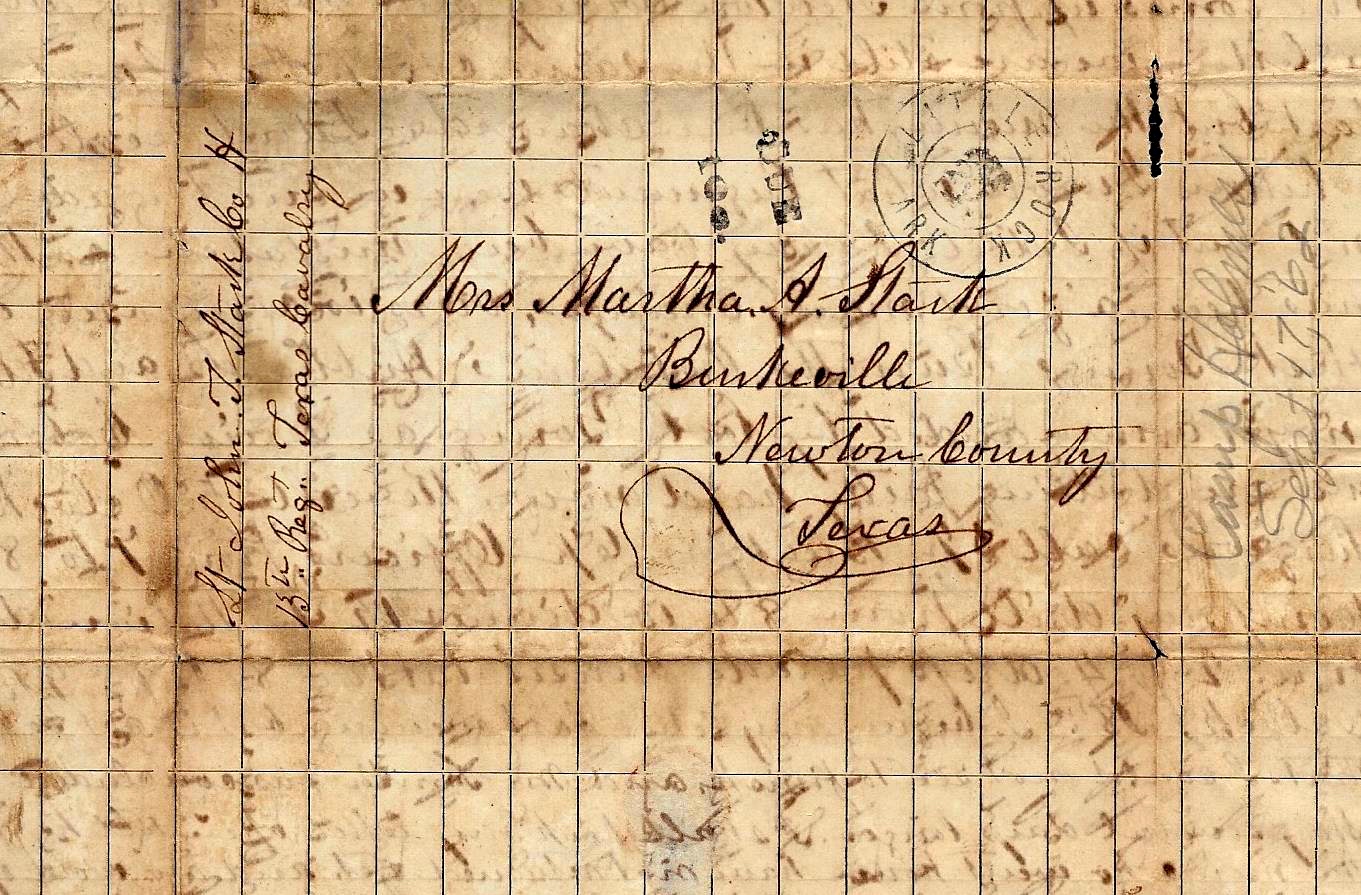


 Spared & Shared 20